
Makeup Archetype Quiz
How the Scales are Structured
Who Usually Takes This Test?
See How You Compare
Below is a preview of how scores are typically distributed across each scale.
Example Questions From the Test
- A neutral palette, brow pencil, and satin complexion product
- Cream blush, liquid highlighter, glossy tint, and soft shimmer
- Skin tint, multipurpose balm, and subtle brown mascara
- Bright pigment, graphic liner, and an unconventional lip color
- Add luminous color and a softly emphasized lip
- Keep it recognizable, then refine the skin and eye definition
- Create deliberate structure with polished neutral placement
- Use the occasion for a noticeable change in shape or contrast
- One or two features stand out, but the overall effect is gentle
- My brows, eyes, lips, and skin create strong visible contrast
- The features blend softly, without one sharply dominating
- The face looks balanced, with moderate definition throughout
Makeup Archetype Quiz - Description and methodology of the test
People seeking makeup ideas that fit their features, mood, and preferred level of definition can use this makeup archetype quiz as a structured styling reflection. Anyone curious about why certain finishes, colors, shapes, or routines feel more convincing can use this makeup archetype test to organize those preferences. The result offers a dominant direction and nearby affinities, giving experimentation a clearer starting point.
What This Assessment Explores
The questions examine contrast, facial structure, luminosity, softness, color, and preferred application control. These themes give this quiz covering four makeup archetypes a practical vocabulary, with four scored style dimensions rather than eight result types.
The four displayed dimensions describe the following style directions:
- Graphic Statement (0-12) measures contrast, bold shapes, saturated color, and creative expression: Occasional Experiment (0-4), Creative Flexibility (5-8), Strong Affinity (9-12).
- Romantic Glow (0-12) measures luminous texture, blended color, expressive lashes, and softly emphasized features: Selective Glow (0-4), Playful Fit (5-8), Strong Affinity (9-12).
- Sculpted Classic (0-12) measures balanced proportions, controlled definition, polished neutrals, and deliberate placement: Occasional Detail (0-4), Adaptable Structure (5-8), Strong Affinity (9-12).
- Soft Natural (0-12) measures visible skin, diffused definition, groomed brows, and an effortless finish: Accent, Not Anchor (0-4), Flexible Fit (5-8), Strong Affinity (9-12).
Methodology and Evidence Base
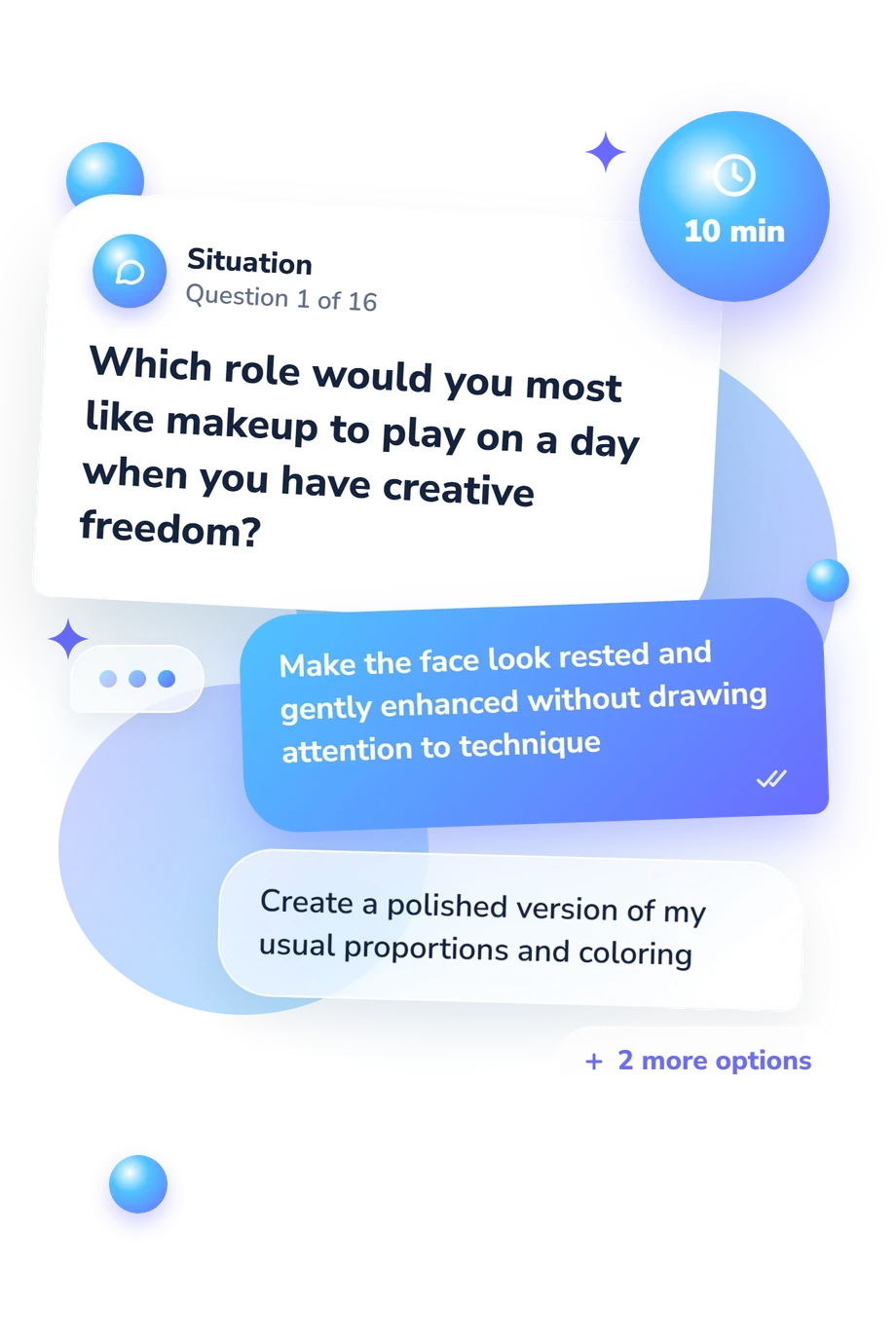
Each item presents four descriptions, and you select the closest fit. The scenarios cover appearance goals, products, facial contrast, complexion, color, structure, routine, and reactions to graphic techniques.
The profile is comparative: responses produce four displayed scores, the highest marks the strongest affinity, and scores within one point form a blended result. The displayed bands are descriptive style categories, not norm-referenced or clinical thresholds, so interpret the profile as relative style affinities.
Its style framework is conceptually consistent with 8 Makeup Archetypes (Dear Peachie, 2023), but this questionnaire is not presented as a direct adaptation. Jones, Russell, and Ward (2015) link facial contrast with cosmetic judgments; Jones, Porcheron, and Russell (2018) show that makeup can alter apparent feature size. Etcoff and colleagues (2011) support the relevance of cosmetics to perceived facial signals, but these studies do not validate this specific test.
Self-report can shift with mood, self-perception, response bias, and makeup experience. In practice, this makeup style quiz reports four scales and offers a starting point for experimentation, while personal context determines what feels effective.
- Dear Peachie. (2023, February 11). Find Your Signature Makeup Style | 8 Makeup Archetypes Explained! [Video]. YouTube.
- Jones, Alex L., Richard Russell, and Robert Ward. (2015). Cosmetics Alter Biologically-Based Factors of Beauty: Evidence from Facial Contrast. Evolutionary Psychology, 13(1), 147470491501300113. 10.1177/147470491501300113
- Jones, Alex L., Aurelie Porcheron, and Richard Russell. (2018). Makeup Changes the Apparent Size of Facial Features. Psychology of Aesthetics, Creativity, and the Arts, 12(3), 359-368. 10.1037/aca0000152
- Etcoff, Nancy L., Shannon Stock, Lauren E. Haley, Sarah A. Vickery, and David M. House. (2011). Cosmetics as a Feature of the Extended Human Phenotype: Modulation of the Perception of Biologically Important Facial Signals. PLOS ONE, 6(10), e25656. 10.1371/journal.pone.0025656
Updated: