
Dating Quiz for Singles
How the Scales are Structured
Who Usually Takes This Test?
See How You Compare
Below is a preview of how scores are typically distributed across each scale.
Example Questions From the Test
- Send a casual message that keeps the conversation going
- Wait for them to contact me, then respond warmly
- Tell them directly that I would like another date
- Give it time and see whether they take the next step
- I regularly start conversations and suggest opportunities to meet
- I make occasional moves when someone especially interests me
- I rarely initiate, though I may welcome someone else's approach
- I initiate with a few people when the interaction feels mutual
- Send a tailored message about something in the profile
- Like the profile and leave room for them to respond
- Use a short, friendly opener to start the conversation
- Wait to see whether they show interest first
Dating Quiz for Singles - Description and methodology of the test
People who want to understand their dating habits can use this relationship quiz for singles to examine how they choose, communicate, and create momentum with a new person. It suits readers who are reflecting on recurring patterns rather than seeking a single right way to date. The dating quiz for singles connects everyday choices with a three-part profile of structure, openness, and initiative.
What This Assessment Explores
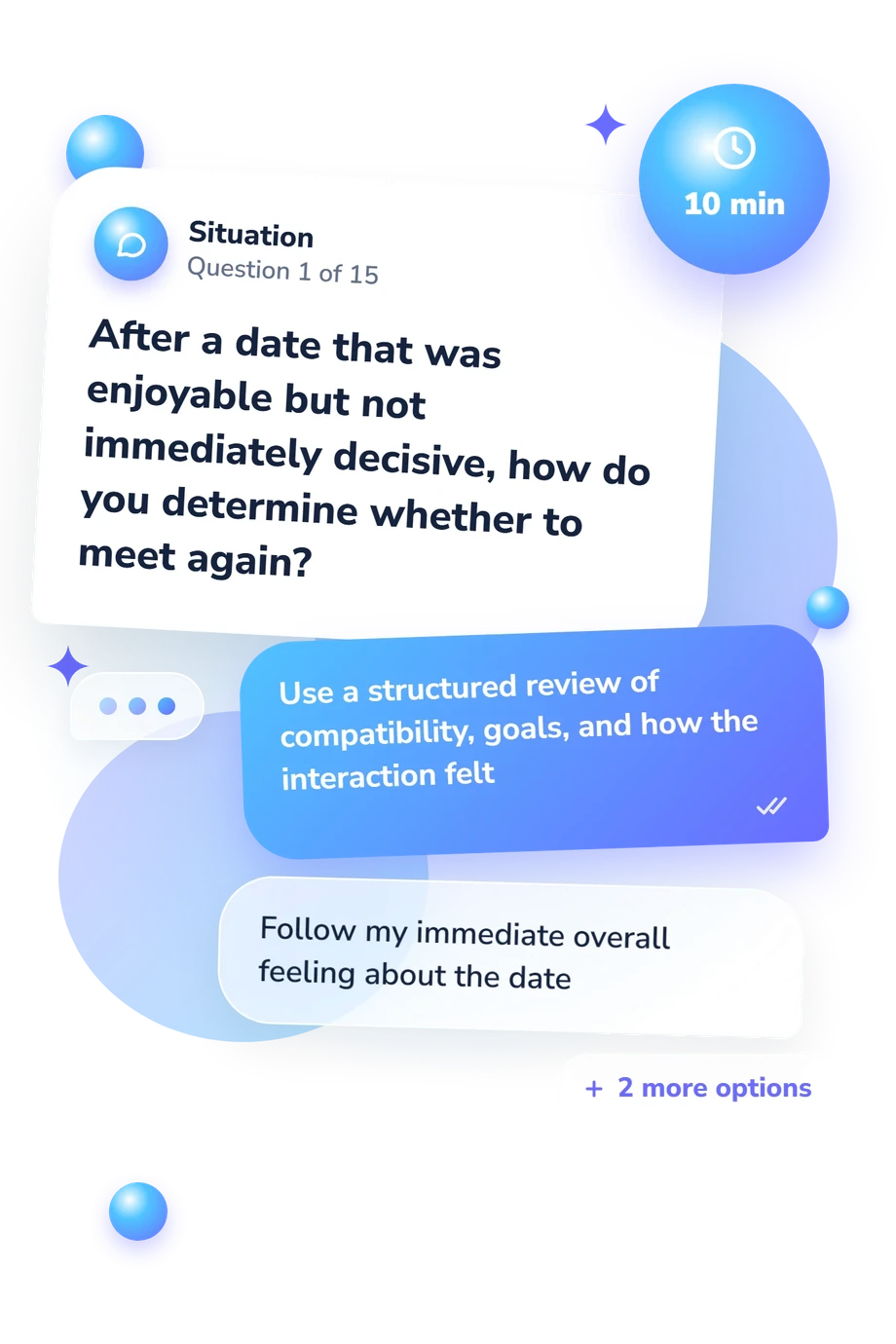
This assessment explores how you move through early dating, not whether you are successful at it. Its scenarios cover judging a promising date, expressing interest, discussing goals, revealing personal experience, responding to uncertainty, and initiating contact. Viewed as a dating style quiz, the assessment turns those situations into three descriptive dimensions:
- Dating Structure (0-15) shows whether you favor spontaneous exploration or defined priorities: Open-Ended Explorer (0-5), Flexible Planner (6-10), or Deliberate Navigator (11-15).
- Emotional Openness (0-15) shows how readily you share feelings and vulnerability: Private at First (0-5), Gradually Revealing (6-10), or Openly Expressive (11-15).
- Social Initiative (0-15) shows how readily you create momentum: Responsive (0-5), Selectively Proactive (6-10), or Forward-Moving (11-15).
The profile describes preferences, not success: different degrees of structure, openness, and initiative can suit different people and circumstances.
Methodology and Scientific Basis
Each item presents a dating situation with four response choices. The options emphasize different approaches, such as following chemistry, applying criteria, waiting for reciprocity, or naming feelings, so you choose the response closest to your usual pattern. The questionnaire groups those choices into three dimensions; the result labels describe the tendency, but the answer choices do not reveal the exact point contribution.
Conceptually, the approach is consistent with Mongeau et al. (2007) on first-date goals, Harris and Aboujaoude (2016) on online relationship initiation, and Altman and Taylor’s (1973) social penetration theory, which explains how personal disclosure can develop. These works provide a conceptual comparison, not evidence that this online questionnaire is an adaptation of their instruments.
For someone taking a dating test for singles, the result is best read as a structured self-reflection exercise rather than a standardized clinical measure. Its categories describe tendencies, not compatibility or a guaranteed relationship outcome. Self-reported results can shift with mood, recent experiences, and self-perception, so the profile cannot predict whether a particular connection will work.
- Mongeau, P. A., Jacobsen, J., & Donnerstein, C. (2007). Defining dates and first date goals: Generalizing from undergraduates to single adults. Communication Research, 34(5), 526-547. 10.1177/0093650207305235
- Harris, K. M., & Aboujaoude, E. (2016). Online friendship, romance, and sex: Properties and associations of the Online Relationship Initiation Scale. Cyberpsychology, Behavior, and Social Networking, 19(8), 487-493. 10.1089/cyber.2016.0164
- Altman, I., & Taylor, D. A. (1973). Social penetration: The development of interpersonal relationships. New York, NY: Holt, Rinehart and Winston.
Updated: