
Elementary School Quiz
How the Scales are Structured
Who Usually Takes This Test?
See How You Compare
Below is a preview of how scores are typically distributed across each scale.
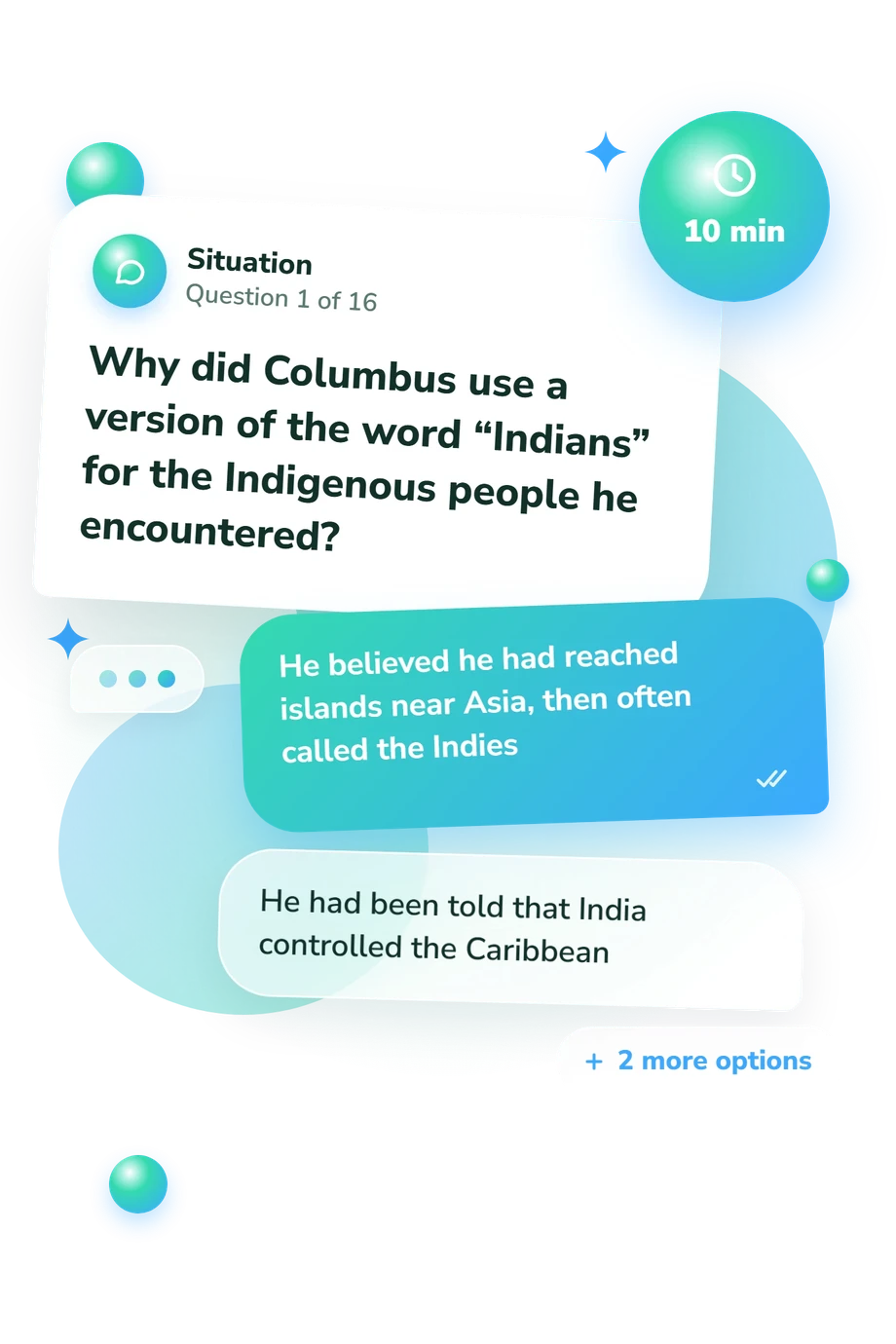
Example Questions From the Test
- Portugal
- England
- France
- The Spanish monarchy
- Genoa, in present-day Italy
- Seville, Spain
- Lisbon, Portugal
- London, England
- Find a southern route around Africa
- Reach Asian trading regions by a western route
- Establish a colony in North America
- Map the entire Atlantic coastline
Elementary School Quiz - Description and methodology of the test
Students and families who want a quick check before a lesson, review session, or classroom discussion can use the elementary school quiz to see whether the overall result supports moving on or returning to foundational material. It suits learners who want an elementary quiz that turns a single score into a next step. The result offers a focused picture of performance on this question set, not a complete history course.
What This Assessment Explores
This assessment places Columbus’s first voyage within wider Atlantic history instead of treating it as a list of isolated names. Questions cover origins, sponsorship, aims, ships, navigation, dates, Indigenous societies, and consequences of sustained contact. It suits readers seeking an elementary history quiz that links factual recall with historical context.
The question themes are:
- Voyage and geography: The result shows how well you identify routes, regions, landfall, ships, and navigation.
- Indigenous societies and language: It shows whether you recognize established peoples and cultures before European arrival.
- Exchange and consequences: It examines examples of transatlantic exchange, including crops and animals, and the consequences of contact, conquest, and colonization.
- Evidence and chronology: It measures ordering events and distinguishing primary sources from later accounts.
A stronger result indicates broader command of the selected facts and connections; a lower result identifies areas for review. The score describes this question set, not all historical knowledge or every interpretation of Columbus’s legacy.
Methodology and Scientific Basis
Each item presents four answer choices and asks for the best historical response. The displayed score reflects the number of correct answers. Its single scale is Christopher Columbus Knowledge (0-16), with Starting Point 0-6, Developing Knowledge 7-12, and Strong Knowledge 13-16.
The historical frame is conceptually consistent with Four Voyages, the 1492-1493 Diario, and work by Nunn and Qian and Crosby. These sources support the historical context of voyage accounts, exchange, and long-term consequences addressed by the questions; this online questionnaire is not presented as an adaptation of any one source.
The displayed bands give this Columbus history quiz a simple review function rather than a norm-referenced grade. No published norm group or standardization is stated for the online version, so the labels should be read as descriptive guidance.
Performance can also reflect prior teaching, language familiarity, guessing, and the facts selected by the questionnaire. A strong band signals success on these items, while a lower band points to useful review; neither captures the full complexity of Indigenous histories or resolves every debate about Columbus’s legacy.
- Columbus, Christopher. The Four Voyages of Christopher Columbus: Being His Own Log-book, Letters and Dispatches with Connecting Narrative Drawn from the Life of the Admiral by His Son Hernando Colon and Other Contemporary Historians. Edited and translated by John Michael Cohen. Penguin Books, 1969.
- Columbus, Christopher. The Diario of Christopher Columbus's First Voyage to America, 1492-1493. Abstracted by Bartolome de las Casas; transcribed and translated, with notes and a concordance, by Oliver Dunn and James E. Kelley, Jr. University of Oklahoma Press, 1989.
- Nunn, Nathan, and Nancy Qian. "The Columbian Exchange: A History of Disease, Food, and Ideas." Journal of Economic Perspectives 24, no. 2 (2010): 163-188. DOI 10.1257/jep.24.2.163.
- Crosby, Alfred W. The Columbian Exchange: Biological and Cultural Consequences of 1492. 30th anniversary ed. Praeger, 2003.
Updated: