
Should I Join a Frat Quiz
How the Scales are Structured
Who Usually Takes This Test?
See How You Compare
Below is a preview of how scores are typically distributed across each scale.
Example Questions From the Test
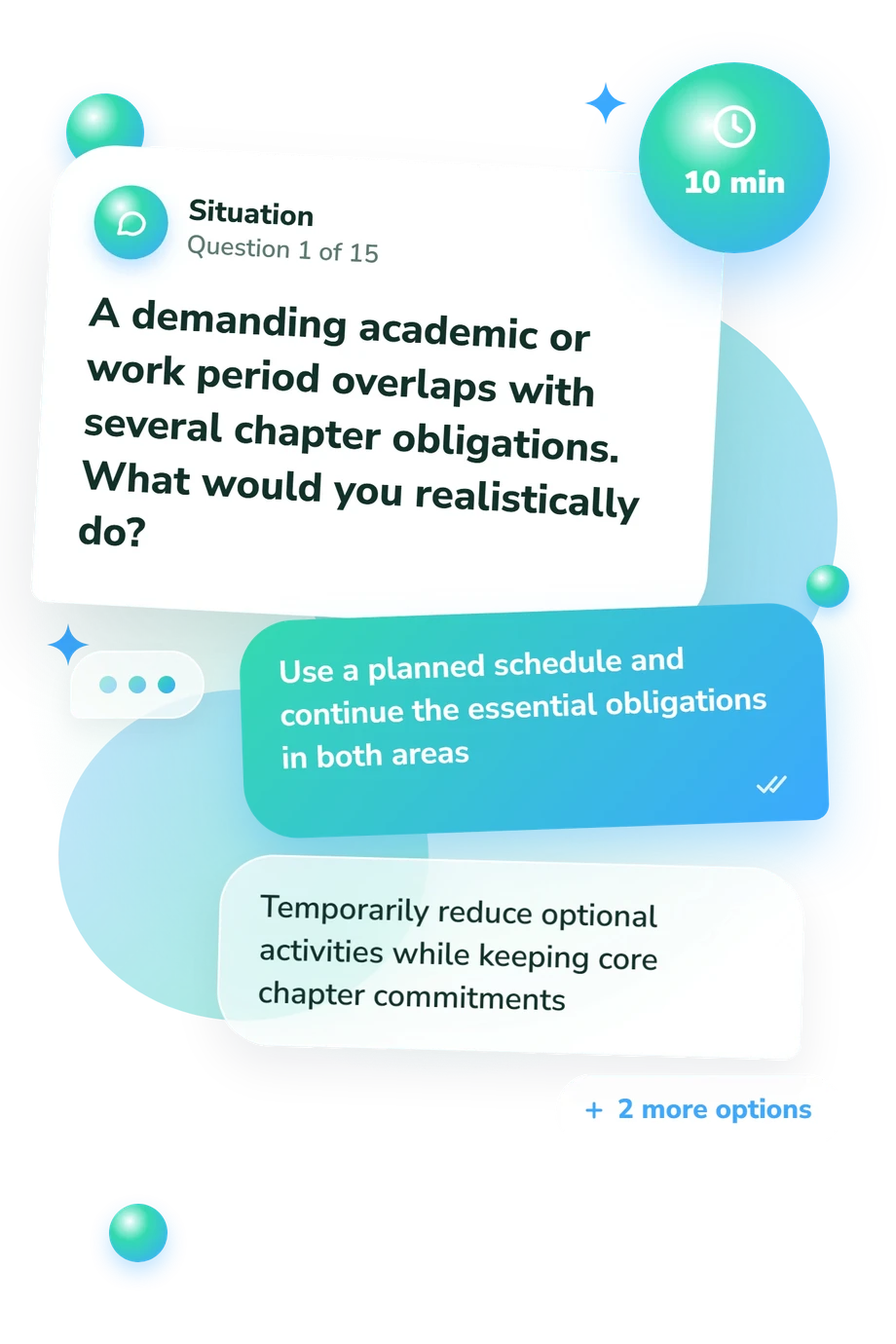
- Use a planned schedule and continue the essential obligations in both areas
- Temporarily reduce optional activities while keeping core chapter commitments
- Step back from chapter participation until the demanding period ends
- Recognize that another recurring obligation does not fit my current life
- I am comfortable tracking deadlines and contributing consistently over time
- I generally follow through when expectations and reminders are clear
- I contribute best when tasks are occasional and scheduling is flexible
- I prefer commitments that I can choose independently from week to week
- Members provide specific, consistent information and let me verify it before deciding
- Their answers are general, but they welcome follow-up questions
- Different members give conflicting answers or repeatedly change the subject
- They demand an immediate commitment or treat reasonable questions as disloyal
Should I Join a Frat Quiz - Description and methodology of the test
People considering Greek-letter membership need a way to separate genuine interest from pressure, unsafe conduct, and obligations that may not fit their lives. The Should I Join a Frat Quiz is intended for prospective members examining a chapter before committing. This fraternity quiz can organize reflection on available time, social preferences, and observable safety signals, helping you decide what to verify next.
What This Assessment Explores
Rather than naming a chapter, it asks whether a close-knit, tradition-based community matches your circumstances. It highlights fit questions when recruitment answers are vague or pressure follows reasonable questions. The result from the what fraternity should I join quiz reflects safety, capacity, and community fit.
Three dimensions are:
- Chapter Pressure & Safety Signals (0-15) measures coercion or danger; Keep Verifying (0), Questions to Resolve (1-2), and Act on the Concern (3-15) show escalating concern.
- Commitment Capacity (0-15) measures room for dues, meetings, events, service, and recurring duties; Limited Room (0-5), Conditional Capacity (6-10), and Sustainable Capacity (11-15) show three levels of room.
- Community Fit (0-15) measures fit with recurring group life; Independent Path (0-5), Selective Interest (6-10), and Strong Community Affinity (11-15) show lower, mixed, or stronger affinity.
Methodology and Evidence Base
Each item presents a situation with four response choices. The options ask what you would do, observe, or expect around obligations, costs, disagreements, initiation, substance use, and refusal. This combines self-report about resources with judgments about chapter behavior.
Results appear across three dimensions rather than as one yes-or-no recommendation. The bands are unvalidated, not legal or clinical cutoffs, and the questionnaire does not state how many points each answer contributes. Any single safety red-flag response overrides the total and should be acted on.
The content is conceptually consistent with Cokley et al. (2001), which examined college students’ views of pledging and hazing. Tingley et al. (2018) and Drout and Corsoro (2003) provide related evidence on initiation and hazing; Cimino et al. (2024) link costly induction with commitment and attrition. These studies address related topics; this questionnaire is not adapted from them, and none of them validates it.
Because this fraternity membership quiz relies on self-report, results remain sensitive to current stress, incomplete information, self-awareness, and the wish to belong. Compare its pattern with chapter policies, costs, reporting routes, and member behavior.
- Cokley, K., Miller, K., Cunningham, D., Motoike, J., King, A., & Awad, G. (2001). Developing an instrument to assess college students’ attitudes toward pledging and hazing in Greek letter organizations. College Student Journal, 35(3), 451-456.
- Tingley, K., Crumb, L., Hoover-Plonk, S., Hill, W., & Chambers, C. R. (2018). Sorority and Fraternity Attitudes Towards Initiation and Hazing. Journal of Sorority and Fraternity Life Research and Practice, 13(2), 46-60. 10.25774/pmpp-0598
- Cimino, A., Pollock, J., & Thomas, B. J. (2024). Costly inductions as a commitment-selection strategy: Assessing hazing’s relationship with attrition in a college fraternity. Evolution and Human Behavior, 45(1), 66-74. 10.1016/j.evolhumbehav.2023.09.003
- Drout, C. E., & Corsoro, C. L. (2003). Attitudes toward fraternity hazing among fraternity members, sorority members, and non-Greek students. Social Behavior and Personality: An International Journal, 31(6), 535-544. 10.2224/sbp.2003.31.6.535
Updated: