
Witchcraft Deities Quiz
How the Scales are Structured
Who Usually Takes This Test?
See How You Compare
Below is a preview of how scores are typically distributed across each scale.
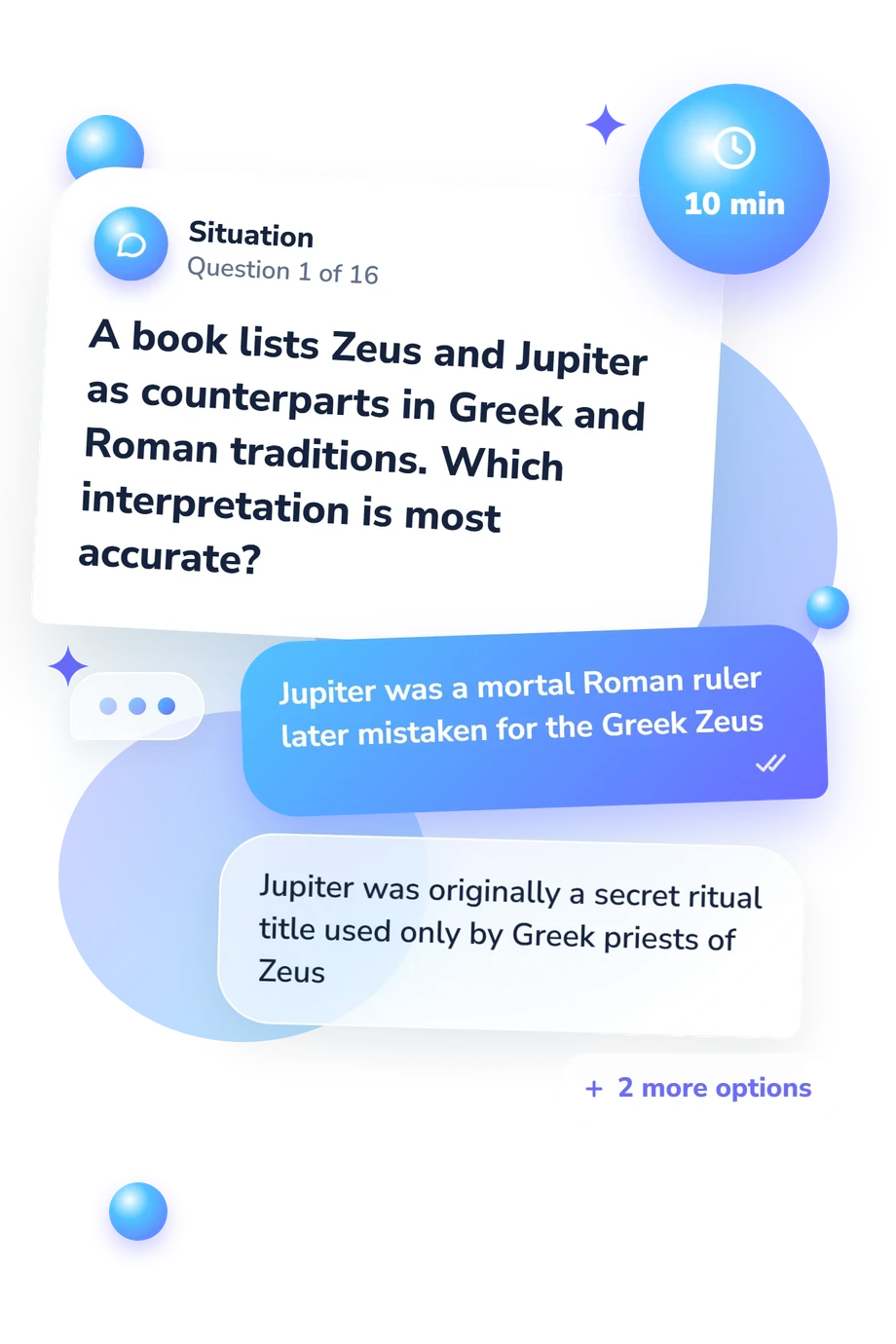
Example Questions From the Test
- Frigg
- Freyja
- Sif
- Iðunn
- Demeter
- Aphrodite
- Athena
- Persephone
- Brigid
- Manannán mac Lir
- Lugh
- The Morrígan
Witchcraft Deities Quiz - Description and methodology of the test
Readers who want to distinguish historical deity traditions from modern assumptions can use the witchcraft deities quiz as a focused knowledge check. Curious practitioners, students, and other readers can use this witchcraft deity assessment to explore deities and religious traditions within witchcraft while reviewing how culture, context, and responsible practice shape interpretations. The result summarizes demonstrated knowledge and points toward useful areas for further reading without judging personal belief.
What This Assessment Explores
These questions test whether you can connect deities with their cultural settings rather than treating distinct traditions as interchangeable. They cover myths, epithets, symbols, historical contact, modern interpretive models, and responsible practice, including offerings, cultural boundaries, source checking, and discernment around possible spiritual signs.
Readers exploring Wiccan deities alongside other traditions may find this broad assessment useful because the items move across Pagan, Egyptian, Greek, Norse, and Irish contexts. The result describes demonstrated knowledge, not sincerity of belief or a personal deity relationship.
The assessment reports one educational scale, Witchcraft Deities Knowledge (0-16), through these bands:
- Foundations to build (0-6) marks some recognition but a need for more context and reliable sources.
- Developing knowledge (7-12) marks a useful base with some gaps or blurred distinctions.
- Strong knowledge (13-16) marks consistent distinctions among traditions, concepts, and responsible interpretations.
Methodology and Scientific Basis
Each item uses four answer options and asks for the best fit to a historical, conceptual, or practical scenario. The set moves from deity names and attributes to syncretism, regional variation, modern frameworks, responsible offerings, initiation boundaries, and source quality.
Scoring is educational rather than standardised: the displayed result should be read through the knowledge described by the bands, without inferring a weighting formula, norm group, or reliability estimate.
Clifton and Harvey's work provides contextual comparison for treating Pagan traditions as diverse rather than uniform. Doyle White's historical account situates modern Wicca as a movement; Spaeth's scholarship supports attention to ancient Mediterranean context and contact; Gardner's book contributes to the history of modern witchcraft. These works offer context for the questions, but they do not validate, standardise, or establish the online questionnaire.
Prior reading, wording familiarity, current attention, and separating belief from historical evidence can affect performance. The result from this deity knowledge assessment is best used as a study guide: it shows how you handled these questions, while gaps point to topics for follow-up rather than defining identity.
- Chas Clifton and Graham Harvey, eds. The Paganism Reader. Routledge, London and New York, 2004.
- Ethan Doyle White. Wicca: History, Belief & Community in Modern Pagan Witchcraft. Liverpool University Press, 2015. 10.2307/j.ctv3029rcf.
- Barbette Stanley Spaeth, ed. The Cambridge Companion to Ancient Mediterranean Religions. Cambridge University Press, 2013. 10.1017/CCO9781139047784.
- Gerald B. Gardner, with an introduction by Margaret Alice Murray. Witchcraft Today. Rider and Company, London, 1954.
Updated: