
What Type of Vampire Am I Quiz
How the Scales are Structured
Who Usually Takes This Test?
See How You Compare
Below is a preview of how scores are typically distributed across each scale.
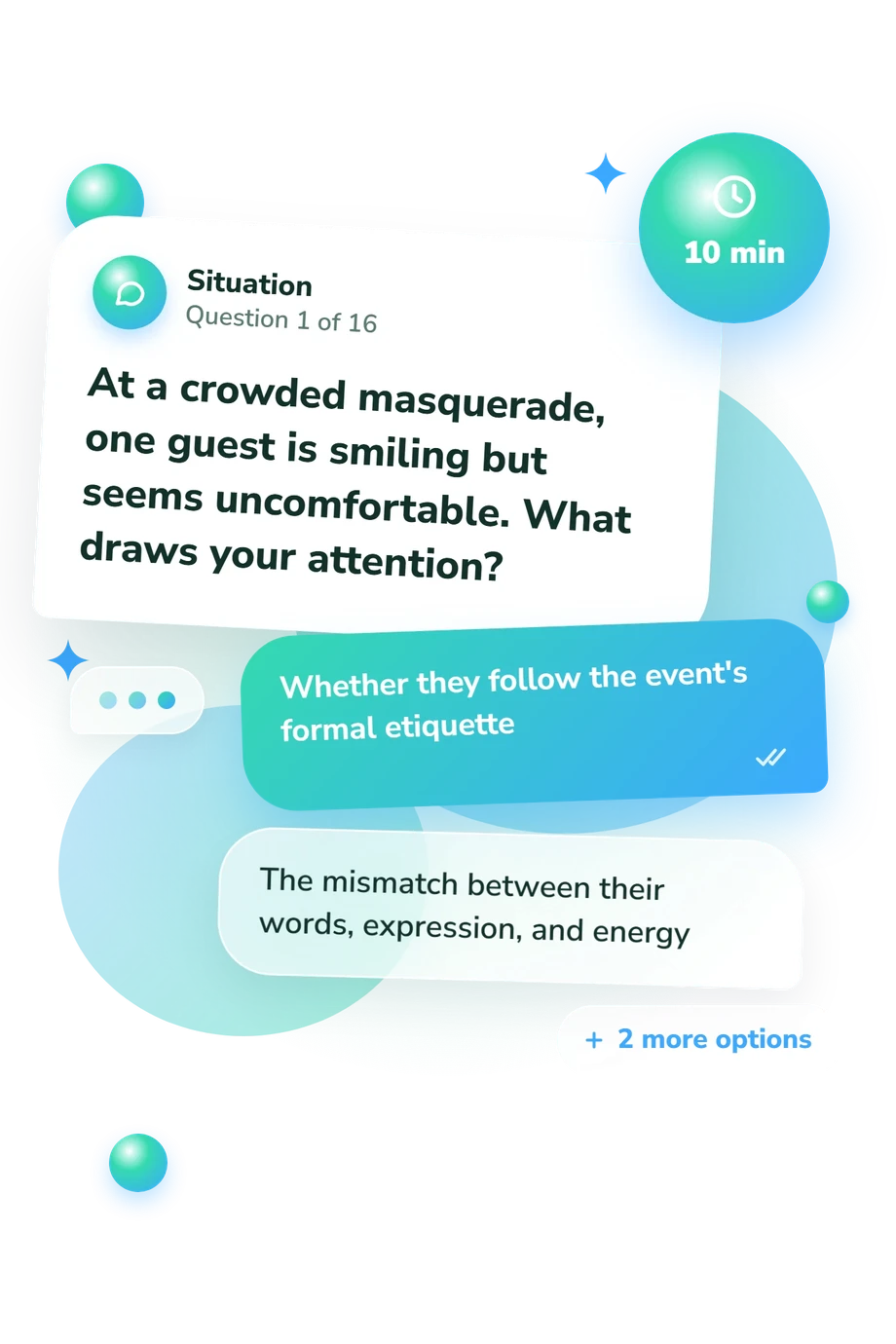
Example Questions From the Test
- Whether they follow the event's formal etiquette
- The mismatch between their words, expression, and energy
- Whether something in the room is causing the discomfort
- The overall spectacle more than any individual guest
- Perfect recall of every book and conversation
- Heightened senses that make the night feel vividly alive
- Swift movement that is exciting but still controllable
- The power to change appearance for any social setting
- The forest trail—I want to rely on my senses and momentum
- The road, because knowing the route lets me move efficiently
- The forest trail, but only after checking where it leads
- Whichever route offers the more interesting story afterward
What Type of Vampire Am I Quiz - Description and methodology of the test
For readers drawn to vampire fiction, this assessment offers a structured way to make sense of imaginative choices. The What Type of Vampire Am I Quiz gives curious fans a creative prompt for exploring how they might act, react, and present themselves in a fictional setting. As a vampire personality quiz, it can inspire role-play, costume ideas, or discussion with friends.
What This Assessment Explores
These scenarios place the imagined vampire in choices about movement, conflict, style, ceremony, influence, and hidden meaning. The quiz asks what type of vampire you are through fictional preferences, not supernatural abilities or fixed real-world traits.
The four result dimensions are:
- Feral Night Hunter (0-12) measures instinct, energy, freedom, and action; Measured Wanderer (0-4), Moonlit Prowler (5-8), Feral Night Hunter (9-12).
- Glamour Poser (0-12) measures aesthetics, theatrical self-presentation, social fun, and enjoying the fantasy without deep identification; the playful label Poser is not an insult; Immersive Fan (0-4), Stylish Shapeshifter (5-8), Glamour Poser (9-12).
- Noble Nightwalker (0-12) measures tradition, composure, refinement, and long-term thinking; Modern Spirit (0-4), Cultivated Guest (5-8), Noble Nightwalker (9-12).
- Veil Reader (0-12) measures perception, emotional awareness, mystery, and the psychic side of vampire lore; Plain-Sight Observer (0-4), Intuitive Listener (5-8), Veil Reader (9-12).
Methodology and Evidence Base
Each item presents a scenario with four response choices. You select the reaction, motive, or detail fitting the persona you would inhabit, making this a thematic self-report profile focused on imaginative preference. After completion, compare the four displayed scores: the highest shows strongest affinity, while scores within one point indicate a blend.
The questionnaire is a thematic online self-report profile organizing imaginative preferences through vampire fiction. For someone asking what vampire you are in a quiz, the result offers a playful profile rather than a fixed identity. Baker, Green, and Stasiewicz-Bieńkowska (2021) connect vampire imagery with cultural identities. Inoue links vampire images with consciousness and inner experience, while Gelder presents the vampire as a flexible cultural figure. Together, these works provide cultural context.
Results are a snapshot of imaginative preference because mood, interests, familiarity with vampire fiction, and the character you want to play can influence choices; no normative sample, reliability estimate, or clinical cutoff is established. The profile is most useful for self-reflection, creative role-play, and noticing which fictional qualities feel compelling.
- Baker, David, Stephanie Green, and Agnieszka Stasiewicz-Bieńkowska. “Vampiric transformations: the popular politics of the (post) romantic vampire.” Continuum: Journal of Media & Cultural Studies 35, no. 2 (2021): 171-177. 10.1080/10304312.2021.1936822
- Inoue, Yoshitaka. “Contemporary Consciousness as Reflected in Images of the Vampire.” Jung Journal: Culture & Psyche 5, no. 4 (2011): 83-99. 10.1525/jung.2011.5.4.83
- Gelder, Ken. Reading the Vampire. Routledge, 1994.
Updated: