
Types of Reactions Quiz
How the Scales are Structured
Who Usually Takes This Test?
See How You Compare
Below is a preview of how scores are typically distributed across each scale.
Example Questions From the Test
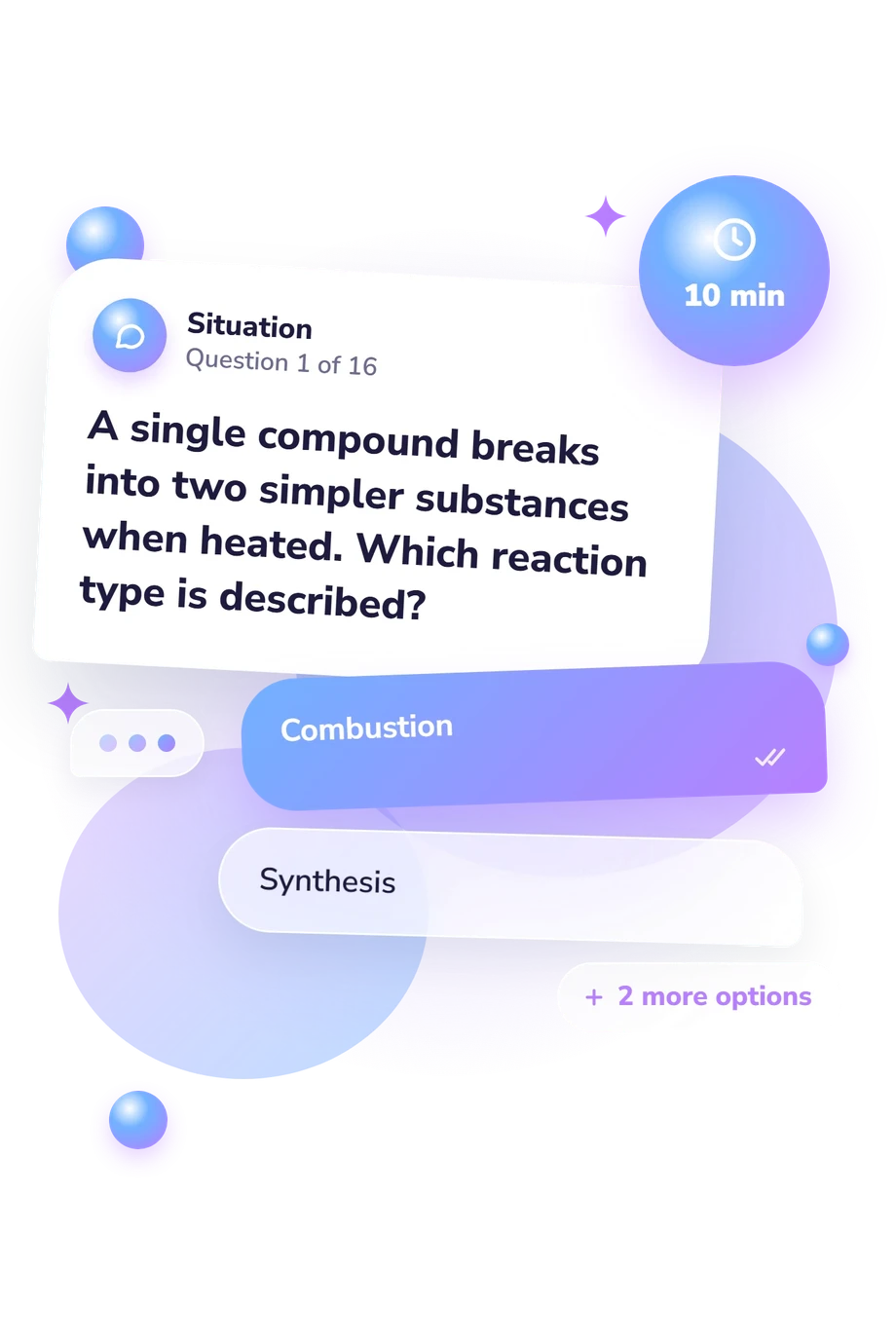
- Combustion
- Synthesis
- Double displacement
- Decomposition
- Combustion
- Decomposition
- Single displacement
- Double displacement
- Carbon monoxide and oxygen
- Carbon and hydrogen gas
- Carbon dioxide and water
- A salt and water
Types of Reactions Quiz - Description and methodology of the test
Students checking their grasp of introductory reaction classification can use the types of reactions quiz to connect equations, observations, and product patterns. For learners reviewing general chemistry, this reaction types quiz offers a quick formative check, while teachers can use the overall score to plan general review. The result provides a focused snapshot for revision, showing overall recognition of reaction classifications and where further practice may help.
What This Assessment Explores
The questionnaire focuses on recognizing reaction classes from what changes, what forms, and how reactants relate to products. It suits learners reviewing introductory general chemistry rather than people seeking a measure of laboratory technique or advanced reaction mechanisms.
Items present equations, verbal descriptions, observations such as a precipitate, and comparisons between similar categories. This reaction classification quiz uses four-option multiple-choice questions: the result is an overall knowledge score and band, not separate scores for each topic.
The question themes are:
- Decomposition and synthesis show whether substances separate into simpler products or combine into one product.
- Single and double displacement show whether an element replaces another or ions exchange between compounds.
- Combustion links burning in oxygen with expected products such as carbon dioxide and water.
- Neutralization and precipitation connect specific observations with more specific reaction classifications.
Methodology and Evidence Base
Each question uses a four-option multiple-choice format, while the chemistry is presented through equations, reactant-product patterns, observations, and conceptual contrasts. The displayed Types of Reactions Knowledge scale runs from 0-16 and reflects the number of correct responses. Its result bands are Foundations to build 0-6, Developing knowledge 7-12, and Strong command 13-16.
The Chemical Reactions Diagnostic Instrument (CRDI; Chandrasegaran et al., 2007) is relevant because it links chemical descriptions and explanations across levels of representation. This questionnaire is conceptually consistent with that instrument but is not an adaptation of it. Wang’s 2020 classification scheme offers a second reference for organizing common reaction types in general chemistry.
Reviewing answers to the quiz on types of reactions alongside the equations can help locate confusion between a defining reaction pattern and a particular product prediction. The online score is a formative snapshot of performance on these classification items, with its bands describing overall knowledge rather than separate topic mastery. Results may also reflect recent study, wording, confidence, and the respondent’s ability to recognize the intended pattern.
- A. L. Chandrasegaran, David F. Treagust, and Mauro Mocerino. (2007). The development of a two-tier multiple-choice diagnostic instrument for evaluating secondary school students’ ability to describe and explain chemical reactions using multiple levels of representation. Chemistry Education Research and Practice, 8(3), 293-307. 10.1039/B7RP90006F
- Bin Wang. (2020). A new classification scheme for teaching reaction types in general chemistry. Chemistry Teacher International, 2(2), 20180017. 10.1515/cti-2018-0017
Updated: