
Badminton Quiz
How the Scales are Structured
Who Usually Takes This Test?
See How You Compare
Below is a preview of how scores are typically distributed across each scale.
Example Questions From the Test
- The outer side lines and the long service line for doubles
- The inner side lines and the back boundary line
- The inner side lines and the long service line for doubles
- The outer side lines and the back boundary line
- When both sides have scored 10 points
- Only after the deciding game has ended
- Whenever the serving side changes
- When one side first reaches 11 points
- Immediately after every change of service
- When both sides reach 10 points
- When the leading score reaches 11 points
- When the leading score reaches 15 points
Badminton Quiz - Description and methodology of the test
Players, students, coaches, and curious newcomers can use this assessment to check how confidently they understand badminton rules and match situations. The badminton quiz turns practical knowledge of service, scoring, court lines, and shot selection into a structured result. Students can use the result from this badminton assessment for PE to decide which rules or strokes to review before practice, study, or competition.
What the Questionnaire Measures
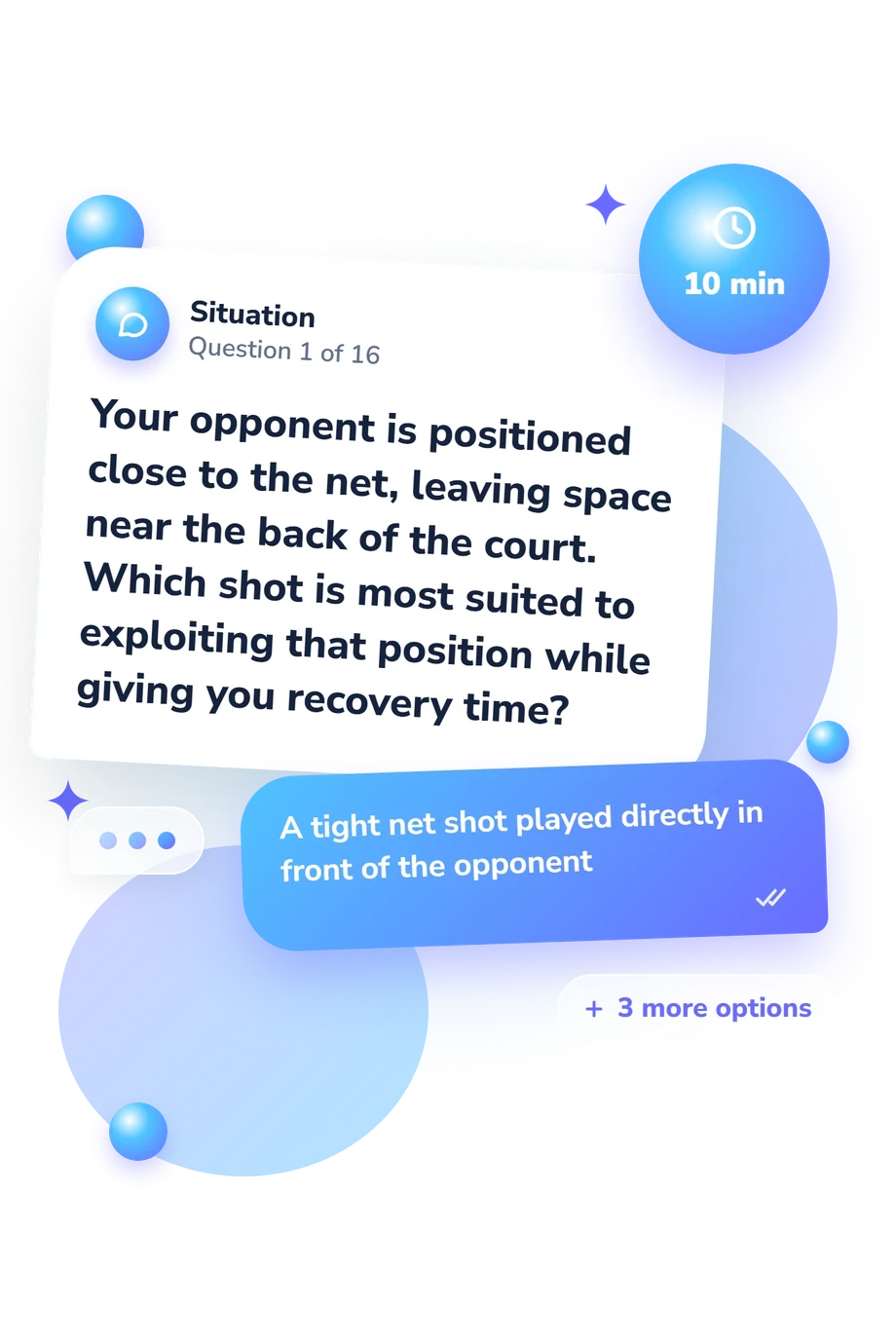
Questions examine knowledge used while applying badminton laws in play. They cover singles and doubles boundaries, service courts, rally-point scoring, intervals, lets, faults, net situations, and partner contacts. Shot items distinguish clears, drops, drives, lifts, and smashes, while tactical scenarios ask which response uses space or allows recovery.
Taken together, the items connect rules and stroke names with concrete match situations through questions and answers about badminton, showing how respondents apply them in play. It suits learners, recreational players, teachers, and fans seeking a structured check of practical knowledge.
The result is organized into one knowledge scale:
- Badminton Knowledge (0-16) shows recognition of rules, procedures, and basic tactical choices: Foundation (0-6) reflects partial familiarity; Developing (7-12) indicates useful working knowledge with gaps; and Strong (13-16) indicates confident understanding.
Methodology and Evidence Base
Each item presents a badminton situation or rule description with four answer choices. Selecting the best option tests recognition and application rather than written recall. The questionnaire reports a total score; it states no separate weighting, penalty, or correction procedure.
Its content is conceptually consistent with Chey et al. (2022), which treats badminton knowledge as applied understanding of rules and play. The questionnaire is not presented as an adaptation of that study's instrument. The BWF Laws of Badminton provide the framework for service, boundaries, scoring, lets, faults, intervals, and court conduct. Phillips (1946) offers historical precedent for standardized badminton knowledge testing, but does not establish that this online questionnaire has been standardized.
For study planning, this badminton rules test offers a broad indication of knowledge through its single score rather than pinpointing a specific need. Respondents can review missed service, shot, or boundary answers separately to decide what to practise, but the result alone cannot identify a precise weakness. The bands are descriptive and have no stated population norms or formal qualification status. Memory, experience, current context, and guessing can affect responses.
- Chey, Won Seok, Phillip Ward, Emi Tsuda, Kyuil Cho, Obidiah Atkinson, and Daekyun Oh. (2022). Evaluating the Content Knowledge in Badminton of Preservice Physical Education Teachers: A Case Study. Journal of Physical Education and Sports Studies, 14(2), 87-101. 10.55929/besad.1133035
- Badminton World Federation. (2025). BWF Statutes, Section 4.1: Laws of Badminton. In force 26 April 2025, Version 5.0 (1).
- Phillips, Marjorie. (1946). Standardization of a Badminton Knowledge Test for College Women. Research Quarterly, 17(1), 48-63. 10.1080/10671188.1946.10621276
Updated: