
What Mood Am I Feeling Quiz
How the Scales are Structured
Who Usually Takes This Test?
See How You Compare
Below is a preview of how scores are typically distributed across each scale.
Example Questions From the Test
- I was usually present in my normal way.
- I drifted away more than usual but could reconnect.
- I often felt distant even while participating.
- I felt completely cut off or unable to participate meaningfully.
- I generally recovered at my usual pace.
- The feeling lingered longer than usual but eased that day.
- It often carried into the next day.
- I felt emotionally stuck for days at a time.
- It has not been noticeably present.
- It has appeared briefly on a few days.
- It has lasted for hours or returned repeatedly on many days.
- It has filled most of the day nearly every day.
What Mood Am I Feeling Quiz - Description and methodology of the test
People who feel unlike themselves, emotionally flat, irritable, disconnected, or less able to manage ordinary tasks can use the What Mood Am I Feeling Quiz to organize recent observations. It offers a structured snapshot for self-reflection rather than a fixed label. It helps a reader notice whether recent mood changes or distress differ from their usual pattern, so recent observations can be organized without treating them as a fixed temperament.
What This Assessment Explores
Rather than asking for one mood label, the questionnaire examines recent changes in daily life. Prompts address sadness, irritability, self-judgment, concentration, sleep, self-care, enjoyment, social contact, and connection. It suits readers whose experience feels different from usual.
The result shows a current mood pattern across all three dimensions:
- Daily Functioning and Warning Signs (0-15) reflects sleep, concentration, self-care, task completion, and safety; bands are Pause and notice (0), Worth addressing (1-2), and Act on the concern (3-15).
- Emotional Heaviness (0-15) reflects sadness, irritability, discouragement, and self-judgment; bands are Pause and notice (0), Worth monitoring (1-2), and Support is warranted (3-15).
- Interest and Connection (0-15) reflects enjoyment, anticipation, social contact, and emotional connection; bands are Pause and notice (0), Worth monitoring (1-2), and Support is warranted (3-15).
Methodology and Evidence Base
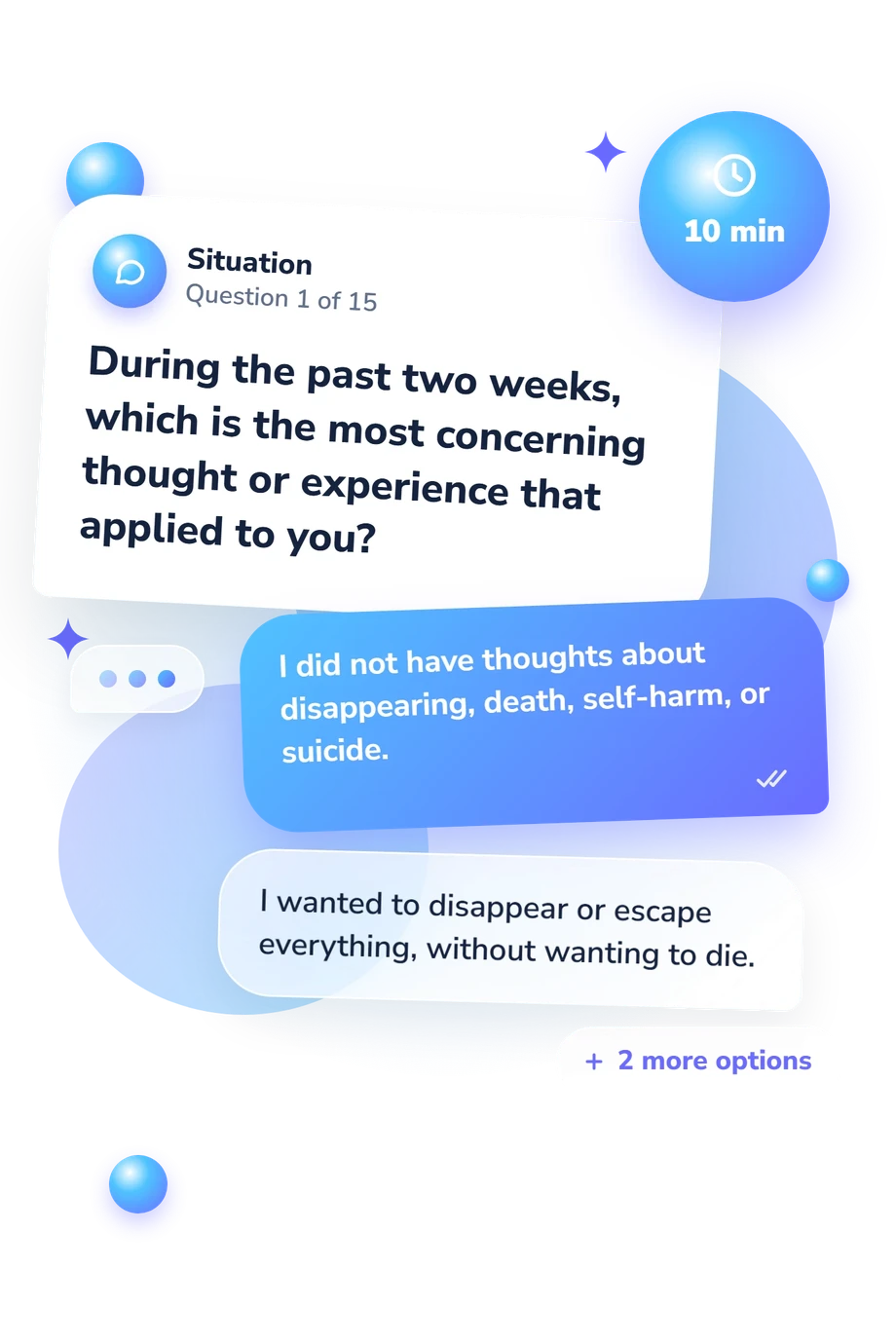
Each question presents four choices; select the one that best matches your recent experience. Examples cover conversations, sleep, enjoyable activities, basic tasks, and reactions to mistakes. Items refer to the past two weeks; choices are not a universally ordered severity scale.
Responses produce a total for each dimension. These unvalidated reflective groupings are not clinical cutoffs or diagnoses, and the range does not show each answer's point value. Any concerning endorsed experience must be considered independently of the total; a single red-flag response takes priority over the total score.
The content is conceptually consistent with PHQ-9 (Kroenke et al., 2001) in its attention to mood, functioning, sleep, concentration, and self-judgment. It has only limited conceptual overlap with suicidal-ideation assessment discussed by Posner et al. (2011). This questionnaire is not an adaptation of those instruments, and those studies do not validate its online scoring.
Interpretation stays close to the situations described in the mood self-assessment. Results can shift with circumstances, recall, self-awareness, and openness; urgent local crisis or emergency help is appropriate when immediate safety is at risk.
- Kroenke K, Spitzer RL, Williams JBW. The PHQ-9: Validity of a brief depression severity measure. Journal of General Internal Medicine. 2001;16(9):606-613. 10.1046/j.1525-1497.2001.016009606.x
- Posner K, Brown GK, Stanley B, Brent DA, Yershova KV, Oquendo MA, Currier GW, Melvin GA, Greenhill L, Shen S, Mann JJ. The Columbia-Suicide Severity Rating Scale: Initial validity and internal consistency findings from three multisite studies with adolescents and adults. American Journal of Psychiatry. 2011;168(12):1266-1277. 10.1176/appi.ajp.2011.10111704
- Spitzer RL, Kroenke K, Williams JBW, Patient Health Questionnaire Primary Care Study Group. Validation and utility of a self-report version of PRIME-MD: The PHQ Primary Care Study. JAMA. 1999;282(18):1737-1744. 10.1001/jama.282.18.1737
Updated: