
Space Trivia Quiz
How the Scales are Structured
Who Usually Takes This Test?
See How You Compare
Below is a preview of how scores are typically distributed across each scale.
Example Questions From the Test
- Earth is between the Sun and the Moon
- The Sun is between Earth and the Moon
- Earth, the Sun, and the Moon form a right angle
- The Moon is between the Sun and Earth
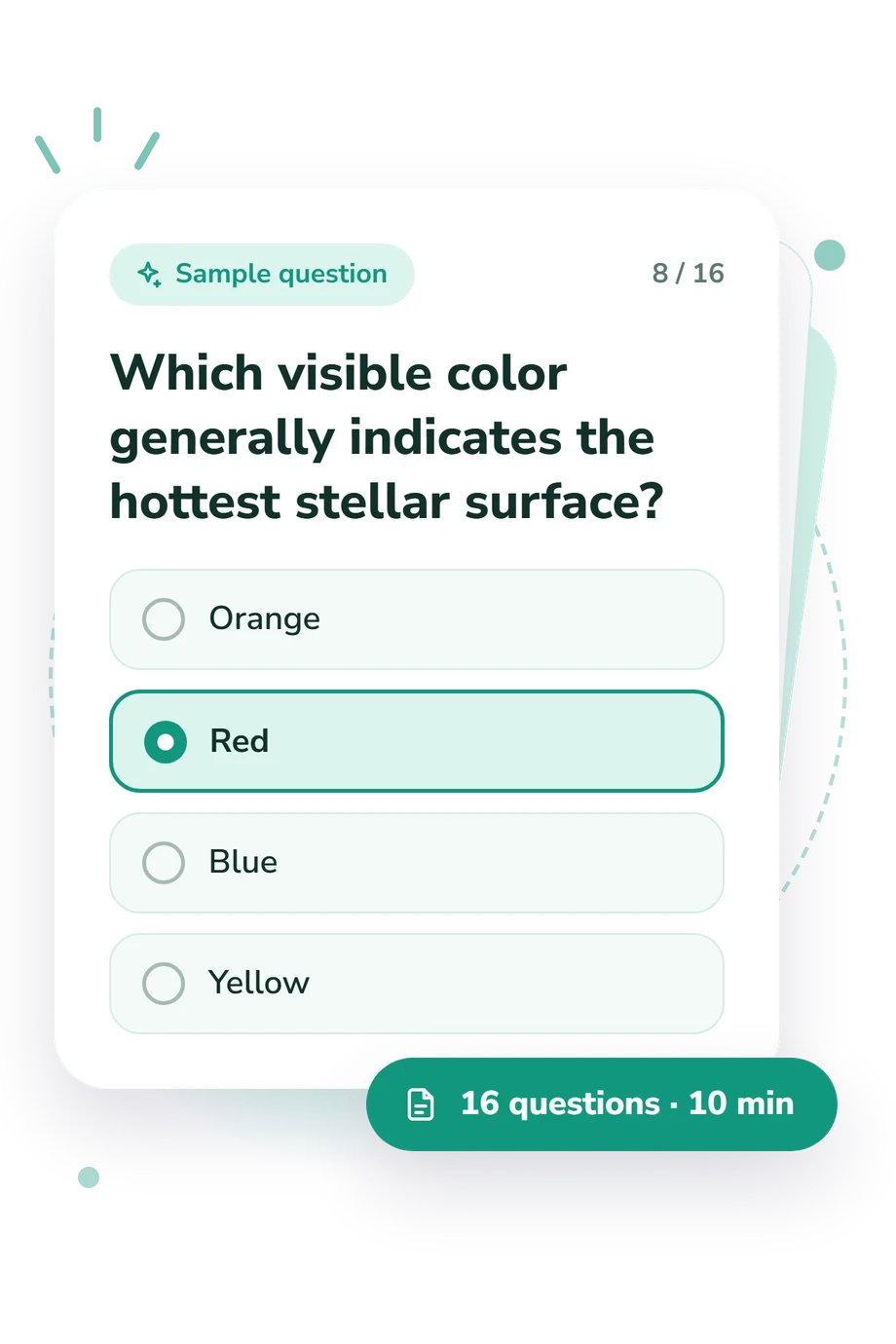
- Orange
- Red
- Blue
- Yellow
- A ring galaxy
- An elliptical galaxy
- An irregular galaxy
- A barred spiral galaxy
Space Trivia Quiz - Description and methodology of the test
People who want to check whether their astronomy fundamentals are secure can use this space trivia quiz as a focused knowledge check. It suits curious learners, students reviewing introductory science, and readers who want a clearer sense of how they understand motion, light, gravity, planets, stars, and galaxies. The resulting score from this online space quiz can show which concepts deserve another look.
What This Assessment Measures
The questionnaire measures conceptual understanding of common astronomy situations rather than opinion or speculation. It covers retrograde motion, seasons, lunar phases, eclipses, redshift, mass and weight, exoplanet detection, stellar color, black holes, galaxies, comets, planets, and astronomical distance.
Curious learners and students reviewing introductory science can use this space knowledge quiz to check their foundation. The result reflects the selected concepts, not every branch of astronomy or skills such as observation, mathematical modelling, and research.
The displayed result is organized into these levels:
- Space Trivia Knowledge (0-16) records one point for each correct answer.
- Cosmic Starter (0-6) indicates recognition of core ideas and points to motion, light, and planetary science for review.
- Developing Astronomer (7-12) indicates a useful foundation with some topics still worth revisiting.
- Stellar Knowledge (13-16) indicates strong command of the stable concepts sampled and accurate application.
Methodology and Evidence Base
Each item presents a short astronomy question with four answer choices. The alternatives distinguish related explanations, such as changing viewing geometry versus a reversed orbit or weaker surface gravity versus changed mass. Respondents select the best explanation, object, alignment, or interpretation.
Scoring is direct: each correct response adds one point, and the total determines the displayed band. Because the questionnaire samples foundational astronomy concepts in this astronomy quiz, the result highlights strengths and suggests topics for study, while reflecting only the concepts sampled here.
The closest conceptual reference is Test of Astronomy STandards (TOAST), which assesses astronomy understanding through standards-aligned concepts. Hufnagel’s Astronomy Diagnostic Test (2002) and Sadler and colleagues’ 2010 concept-inventory work offer relevant comparison points. These published instruments are precedents for the subject matter, not evidence that this questionnaire is their adaptation or a standardized administration.
Prior learning, guessing, attention, and the conditions of one attempt can influence performance, so the result is best used to guide reflection and further learning rather than treated as a complete measure of astronomy expertise.
- Slater, Stephanie J. (2015). The Development And Validation Of The Test Of Astronomy STandards (TOAST). Journal of Astronomy & Earth Sciences Education, 1(1), 1-22. 10.19030/jaese.v1i1.9102
- Hufnagel, Beth (2002). Development of the Astronomy Diagnostic Test. Astronomy Education Review, 1(1), 47-51. 10.3847/AER2001004
- Sadler, Philip M., Harold Coyle, Jaimie L. Miller, Nancy Cook-Smith, Mary Dussault, and Roy R. Gould (2010). The Astronomy and Space Science Concept Inventory: Development and Validation of Assessment Instruments Aligned with the K-12 National Science Standards. Astronomy Education Review, 8(1), 010111. 10.3847/AER2009024
Updated: