
Why Can't I Get a Boyfriend Quiz
How the Scales are Structured
Who Usually Takes This Test?
See How You Compare
Below is a preview of how scores are typically distributed across each scale.
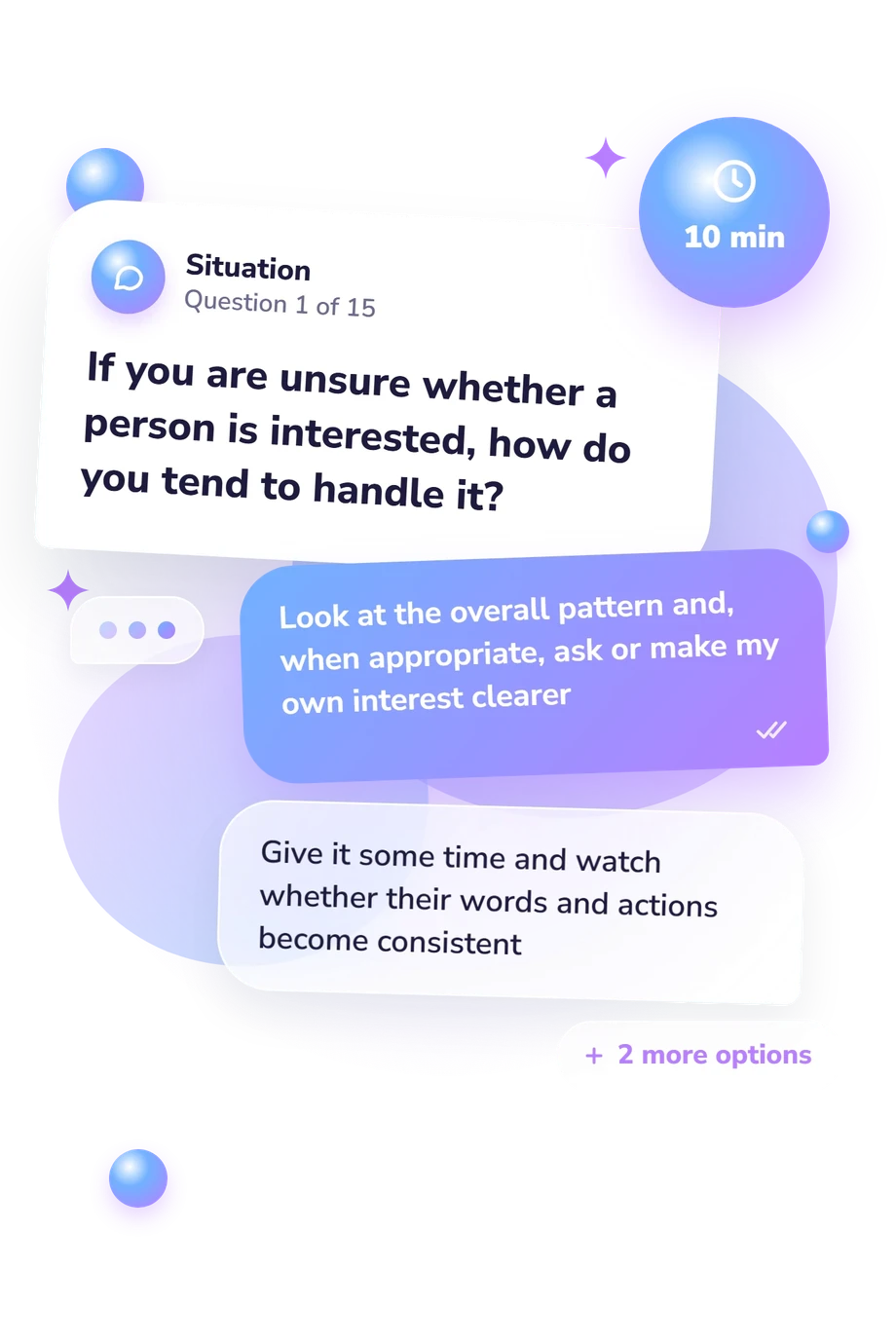
Example Questions From the Test
- Look at the overall pattern and, when appropriate, ask or make my own interest clearer
- Give it some time and watch whether their words and actions become consistent
- Analyze small details while avoiding any direct signal of my own
- Assume they are not interested and withdraw before finding out
- They vary, but many are emotionally available and broadly compatible with me
- Some are compatible, while others require compromises I eventually question
- I am often drawn to people whose lifestyles, goals, or availability conflict with mine
- The strongest attraction repeatedly appears with people who cannot or will not build the relationship I want
- I answer naturally and let them know whether I would like to meet again
- I reply positively but wait for them to suggest the next step
- I intentionally delay or shorten my reply to avoid appearing eager
- I struggle to reply and may let the connection disappear despite wanting it
Why Can't I Get a Boyfriend Quiz - Description and methodology of the test
People who feel stuck between wanting a relationship and repeating the same dating patterns can use the Why Can't I Get a Boyfriend Quiz to organize that uncertainty. This dating confidence quiz looks beyond attractiveness and asks where opportunities, communication, or partner choices may be narrowing. The result offers a practical map for self-reflection, not a verdict about your desirability.
What This Assessment Explores
Instead of assigning one cause, the questionnaire separates opportunities, connection habits, and partner selection. As a relationship patterns quiz, it helps readers examine recurring situations without turning attraction or relationship status into a measure of worth.
The three displayed dimensions are:
- Dating Opportunities & Initiative: 0-15 - Open Pathways (0-5) shows more available openings; Selective Openings (6-10) shows inconsistency; Narrow Pathways (11-15) shows few current openings.
- Early Connection & Communication: 0-15 - Readable Connection (0-5) shows clearer signals; Cautious Connection (6-10) shows reserve; Protected Connection (11-15) shows stronger self-protection.
- Relationship Fit & Selection: 0-15 - Consistent Fit (0-5) shows closer alignment; Mixed Fit (6-10) shows tension between chemistry and suitability; Recurring Mismatch (11-15) shows repeated incompatibility.
Methodology and Scientific Basis
As a structured self-report, each prompt offers four ordered responses, moving from clearer initiative or compatibility awareness toward hesitation, guardedness, withdrawal, or mismatch. Selected responses produce three displayed scores, but no point-by-point weighting rule is stated, so the ranges support pattern reading rather than calculation from one answer.
Conceptually, the questionnaire is consistent with Kredl, Kubin, and Lydon (2024), whose findings link self-concept clarity with evaluating incompatible dating partners. Baxter et al. (2022) adds compatibility, Houser, Horan, and Furler (2008) adds early-dating communication, and Smith and Betz (2000) adds social self-efficacy. These studies support the themes; the online questionnaire is not an adaptation of their instruments.
In practice, this compatibility self-assessment can reflect current mood, recent experiences, self-awareness, and answer precision. The questionnaire provides no standardized norms, so a higher band is a pattern within its framework rather than a universal threshold or clinical finding. Compare the result with concrete situations and treat it as a prompt for a small, testable change.
- Kredl, Katya F., Kubin, Dita, and Lydon, John E. (2024). Self-concept clarity and the evaluation and selection of incompatible dating partners. Personal Relationships, 31(4), 1067-1089. 10.1111/pere.12570
- Baxter, Alexander, Maxwell, Jessica A., Bales, Karen L., Finkel, Eli J., Impett, Emily A., and Eastwick, Paul W. (2022). Initial impressions of compatibility and mate value predict later dating and romantic interest. Proceedings of the National Academy of Sciences, 119(45), e2206925119. 10.1073/pnas.2206925119
- Houser, Marian L., Horan, Sean M., and Furler, Lisa A. (2008). Dating in the fast lane: How communication predicts speed-dating success. Journal of Social and Personal Relationships, 25(5), 749-768. 10.1177/0265407508093787
- Smith, Heather M., and Betz, Nancy E. (2000). Development and validation of a scale of perceived social self-efficacy. Journal of Career Assessment, 8(3), 283-301. 10.1177/106907270000800306
Updated: