
Why Can't I Get a Girlfriend Quiz
How the Scales are Structured
Who Usually Takes This Test?
See How You Compare
Below is a preview of how scores are typically distributed across each scale.
Example Questions From the Test
- I want a relationship, but much of my attention is still tied to a past connection or unresolved situation
- I have some emotional room, although I often compare new people with a past or imagined ideal
- I can invest in someone new, but I may protect my independence when closeness increases
- I can make room for mutual needs while keeping appropriate boundaries and existing priorities
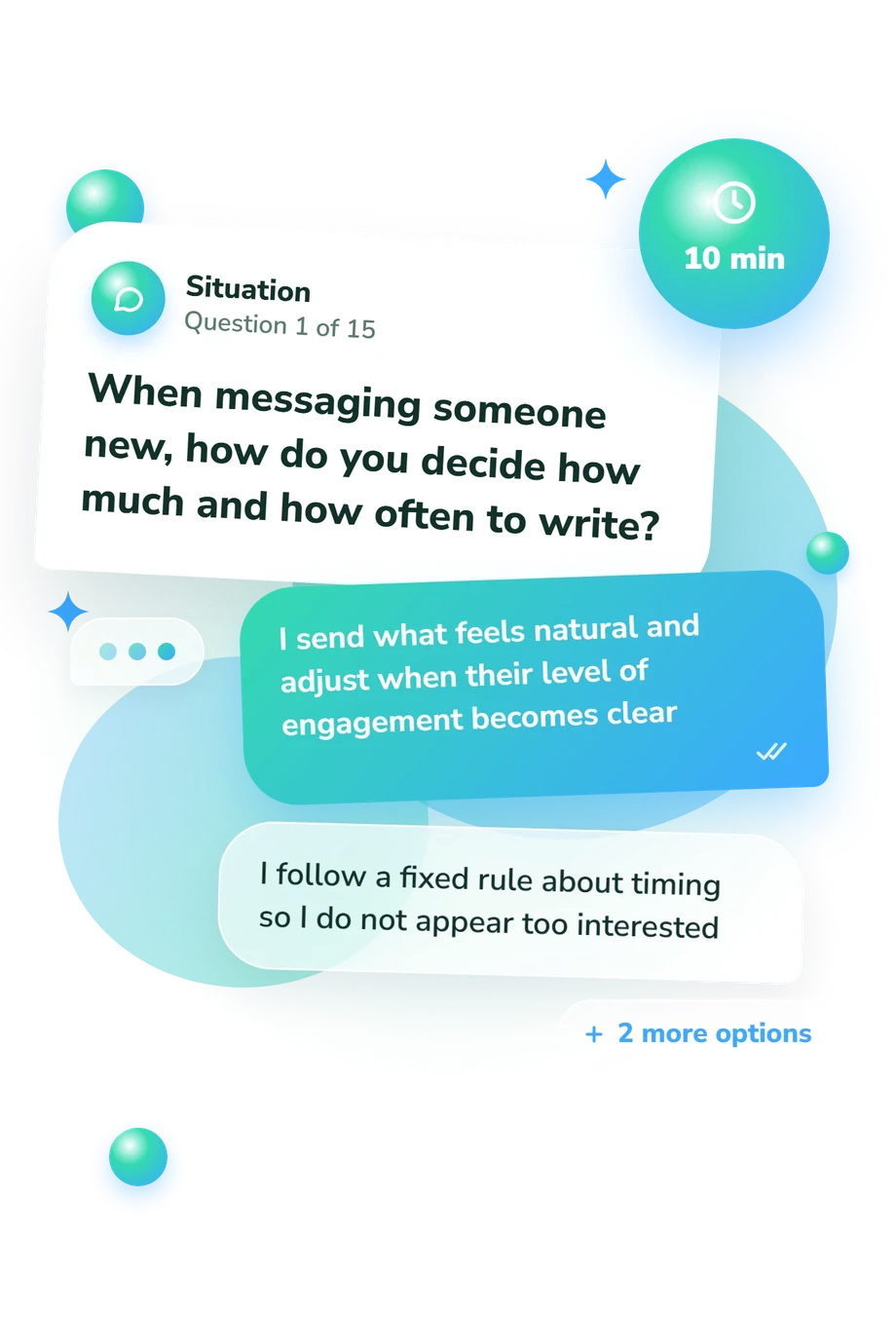
- I send what feels natural and adjust when their level of engagement becomes clear
- I follow a fixed rule about timing so I do not appear too interested
- I sometimes send several follow-ups when I am uncertain about their response
- I generally match their pace, though I may hesitate to initiate a new exchange
- Continue the conversation and suggest a simple, specific way to meet again
- Show interest and hope a natural opportunity to reconnect appears
- Exchange contact details but wait for them to make the next move
- Keep the interaction friendly without indicating that I am interested
Why Can't I Get a Girlfriend Quiz - Description and methodology of the test
People stuck in dating often need more than a yes-or-no explanation; they need a clearer view of habits, expectations, and opportunities shaping connection. The Why Can't I Get a Girlfriend Quiz helps examine those patterns without reducing relationship outcomes to one personal flaw. It suits anyone taking a quiz about why I don't have a girlfriend and seeking practical reflection rather than a fixed label.
What This Assessment Explores
Rather than treating singleness as proof of a defect, the questionnaire examines communication, openness, expectations, and creating dating opportunities. That makes it relevant to someone taking a quiz about why I can't find a girlfriend while leaving room for timing, circumstance, and mutual choice. The result describes reported tendencies, not attractiveness or worth.
The three displayed dimensions cover these parts of the profile:
- Connection & Communication (0-15) reflects reciprocal conversation, cue-reading, clear interest, and respectful differences: Connection may stall (0-5), Emerging skills (6-10), or Reciprocal communicator (11-15).
- Expectations & Emotional Availability (0-15) reflects flexibility, willingness to be known, realistic pacing, and emotional room: Significant reservations (0-5), Selectively open (6-10), or Grounded openness (11-15).
- Opportunities & Initiative (0-15) reflects creating realistic openings and acting on mutual interest: Limited opportunity (0-5), Inconsistent momentum (6-10), or Active approach (11-15).
Methodology and Scientific Basis
Each item presents a situation with four self-report choices. Prompts address messaging, cues, interest, rejection, vulnerability, expectations, disagreement, and opportunities. Choices describe patterns, not binary judgments.
Results appear by dimension, but the questionnaire does not specify how answers become points. Higher results indicate more of each scale’s tendency; interpretation should follow the displayed band. For someone taking a quiz about why I do not have a girlfriend, the question is which pattern feels changeable.
Its evidence is conceptually consistent with Initiation-efficacy (Watkins & Beckmeyer, 2023), linking initiation confidence with well-being, and relationship self-efficacy research by Riggio et al. (2011). Buhrmester et al. (1988) supports interpersonal competence; Clark, Shaver, and Abrahams (1999) examined relationship initiation. It is not an adaptation of those instruments and has no stated standardization or norms.
Because responses are self-reported, context, self-awareness, and impression management influence scores. Someone taking a quiz about why I have never had a girlfriend can try one experiment, such as clearer interest, broader social settings, or flexible pacing; the profile cannot establish why someone is single or predict success.
- Watkins, Nicole K., and Jonathon J. Beckmeyer. (2023). Perceived Efficacy in Initiating Romantic Relationships and Single Emerging Adults’ Well-Being. Emerging Adulthood, 11(4), 972-978. 10.1177/21676968231182755
- Riggio, Heidi R., Dana Weiser, Ann Valenzuela, Priscilla Lui, Robert Montes, and Julie Heuer. (2011). Initial Validation of a Measure of Self-Efficacy in Romantic Relationships. Personality and Individual Differences, 51(5), 601-606. 10.1016/j.paid.2011.05.026
- Buhrmester, Duane, Wyndol Furman, Mitchell T. Wittenberg, and Harry T. Reis. (1988). Five Domains of Interpersonal Competence in Peer Relationships. Journal of Personality and Social Psychology, 55(6), 991-1008. 10.1037/0022-3514.55.6.991
- Clark, Catherine L., Phillip R. Shaver, and Matthew F. Abrahams. (1999). Strategic Behaviors in Romantic Relationship Initiation. Personality and Social Psychology Bulletin, 25(6), 709-722. 10.1177/0146167299025006006
Updated: