
What Mean Girl Are You Quiz
How the Scales are Structured
Who Usually Takes This Test?
See How You Compare
Below is a preview of how scores are typically distributed across each scale.
Example Questions From the Test
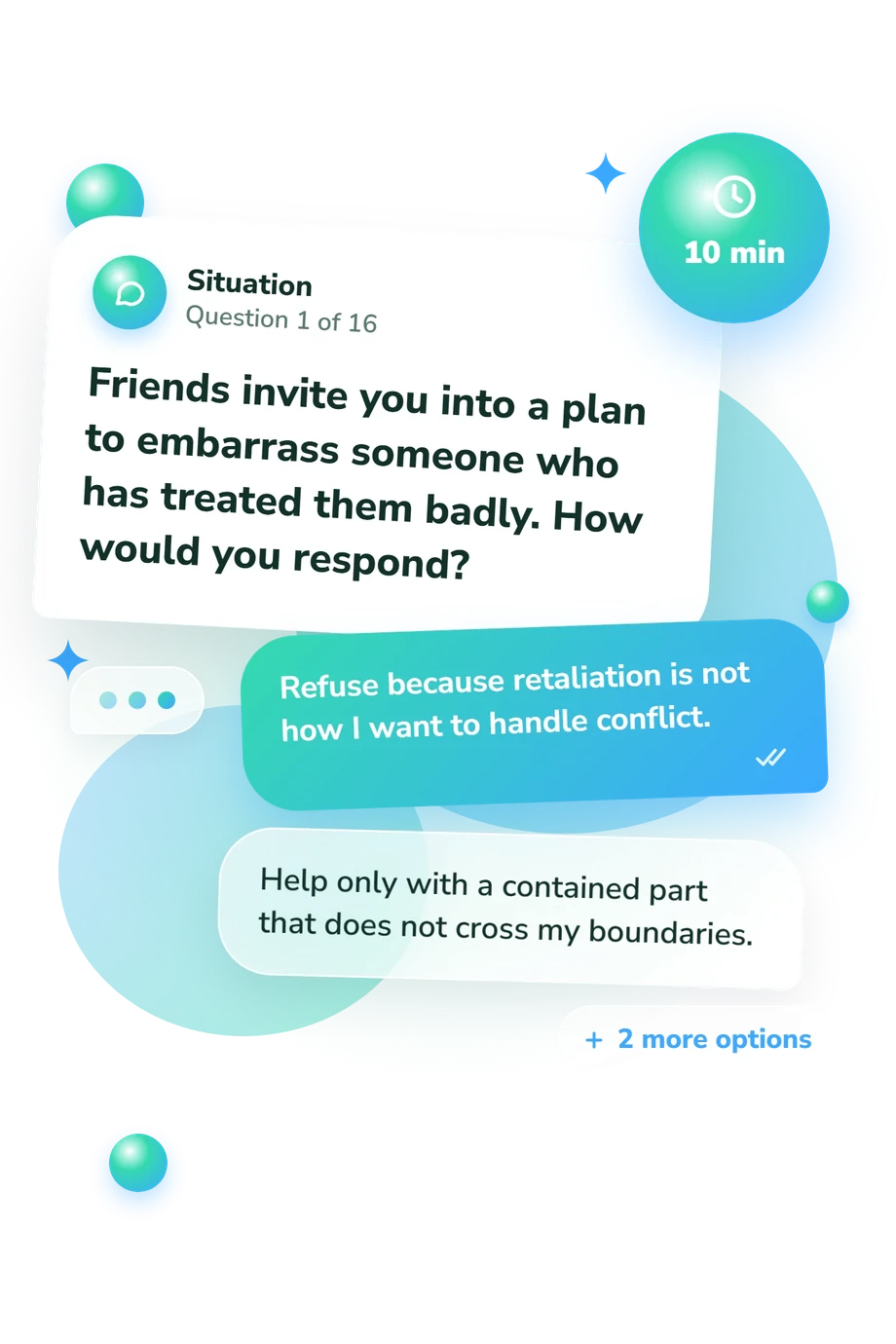
- Refuse because retaliation is not how I want to handle conflict.
- Help only with a contained part that does not cross my boundaries.
- Get increasingly absorbed in the plan and temporarily lose sight of my original limits.
- Participate, but keep checking whether the plan is going too far.
- Support whichever option gains a genuine consensus.
- Recommend my preference, then let everyone decide.
- Build enough enthusiasm that my preferred plan becomes the obvious default.
- Present the plan as settled and expect the group to align.
- Ignore it and trust that people who know me will judge for themselves.
- Clarify the facts privately with the people most affected.
- Shape the story through a few carefully chosen conversations.
- Confront the source and visibly take control of the narrative.
What Mean Girl Are You Quiz - Description and methodology of the test
For readers who enjoy character-based self-reflection, the What Mean Girl Are You Quiz offers a playful way to examine social instincts without reducing personality to a fixed label. It helps frame the question of which mean girl you are through choices about belonging, influence, loyalty, conflict, attention, and everyday decisions.
What This Assessment Explores
Rather than measuring popularity, this assessment examines responses when group rules, reputations, alliances, and boundaries come into tension. Its scenarios cover retaliation, leadership, rumors, exclusion, confidentiality, style, ambiguity, and social strategy. For someone asking which Mean Girls character you are, the result describes a strongest fictional affinity, not a complete personality portrait.
The scales represent these patterns:
- Cady Heron Affinity (0-12) places curiosity and adaptability in Different Path (0-4), Shared Traits (5-8), or Strong Cady Affinity (9-12).
- Gretchen Wieners Affinity (0-12) tracks belonging and social awareness as Different Social Style (0-4), Socially Attuned (5-8), or Strong Gretchen Affinity (9-12).
- Karen Smith Affinity (0-12) places sincerity and spontaneity in Different Outlook (0-4), Playful Instincts (5-8), or Strong Karen Affinity (9-12).
- Regina George Affinity (0-12) reflects influence and control as Different Presence (0-4), Selective Authority (5-8), or Strong Regina Affinity (9-12).
Methodology and Evidence Base
Each item presents a school or friendship situation with four responses. The options differ in their handling of boundaries, consensus, image management, social information, spontaneity, and authority, so choose the reaction that feels most natural rather than most admirable. This remains a self-report exercise shaped by context and self-perception.
For a reader asking what mean girl am I, the scoring is comparative: answers feed four character-affinity totals, the highest marks the strongest match, and totals within one point indicate a blended result. The bands organize resemblance, not clinical norms or diagnostic cutoffs.
The framework is conceptually consistent with Identification scale (Huang & Fung, 2024), which addresses identification with narrative characters; this questionnaire is not presented as an adaptation or validation of that scale. Cohen’s theory explains how resemblance may involve motives, attention, and social perspective, while Mean Girls and Wiseman’s work provides the fictional and clique-related context. Honest self-report makes the profile a flexible reflection prompt, not a complete account of behavior across every relationship.
- Huang, Kate Y., and Helene H. Fung. “Measuring identification with narrative characters: the development and validation of a new scale.” Current Psychology 43 (2024): 24835-24849. 10.1007/s12144-024-06191-2
- Fey, Tina (screenwriter), and Mark S. Waters (director). Mean Girls. Paramount Pictures, 2004.
- Wiseman, Rosalind. Queen Bees and Wannabes: Helping Your Daughter Survive Cliques, Gossip, Boyfriends, and Other Realities of Adolescence. Three Rivers Press, 2002.
- Cohen, Jonathan. “Defining identification: A theoretical look at the identification of audiences with media characters.” Mass Communication and Society 4, no. 3 (2001): 245-264. 10.1207/S15327825MCS0403_01
Updated: