
Love Trope Quiz
How the Scales are Structured
Who Usually Takes This Test?
See How You Compare
Below is a preview of how scores are typically distributed across each scale.
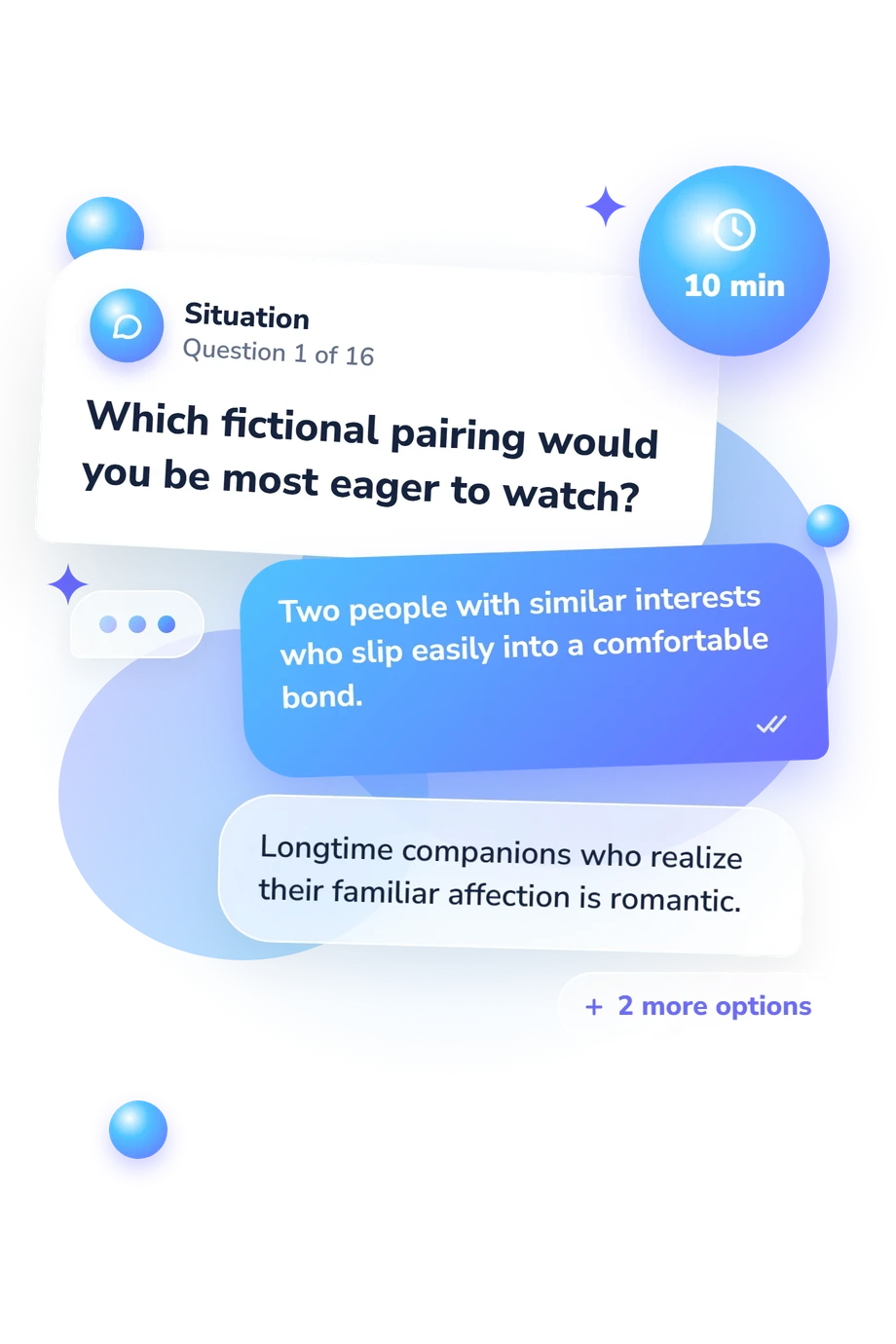
Example Questions From the Test
- Two people with similar interests who slip easily into a comfortable bond.
- Longtime companions who realize their familiar affection is romantic.
- A reserved homebody and a spontaneous explorer who broaden each other's worlds.
- Two people whose attraction emerges through months of restrained interaction.
- The conflict is only a brief misunderstanding before an otherwise easy romance.
- Their competition gradually exposes mutual respect and unwanted attraction.
- They have a tender shared history that matters more than the rivalry.
- They become fascinated by the different methods each brings to the challenge.
- The contrast between them and their unsuitable dates creates comic surprises.
- They slowly recognize that the dependable connection they want already exists.
- One date becomes an exciting new match who changes the direction of the story.
- The realization stays unspoken for many chapters, building patient anticipation.
Love Trope Quiz - Description and methodology of the test
For readers who wonder why certain fictional romances feel especially satisfying, the Love Trope Quiz maps preferences across familiar story dynamics. It is a romance trope quiz for people comparing favorite books, films, or series, choosing what to read next, or reflecting on the emotional pacing and character chemistry they enjoy. The result describes narrative taste, not the quality of a person’s real relationships.
What This Assessment Explores
Instead of rating real-life compatibility, it asks which imagined pairings, emotional rhythms, and sources of chemistry hold your attention. As a quiz about what romance trope you are, it maps four preferences: rivalry, friendship, difference, and delayed development.
The profile distinguishes these preferences:
- Enemies to Lovers (0-12) measures rivalry appeal: Softer Chemistry (0-4), Playful Friction (5-8), and Rivalry Spark (9-12) mark increasing attraction, not cruelty or harmful conflict.
- Friends to Lovers (0-12) measures friendship appeal: New-Connection Lean (0-4), Trust Before Romance (5-8), and Friendship First (9-12) mark attraction to shared history and emotional safety.
- Opposites Attract (0-12) measures contrast appeal: Common-Ground Lean (0-4), Complementary Curiosity (5-8), and Contrast Chemistry (9-12) mark attraction to difference, not disrespect or incompatibility.
- Slow Burn (0-12) measures delayed-resolution appeal: Quick Momentum (0-4), Measured Build (5-8), and Patient Payoff (9-12) mark attraction to anticipation.
Methodology and Evidence Base
Each item presents a fictional situation with four choices. Options vary attraction, pacing, similarity or difference, and the interaction behind a pairing. Four scores are compared: the highest marks strongest affinity, while scores within one point create a blended result. This shows whether one dynamic stands out or several share the profile.
Because the questions focus on narrative preferences, this romantic trope quiz describes story taste rather than personality. Conceptually, it is consistent with Stinson et al. (2022), whose work is relevant to friendship developing into romance. Montoya et al. (2008) frames similarity and difference, while Reis et al. (2011) supports familiarity as a possible source of attraction in interaction. These studies provide conceptual context; this questionnaire is not an adaptation of their published measures.
Interpret the profile as a snapshot of story taste shaped by current interests, mood, and experience with romance conventions. Self-report depends on response style, mood, and how each fictional scenario is interpreted; result bands are descriptive labels rather than standardized norms or clinical thresholds.
- Danu Anthony Stinson, Jessica J. Cameron, and Lisa B. Hoplock (2022). The Friends-to-Lovers Pathway to Romance: Prevalent, Preferred, and Overlooked by Science. Social Psychological and Personality Science, 13(2), 562-571. 10.1177/19485506211026992
- R. Matthew Montoya, Robert S. Horton, and Jeffrey L. Kirchner (2008). Is actual similarity necessary for attraction? A meta-analysis of actual and perceived similarity. Journal of Social and Personal Relationships, 25(6), 889-922. 10.1177/0265407508096700
- Harry T. Reis, Michael R. Maniaci, Peter A. Caprariello, Paul W. Eastwick, and Eli J. Finkel (2011). Familiarity does indeed promote attraction in live interaction. Journal of Personality and Social Psychology, 101(3), 557-570. 10.1037/a0022885
Updated: