
Am I Having a Midlife Crisis Quiz
How the Scales are Structured
Who Usually Takes This Test?
See How You Compare
Below is a preview of how scores are typically distributed across each scale.
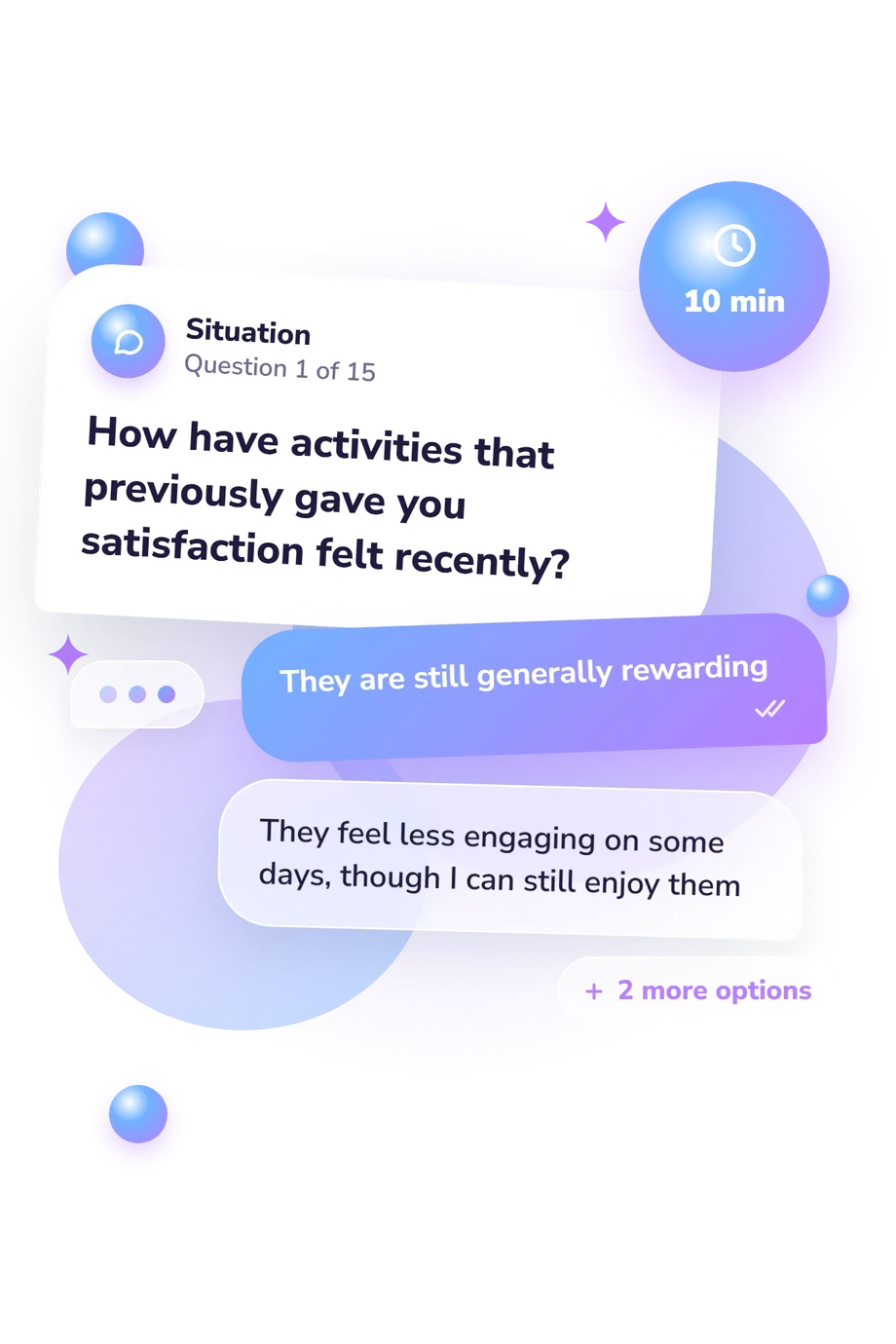
Example Questions From the Test
- They are still generally rewarding
- They feel less engaging on some days, though I can still enjoy them
- Many feel flat, and I often need novelty to feel engaged
- Very little feels satisfying, and this change is affecting my daily life
- I mainly see it as an occasion to mark time and reconnect
- It prompts some comparison between my expectations and my actual life
- It leads me to seriously reassess what my achievements mean to me
- It makes me feel that my current life belongs to a version of me I no longer recognize
- Rarely or never
- Occasionally, but it does not usually direct my choices
- Frequently, especially when a new possibility appears
- Very often; it creates intense pressure to act quickly
Am I Having a Midlife Crisis Quiz - Description and methodology of the test
People who feel less settled about their routines, relationships, identity, or next steps can use the Am I Having a Midlife Crisis Quiz to organize those experiences into a clearer profile. Rather than forcing a yes-or-no label, this midlife crisis quiz separates everyday strain from questions about meaning and the pressure to make major changes.
What This Assessment Explores
The questions connect emotional changes with everyday functioning, identity, meaning, and decisions about change. They touch enjoyment, sleep, attention, relationships, work dissatisfaction, self-continuity, novelty, and urgency. For people reflecting on their current experience, this midlife crisis profile organizes these themes without assigning a fixed label.
These are the three dimensions shown in the result:
- Emotional and Everyday Strain (0-15) reflects interference with mood, focus, connection, enjoyment, and daily functioning: Limited disruption (0-5), Noticeable strain (6-10), or Substantial disruption (11-15).
- Identity and Meaning Reevaluation (0-15) reflects questioning of roles, priorities, success, and self-continuity: Grounded continuity (0-5), Active reevaluation (6-10), or Strong identity questioning (11-15).
- Urgency for Major Change (0-15) reflects pressure for novelty, reinvention, or major decisions: Measured adjustment (0-5), Growing change pressure (6-10), or Urgent reinvention (11-15).
Methodology and Evidence Base
The midlife crisis questionnaire is a structured self-report questionnaire with four ordered response options, moving from steady or gradual reactions toward greater disruption, disconnection, or time pressure. Results summarize three profiles rather than one overall crisis verdict.
The displayed bands are reflective summaries, not validated clinical severity levels or diagnostic cutoffs, and they do not identify a specific cause. Read each band as a summary of the response pattern on its scale.
The evidence frame is the Concise Midlife Crisis Measure (Husain et al., 2025). This questionnaire is conceptually consistent with that published instrument but is not a direct adaptation. Its themes also align with Shek’s research on midlife concerns, Wethington’s distinction between expected stress and crisis interpretations, and Robinson and Wright’s account of crisis episodes involving roles, relationships, work, and major change. For interpretation, the cited work helps situate the questionnaire's coverage of identity transition, emotional strain, and pressure for major change, without validating this online version.
Current circumstances, self-awareness, honest self-report, and response bias can influence scores. Use the profile as a structured prompt for reflection on mood, functioning, identity, and decision-making.
- Husain, W., Trabelsi, K., Ali, A., Usman, Y., Husain, M. A., Ijaz, F., Ammar, A., & Jahrami, H. (2025). Development and validation of the concise midlife crisis measure. Scientific Reports, 15, 39770. 10.1038/s41598-025-23549-z
- Shek, D. T. L. (1996). Midlife crisis in Chinese men and women. The Journal of Psychology, 130(1), 109-119. 10.1080/00223980.1996.9914993
- Wethington, E. (2000). Expecting stress: Americans and the “midlife crisis”. Motivation and Emotion, 24(2), 85-103. 10.1023/A:1005611230993
- Robinson, O. C., & Wright, G. R. T. (2013). The prevalence, types and perceived outcomes of crisis episodes in early adulthood and midlife: A structured retrospective-autobiographical study. International Journal of Behavioral Development, 37(5), 407-416. 10.1177/0165025413492464
Updated: