
AP Chem Quiz
How the Scales are Structured
Who Usually Takes This Test?
See How You Compare
Below is a preview of how scores are typically distributed across each scale.
Example Questions From the Test
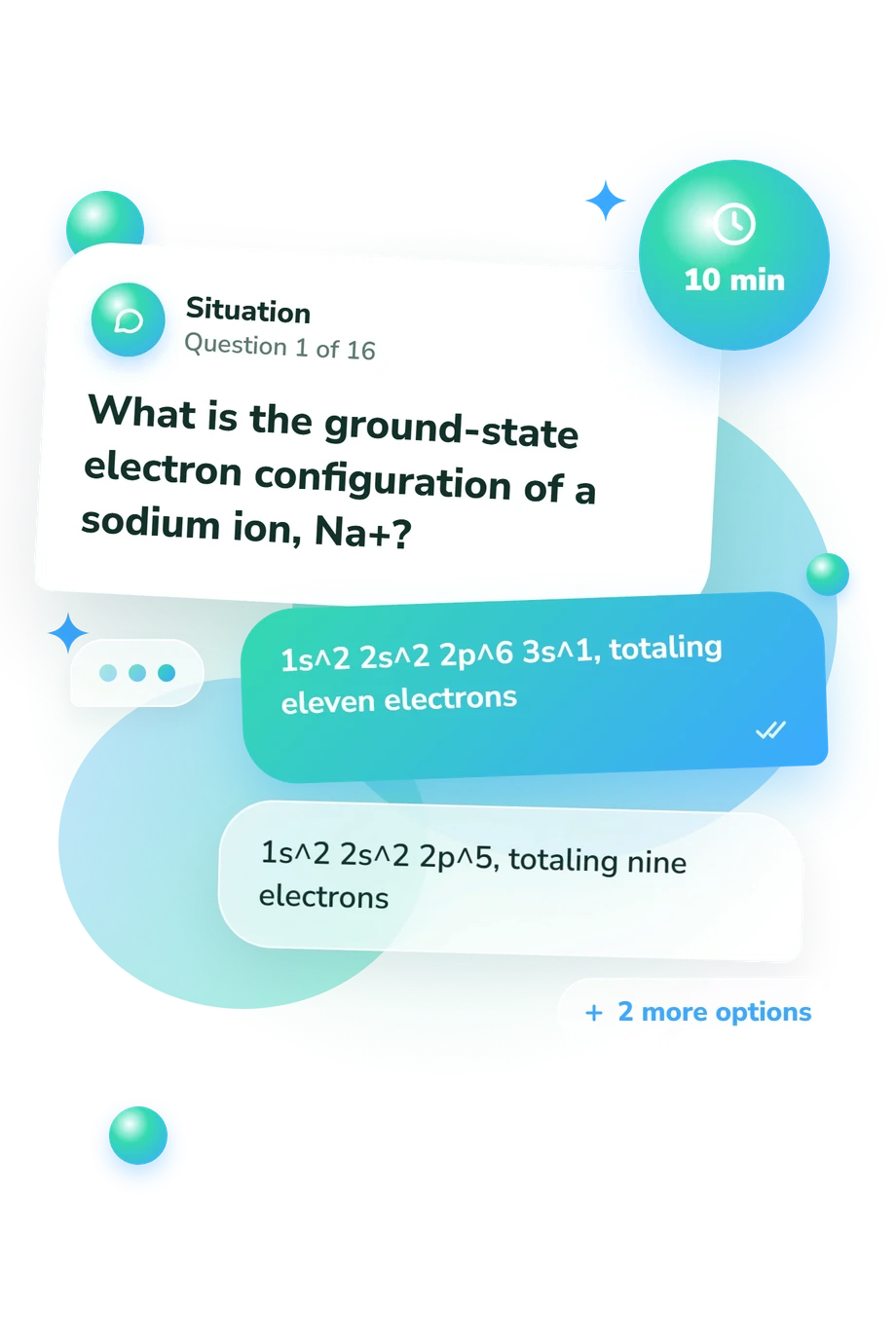
- 1s^2 2s^2 2p^6 3s^1, totaling eleven electrons
- 1s^2 2s^2 2p^5, totaling nine electrons
- 1s^2 2s^2 2p^6, totaling ten electrons
- 1s^2 2s^2 2p^6 3s^2, totaling twelve electrons
- It decreases to one-half its original value.
- It increases to twice its original value.
- It increases to four times its original value.
- It remains unchanged because the volume is fixed.
- 2 mol
- 6 mol
- 4 mol
- 80 mol
AP Chem Quiz - Description and methodology of the test
Students preparing for an AP course or reviewing before a classroom assessment can use the AP Chem Quiz to check how securely they connect chemical ideas. It suits learners who want an AP chemistry quiz that samples concepts rather than a single chapter. The result identifies strengths and places your overall performance in a broad band, helping you choose a sensible next study step.
What This Assessment Explores
Across the items, the assessment checks whether you can connect representations, apply chemical relationships, and predict changes when conditions shift. It samples atomic structure, periodic trends, molecular shape, bonding, stoichiometry, gases, thermochemistry, kinetics, equilibrium, acids and bases, solutions, and electrochemistry.
The main topic groups represented by the questions are:
- Structure and properties show how electron arrangement, geometry, bonding, and intermolecular forces explain observable behavior.
- Quantitative reasoning measures how you use ratios, gas relationships, dilution, rate laws, and reaction equations.
- Reactivity and energy cover heat flow, equilibrium, acids and bases, redox, precipitation, titration, and catalysts.
That breadth makes the AP chemistry practice quiz useful for a cross-unit check. The displayed AP Chemistry Knowledge scale (0-16) counts correct answers: Foundation to Build (0-6) calls for review, Developing Command (7-12) suggests targeted work, and Strong Command (13-16) indicates broad command of sampled concepts.
Methodology and Evidence Base
As an AP-focused multiple-choice quiz, it presents four choices for each AP chemistry question and asks for the response that best matches a chemical principle, relationship, or calculation. Scoring is based on correct responses, so the displayed band describes performance on this sample rather than converting it into an official AP result.
Content is conceptually consistent with the College Board’s AP Chemistry framework, which emphasizes applying principles across representations and contexts. Its multiple-choice approach is also conceptually consistent with Domyancich’s work on AP Chemistry items, which addresses questions designed to assess deeper understanding within the course. Silberberg and Amateis provide a reference for the chemistry concepts tested. The quiz’s topics and item approach are conceptually consistent with this framework and study; they do not make it a College Board instrument or reproduce cited work.
Interpret the result alongside preparation, concentration, and familiarity with the sampled topics. This online educational snapshot is not a standardized College Board assessment and cannot represent every AP Chemistry unit, laboratory skill, or free-response demand; it does not provide an official or predicted AP exam score.
- The College Board. AP Chemistry Course and Exam Description, Effective Fall 2024. College Board, 2024.
- Domyancich, John M. “The Development of Multiple-Choice Items Consistent with the AP Chemistry Curriculum Framework To More Accurately Assess Deeper Understanding.” Journal of Chemical Education 91, no. 9 (2014): 1347-1351. 10.1021/ed5000185
- Silberberg, Martin, and Patricia Amateis. Chemistry: The Molecular Nature of Matter and Change, AP Edition. 10th ed. McGraw-Hill Education, 2024.
Updated: