
ESL Quiz
How the Scales are Structured
Who Usually Takes This Test?
See How You Compare
Below is a preview of how scores are typically distributed across each scale.
Example Questions From the Test
- mine
- I
- myself
- me
- Nina said that she can’t attend today.
- Nina said that she couldn’t attend that day.
- Nina said that she hasn’t attended that day.
- Nina said that she won’t attend yesterday.
- many
- an
- more
- a few
ESL Quiz - Description and methodology of the test
For learners reviewing English, this esl quiz examines grammar choices in context rather than broad language performance. It suits people studying independently, returning to English after a break, or checking which areas deserve attention next. As a quiz for ESL students, it turns a short check into a starting point for targeted revision. The result gives a concise profile of current performance.
What This Assessment Explores
The quiz’s grammar questions for ESL learners test whether a person can choose forms that make a sentence accurate and meaningful. The situations cover tense and aspect, pronouns and reported speech, modal deduction, quantifiers and articles, passive voice, relative clauses, agreement, prepositions, gerunds and infinitives, comparison, conjunctions, and conditionals. Together, they sample grammar decisions that arise in everyday communication, study, and work.
The result reports ESL Knowledge on a 0-16 scale. The displayed bands describe performance as follows:
- Foundations to build (0-6) indicates that core grammar patterns merit review.
- Developing control (7-12) shows understanding of many everyday patterns, with gaps in complex or contextual choices.
- Strong grammar knowledge (13-16) indicates accurate use of common English grammar rules.
This educational score is not a certified CEFR proficiency assessment.
Methodology and Educational Context
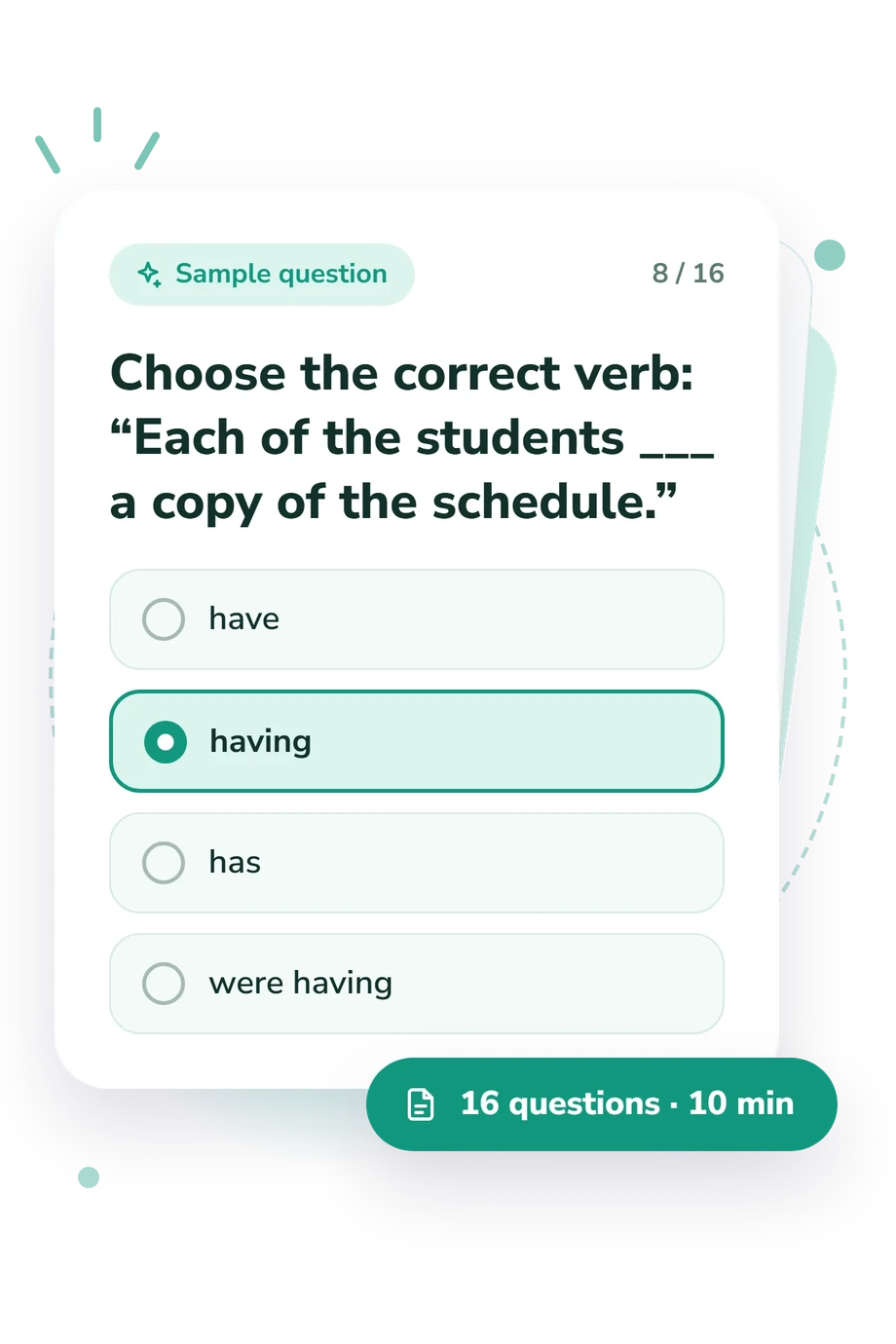
Each item presents a sentence or situation with four answer choices. Selecting the option that best completes or corrects it tests recognition of grammar forms in context rather than extended writing or speaking. An ESL fun quiz can feel approachable, but the alternatives still require attention to tense, agreement, reference, and meaning.
The result is an educational total on the displayed scale. Differential weighting, penalty points, and partial credit are not specified, so no additional scoring formula should be inferred from the range. Read the outcome as a snapshot of the sampled structures; missed items can suggest review topics.
The questionnaire is conceptually consistent with the English Grammar Profile (O’Keeffe and Mark, 2017), which maps learner grammar across structures and proficiency levels, but it is not an adaptation of that work. It also reflects the diagnostic perspective of Clark and Endres (2021), while the CEFR Companion volume supplies descriptors for broader progress. This score does not assign a CEFR level.
Guessing, concentration, study context, and wording familiarity can affect results. Use the profile to set practice priorities; it does not capture spontaneous communication or every aspect of English ability.
- O’Keeffe, Anne, and Geraldine Mark. (2017). “The English Grammar Profile of learner competence: Methodology and key findings.” International Journal of Corpus Linguistics, 22(4), 457-489. 10.1075/ijcl.14086.oke
- Clark, Tony, and Heidi Endres. (2021). “Computer-based diagnostic assessment of high school students’ grammar skills with automated feedback - an international trial.” Assessment in Education: Principles, Policy & Practice, 28(5-6), 602-632. 10.1080/0969594X.2021.1970513
- Council of Europe. (2020). Common European Framework of Reference for Languages: Learning, teaching, assessment - Companion volume. Council of Europe Publishing.
Updated: