
Historical Figures Quiz
How the Scales are Structured
Who Usually Takes This Test?
See How You Compare
Below is a preview of how scores are typically distributed across each scale.
Example Questions From the Test
- Nicolaus Copernicus
- Galileo Galilei
- Johannes Kepler
- Tycho Brahe
- Desiderius Erasmus
- Johannes Gutenberg
- Leonardo da Vinci
- Niccolò Machiavelli
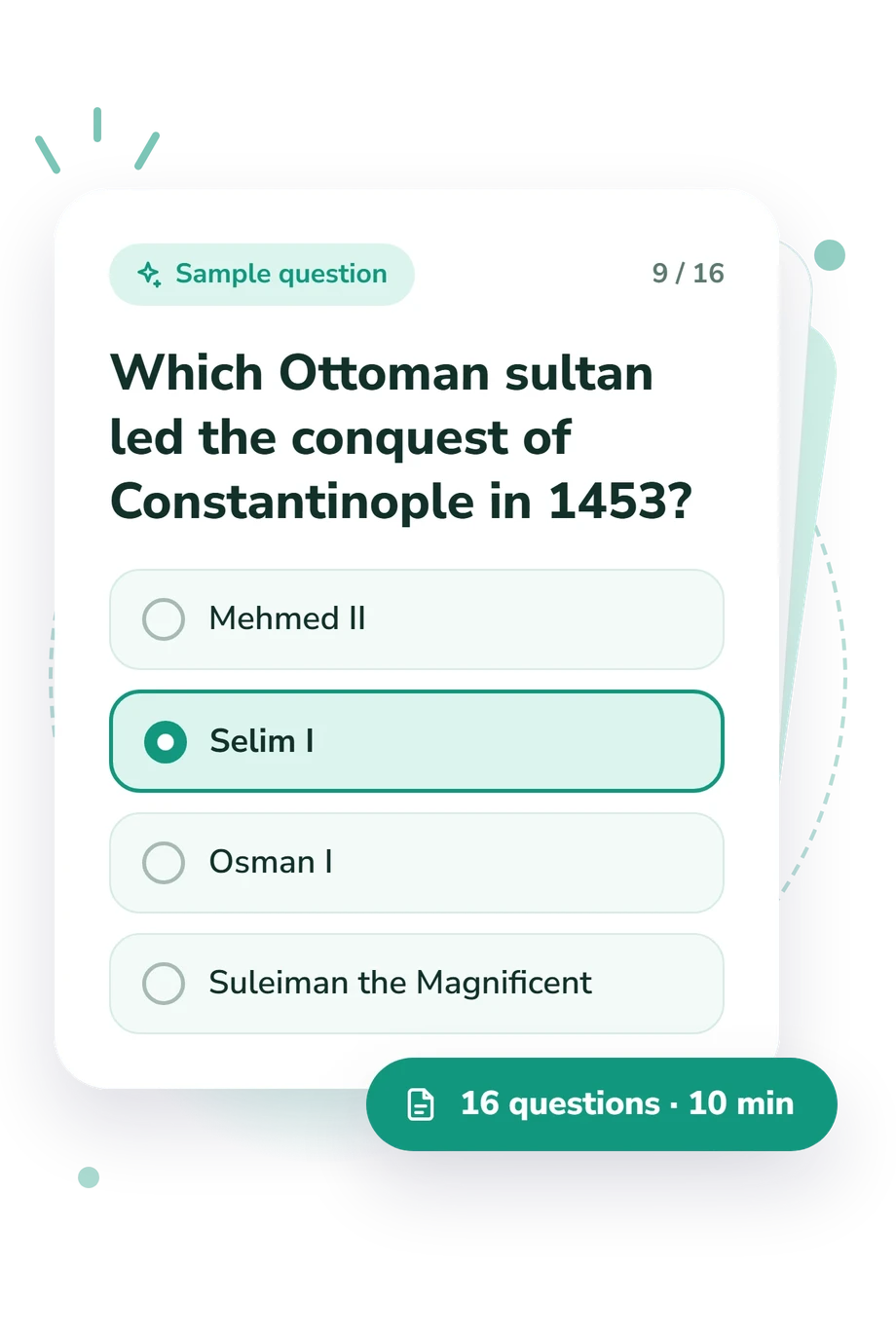
- Mehmed II
- Selim I
- Osman I
- Suleiman the Magnificent
Historical Figures Quiz - Description and methodology of the test
People who want to check how confidently they connect individuals with events, ideas, and institutions can use this historical figures quiz as a focused self-assessment. It suits learners, curious adults, and anyone revising a broad span of world history. As a quiz about historical people, it helps a reader decide whether their current knowledge feels ready for a challenge or calls for more structured revision.
What This Assessment Explores
The questionnaire links notable people with discoveries, reforms, rulers, movements, and cultural achievements. Many prompts offer a setting or consequence instead of a name, so recognition depends on connecting a figure with the correct context. As a historical figures test, it is useful for broad self-checking rather than isolated fact recall.
The main thematic groups are:
- Science and medicine show recognition of discoveries, evidence, and public-health work.
- Power and state-building show identification through laws, conquests, and institutions.
- Rights and liberation show links with abolition, independence, reform, and anti-apartheid activism.
- Arts and ideas show recognition through creative work and cultural change.
The result uses the Historical Figures Knowledge scale, 0-16: Foundation Building (0-6) signals basic recognition; Developing Knowledge (7-12) shows many accurate connections; Strong Knowledge (13-16) reflects consistent identification from facts and clues.
Methodology and Evidence Base
This world history quiz uses four answer choices and asks for one best match. The items combine direct identification questions with prompts built around contextual clues about a person’s work, political role, or historical setting. The single total reflects overall recognition across the items rather than separate subscores. This format requires recognition from both factual information and contextual clues.
Reich (2013) offers the most relevant conceptual comparison because it discusses how multiple-choice history assessment makes knowledge visible through item construction and answer options; this questionnaire likewise identifies figures through facts and contextual clues. Huijgen et al. (2014) distinguish factual knowledge from historical perspective-taking, while Rosenlund (2023) examines how item formats make some forms of historical knowledge more visible. The online questionnaire is not an adaptation of, or validated by, these studies.
Interpret the result as a snapshot shaped by attention, prior exposure, and familiarity with particular regions or figures. The displayed bands describe performance on this questionnaire, not population norms; the score summarizes the answers given rather than a general level of historical ability. An incorrect answer may reflect an unfamiliar region or period rather than a broad gap in understanding.
- Reich, Gabriel A. (2013). Imperfect models, imperfect conclusions: An exploratory study of multiple-choice tests and historical knowledge. The Journal of Social Studies Research, 37(1), 3-16. 10.1016/j.jssr.2012.12.004
- Huijgen, Tim, Carla van Boxtel, Wim van de Grift, and Paul Holthuis. (2014). Testing elementary and secondary school students’ ability to perform historical perspective taking: the constructing of valid and reliable measure instruments. European Journal of Psychology of Education, 29, 653-672. 10.1007/s10212-014-0219-4
- Rosenlund, David. (2023). The nature of historical knowledge in large-scale assessments - a study of the relationship between item formats and offerings of epistemic cognition in the Swedish national test in history. Frontiers in Education, 8, 1253926. 10.3389/feduc.2023.1253926
Updated: