
Am I Russian Quiz
How the Scales are Structured
Who Usually Takes This Test?
See How You Compare
Below is a preview of how scores are typically distributed across each scale.
Example Questions From the Test
- I would not normally use that description for myself.
- I might mention a loose connection if it became relevant.
- I would use it in some settings, usually with added explanation.
- I would readily use it as an important part of my identity.
- Most dialogue, tone, and implied meaning.
- Almost none beyond visual clues.
- Familiar expressions and a rough sense of a few scenes.
- The main storyline and much of the everyday dialogue.
- It comes up occasionally, but only as a minor detail.
- It rarely or never appears in our family stories.
- It is a recurring part of stories about one side of the family.
- It is central to stories shared across my close family.
Am I Russian Quiz - Description and methodology of the test
People unsure how family history, Russian culture, and self-description fit together may use this assessment to sort those strands without forcing a single label. The Am I Russian Quiz offers a profile across heritage, belonging, language, and cultural familiarity. Read as a quiz about whether Russian identity fits your life, this assessment becomes more informative when the result is viewed as a pattern: one strong connection can coexist with a limited connection in another.
What This Assessment Explores
The questions distinguish family links, personal identification, and cultural familiarity. They cover relatives, stories, customs, community belonging, language, media, celebrations, and Russian identity in different settings. As a Russian heritage quiz, it separates known family connection from present culture and personal identity.
Three strands are assessed:
- Family Heritage Connection (0-15) shows known Russian family origins and traditions: Limited family link (0-5), Present family link (6-10), or Central family link (11-15).
- Russian Identity and Belonging (0-15) shows how central Russian identification feels: Not a central identity (0-5), Contextual or evolving identity (6-10), or Central identity (11-15).
- Russian Language and Cultural Connection (0-15) shows present familiarity with language and practices: Limited familiarity (0-5), Developing familiarity (6-10), or Deep familiarity (11-15).
Read together, the scores show whether heritage, identity, and cultural connection align or differ.
Methodology and Evidence Base
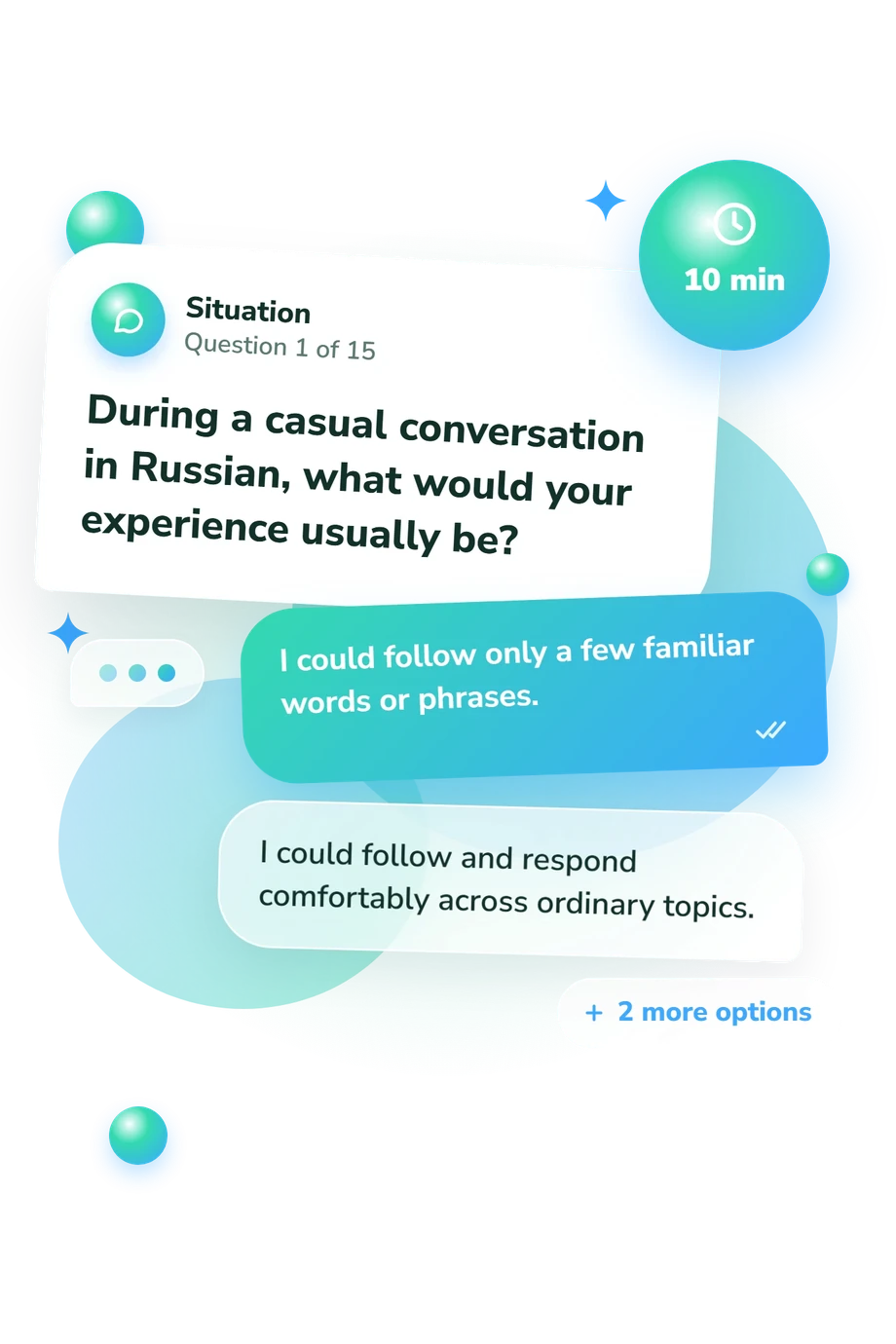
Each item offers four response options describing different levels of experience. Scenarios cover Russian conversation, traditions, family origins, food, community belonging, media, and self-description, encouraging answers grounded in lived context rather than labels. The four response options lead to three separate scale results, with each reported in its displayed named band.
The questionnaire uses an online self-report format, and its themes are conceptually consistent with the three-generation study of Russian-minority acculturation and identity by Galyapina and colleagues, which connects Russian identity and acculturation with generational context. They also align with work by Doucerain and colleagues showing how language and situation can shape cultural identification, and with Demes and Geeraert's treatment of cultural orientations as distinct dimensions. These studies provide conceptual context; they do not establish standardization, norms, or validation for this questionnaire.
The profile is most useful when read comparatively: a Russian cultural connection may be strong while language familiarity is limited, or belonging may be central despite uncertain family evidence. Self-report can be affected by memory, recent contact, and response context; scores cannot verify ancestry, citizenship, or ethnicity.
- V. Galyapina, Nadezhda Lebedeva, and F. van de Vijver (2018). A three-generation study of acculturation and identity of the Russian minority in the Republic of North Ossetia-Alania. Journal of Cross-Cultural Psychology, 49(6), 976-992. 10.1177/0022022118767578
- M. M. Doucerain, A. Medvetskaya, D. Moldoveanu, and A. G. Ryder (2023). Who Are You-Right Now? Cultural Orientations and Language Used as Antecedents of Situational Cultural Identification. Journal of Cross-Cultural Psychology, 54(8), 784-807. 10.1177/00220221231193148
- K. A. Demes and N. Geeraert (2014). Measures Matter: Scales for Adaptation, Cultural Distance, and Acculturation Orientation Revisited. Journal of Cross-Cultural Psychology, 45(1), 91-109. 10.1177/0022022113487590
Updated: