
Are You a Weeb Quiz
How the Scales are Structured
Who Usually Takes This Test?
See How You Compare
Below is a preview of how scores are typically distributed across each scale.
Example Questions From the Test
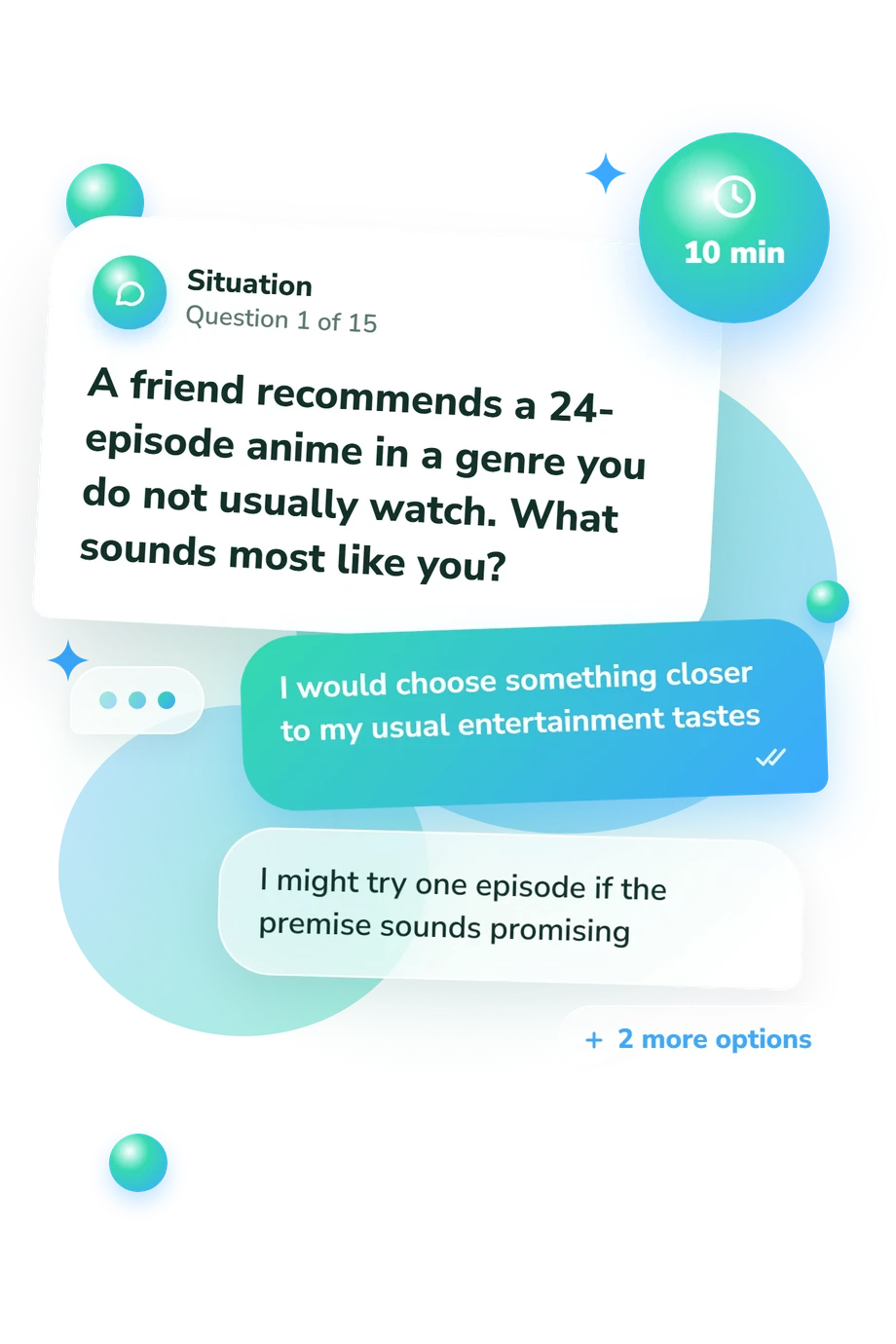
- I would choose something closer to my usual entertainment tastes
- I might try one episode if the premise sounds promising
- I would sample a few episodes before deciding whether to continue
- I would be eager to make room for it and give the story a substantial chance
- It does not really describe how I see myself
- I might accept it as a joke, but I would not normally choose it
- It often feels like a recognizable shorthand for my interests
- I actively use or embrace it as part of my fandom identity
- Rely on the translation and focus on the story
- Look it up if its meaning seems important or interesting
- Check its meaning, pronunciation, and how it is used in context
- Use it as a starting point for continued Japanese-language study
Are You a Weeb Quiz - Description and methodology of the test
People wondering whether anime is occasional or central can use the Are You a Weeb Quiz to examine that distinction without reducing it to a label. It suits someone checking whether their connection is private, socially expressed, or spread across several kinds of involvement. This weeb quiz separates entertainment from social fandom participation, so a higher score in one area need not imply the same pattern elsewhere.
What This Assessment Explores
The questions examine how anime and manga shape entertainment choices, release-following, fan activity, source exploration, and curiosity about Japanese life and culture. Themes create a profile, not a ladder of fan legitimacy: a more pronounced pattern reflects preference, not superiority. This anime fandom quiz distinguishes private enjoyment from social participation. The three dimensions are:
- Anime & Manga Engagement (0-15) reflects how consistently and deeply anime or manga feature in your entertainment habits: Casual Contact (0-5), Regular Interest (6-10), or Deep Engagement (11-15).
- Fandom Participation (0-15) reflects how visibly and socially your interest appears in discussion, creation, collecting, events, or identity: Mostly Private (0-5), Connected Fan (6-10), or Fandom-Forward (11-15).
- Japanese Cultural Curiosity (0-15) reflects whether media interest opens into language, history, places, arts, food, or daily life: Entertainment-Focused (0-5), Context-Curious (6-10), or Sustained Curiosity (11-15).
Methodology and Evidence Base
Each item uses an ordered self-report format: a situation followed by four response options that generally move from limited or private involvement toward more sustained, active, or exploratory engagement. The respondent chooses the description that fits best. Selections feed the three displayed dimensions; because no point value is stated for each option, the displayed profile should be read as the questionnaire's output rather than a scoring rule reconstructed from answer wording.
Themes are conceptually consistent with audience research. Gonçalves, Navio, and Moura examined anime-viewing motivations and engagement; Ray, Plante, Reysen, Roberts, and Gerbasi distinguished personal fanship from social fandom; Iida and Armour linked media consumption with interest in learning Japanese. These studies provide context, not evidence that this questionnaire adapts any one published instrument.
For interpretation, the anime quiz results form a three-dimension engagement profile, not a measure of expertise or identity. The bands describe engagement, participation, and curiosity; current interests, memory, self-awareness, and self-presentation may shape answers. Read differences between dimensions as patterns to consider, not fixed judgments.
- Gonçalves, João, Catarina Navio, and Pedro Moura. (2021). The occidental otaku: Portuguese audience motivations for viewing anime. Convergence: The International Journal of Research into New Media Technologies, 27(1), 247-265. DOI 10.1177/1354856520923966
- Ray, Adam, Courtney N. Plante, Stephen Reysen, Sharon E. Roberts, and Kathleen C. Gerbasi. (2017). Psychological Needs Predict Fanship and Fandom in Anime Fans. The Phoenix Papers: A Journal of Fandom and Neomedia Studies, 3(1), 56-68.
- Iida, Sumiko, and William S. Armour. (2019). The voices of adult anime/'manga' fans in Australia: Motivations, consumption patterns and intentions to learn the Japanese language. East Asian Journal of Popular Culture, 5(1), 7-23. DOI 10.1386/eapc.5.1.7_1
Updated: