
Software Engineer Quiz
How the Scales are Structured
Who Usually Takes This Test?
See How You Compare
Below is a preview of how scores are typically distributed across each scale.
Example Questions From the Test
- Keep service instances stateless where practical and place shared state in an appropriate external store
- Store uploaded files only on one instance's local disk
- Require every request to return to a manually selected server
- Keep each user's session only in the memory of the first instance they contact
- A utility class handles authentication, invoices, email, and database backups
- A module groups closely related invoice-calculation responsibilities
- Every function can directly modify every part of the application state
- One module changes whenever any feature in the system changes
- O(n)
- O(1)
- O(log n)
- O(n log n)
Software Engineer Quiz - Description and methodology of the test
For learners, career changers, and early practitioners, this assessment offers a structured snapshot of foundational engineering judgment rather than a prediction of job performance. The software engineer quiz can help someone weighing a technical path organize study priorities. It is also useful for the question of whether I should become a software engineer, turning a broad career concern into a concrete plan for practice, feedback, and reflection.
What This Assessment Measures
This assessment samples decisions from software development rather than one programming language. Scenarios cover architecture, cohesion, version control, HTTP, observability, security, concurrency, requirements, algorithms, caching, and resilience. It suits people who want to examine practical foundations or choose topics for further study.
A result can inform a reflection on whether I should be a software engineer, but it does not measure personality, motivation, employability, or project history. That keeps the focus on practical engineering judgment.
The items fall into three themes. Software engineering quiz questions ask the respondent to distinguish a robust response from a tempting but weaker alternative.
- Design and architecture show whether the result recognizes cohesion, abstraction, dependencies, and scalable structure.
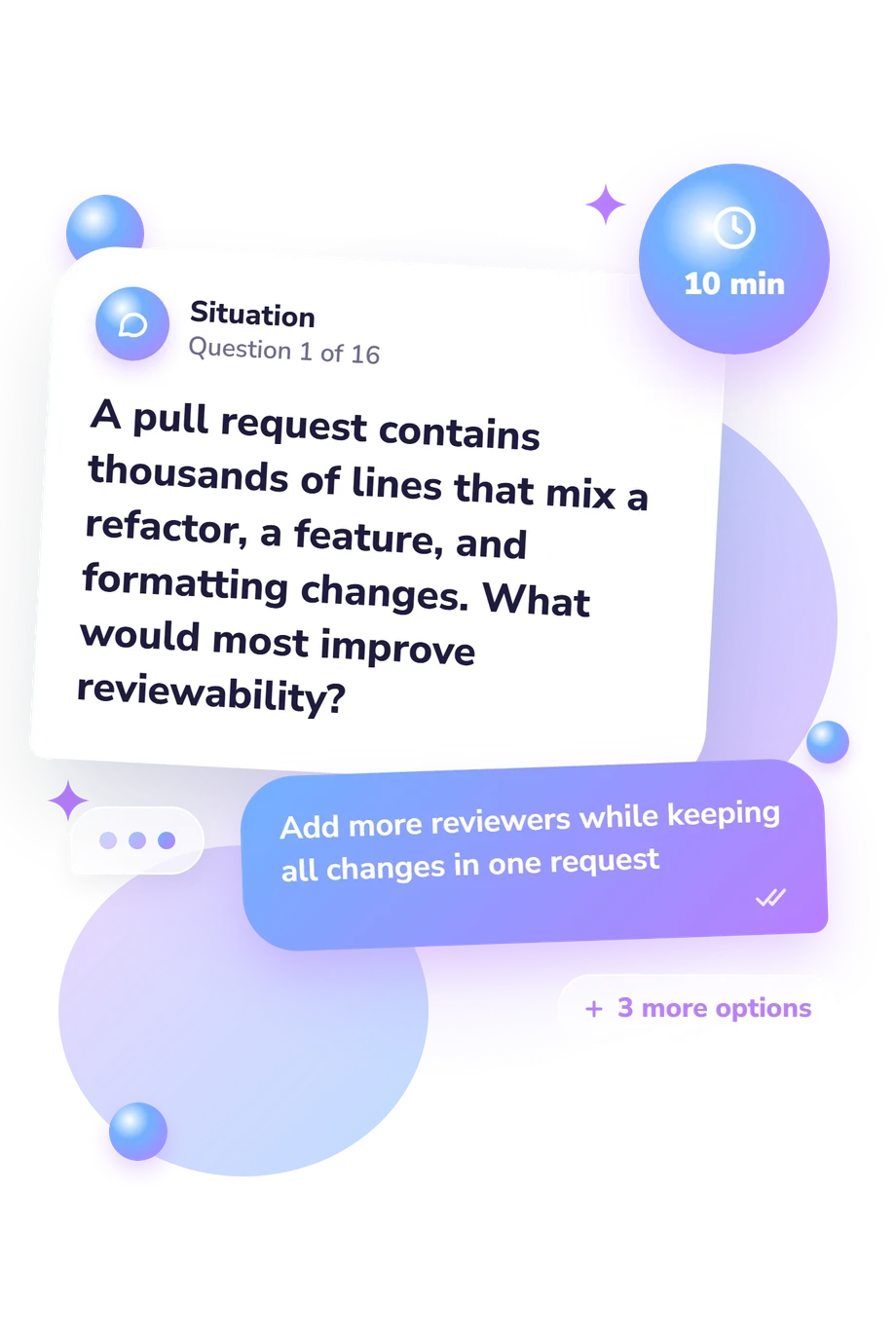
- Testing, delivery, and requirements indicate attention to reviewability, deterministic tests, version control, and measurable goals.
- Security, data, and reliability reveal understanding of safe handling, concurrency, observability, caching, and resilient services.
Methodology and Evidence Base
Each item presents a scenario with four answer choices. The alternatives contrast a sound principle with weaker responses, so the respondent connects a concept to a concrete engineering situation rather than recalls a definition in isolation.
The result aggregates performance as Software Engineering Knowledge: 0-16. The displayed bands are Foundations to build (0-6), Developing knowledge (7-12), and Strong knowledge (13-16). They describe an educational snapshot of foundational decisions and trade-offs, not occupational norms or a professional certification.
Its content is conceptually consistent with UComGSP (Assyne et al., 2022), the related systematic mapping study by Assyne et al. (2022), and the SWEBOK Guide, Version 4.0. It is not an adaptation or validated implementation of these works; they provide a traceable reference for the domains sampled here.
The question of whether I would be a good software engineer is broader than this result. Project work, code review, communication, persistence, and learning habits reveal qualities selected-response items cannot capture.
Because answers depend on familiarity with scenarios and current context, uneven experience can influence performance. Treat the score as a learning prompt for targeted practice rather than a hiring decision.
- Assyne, Nana, Hadi Ghanbari, and Mirja Pulkkinen. "The essential competencies of software professionals: A unified competence framework." Information and Software Technology, vol. 151, 2022, article 107020. 10.1016/j.infsof.2022.107020
- Assyne, Nana, Hadi Ghanbari, and Mirja Pulkkinen. "The state of research on software engineering competencies: A systematic mapping study." Journal of Systems and Software, vol. 185, 2022, article 111183, pp. 1-18. 10.1016/j.jss.2021.111183
- Washizaki, Hironori, ed. Guide to the Software Engineering Body of Knowledge (SWEBOK Guide), Version 4.0. IEEE Computer Society, 2024.
Updated: