
Dream Boyfriend Quiz
How the Scales are Structured
Who Usually Takes This Test?
See How You Compare
Below is a preview of how scores are typically distributed across each scale.
Example Questions From the Test
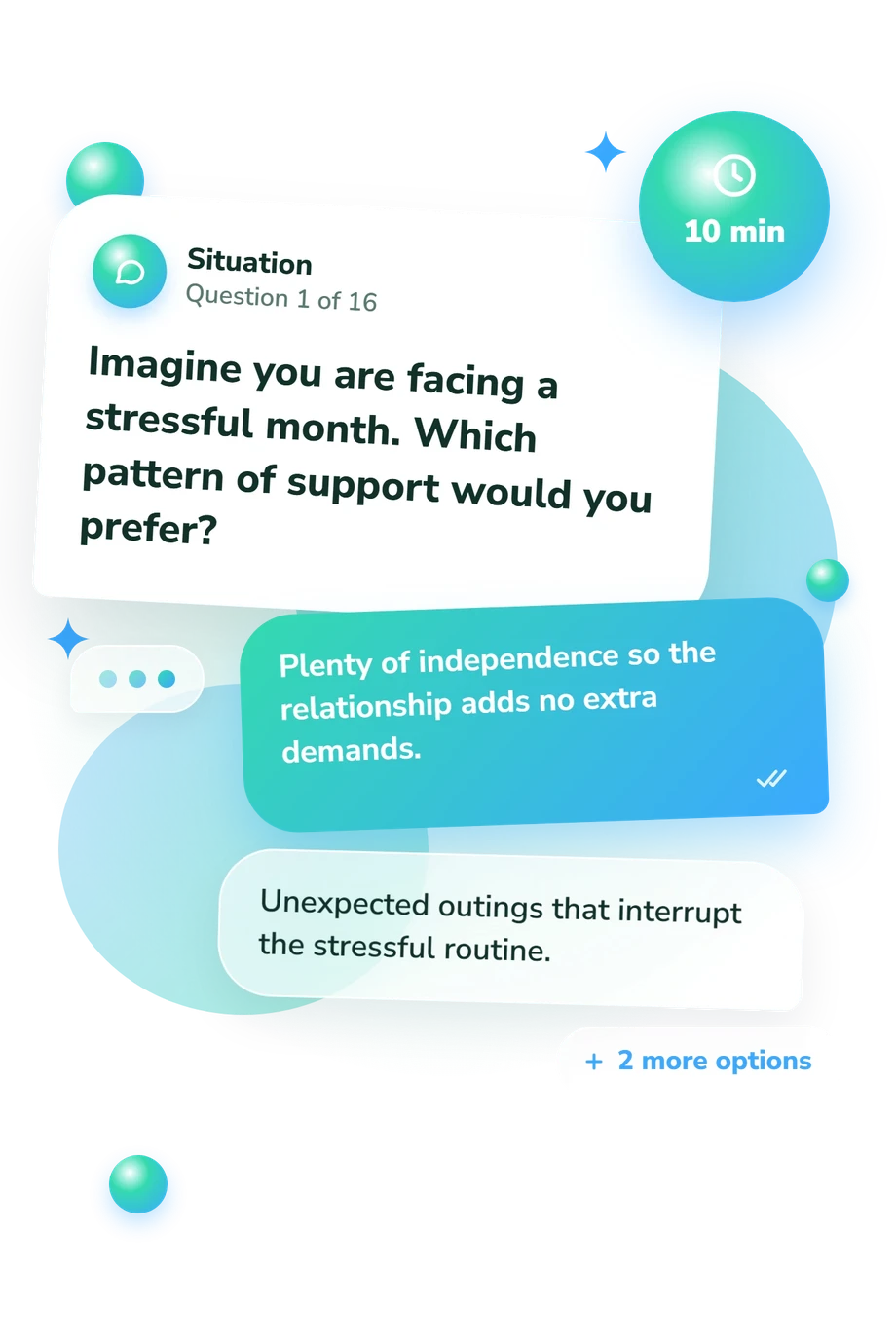
- Plenty of independence so the relationship adds no extra demands.
- Unexpected outings that interrupt the stressful routine.
- A shared plan for handling tasks and deadlines.
- Reliable check-ins and reassurance that he will remain available.
- “I made dinner, and we can enjoy a peaceful night in.”
- “I reserved a table at that dependable place we both like.”
- “There’s a new event tonight—shall we give it a try?”
- “Pack a small bag; I planned a surprise mini-adventure.”
- Suggest returning to the hotel and reorganizing the itinerary.
- Find a similar attraction that preserves the original plan.
- Offer a few unplanned alternatives for us to choose between.
- Treat it as an invitation to wander and see what we discover.
Dream Boyfriend Quiz - Description and methodology of the test
For readers exploring romantic priorities, the Dream Boyfriend Quiz offers a structured way to compare what matters in an ideal relationship rather than reduce attraction to a single type. It turns imagined relationship choices into a personal profile, helping you clarify ideal partner preferences and notice whether shared goals, lively experiences, dependable care, or expressive affection matters most.
What This Assessment Explores
The questionnaire is for people reflecting on romantic preferences, rather than judging a current partner. Its scenarios cover stress, opportunity, disagreement, travel, routines, affection, and shared plans, making the result relevant to romantic compatibility and everyday relationship expectations.
The displayed dimensions are:
- Ambitious Teammate (0-12) measures preference for shared growth and long-term goals: Present-Focused Bond (0-4), Supportive Partnership (5-8), or Ambitious Teammate Affinity (9-12).
- Playful Adventurer (0-12) measures attraction to spontaneity, humor, exploration, and novelty: Familiar-Rhythm Preference (0-4), Curious Companion (5-8), or Playful Adventurer Affinity (9-12).
- Steady Supporter (0-12) measures value placed on consistency, calm communication, and dependable presence: Flexible Connection (0-4), Grounded Preference (5-8), or Steady Supporter Affinity (9-12).
- Thoughtful Romantic (0-12) measures value placed on affectionate expression and meaningful gestures: Understated Affection (0-4), Meaningful Warmth (5-8), or Thoughtful Romantic Affinity (9-12).
Methodology and Evidence Base
Each item presents a relationship situation with four response options. The choices move across different priorities-for example, independence, novelty, practical teamwork, reliable presence, or emotionally expressive affection-so the respondent selects the response that best matches an imagined ideal. The questionnaire then aggregates answers into four scale totals. The highest total represents the strongest affinity; totals within one point are read as a blended result. No answer is treated as universally better; meaning comes from the pattern across choices. The profile describes imagined preferences, not the behavior of a particular partner or relationship.
The framework is conceptually consistent with Fletcher et al. (1999), whose work examines how people organize standards for close partners, and with Fletcher and Simpson’s account of ideal standards. The playful-novelty dimension also sits alongside findings from Aron et al. (2000) on shared novel activities and relationship quality. The questionnaire is conceptually consistent with these works, but it is not an adaptation or validation of those studies. Its ideal relationship standards are interpreted through the displayed bands rather than population norms. Because answers are self-reported, current mood, relationship history, and self-presentation can shape the profile; use it for reflection and conversation, not diagnosis.
- Fletcher, Garth J. O., Jeffry A. Simpson, Geoff Thomas, and Louise Giles. "Ideals in Intimate Relationships." Journal of Personality and Social Psychology 76, no. 1 (1999): 72-89. 10.1037/0022-3514.76.1.72
- Fletcher, Garth J. O., and Jeffry A. Simpson. "Ideal Standards in Close Relationships: Their Structure and Functions." Current Directions in Psychological Science 9, no. 3 (2000): 102-105. 10.1111/1467-8721.00070
- Aron, Arthur, Christina C. Norman, Elaine N. Aron, Colin McKenna, and Richard E. Heyman. "Couples' Shared Participation in Novel and Arousing Activities and Experienced Relationship Quality." Journal of Personality and Social Psychology 78, no. 2 (2000): 273-284. 10.1037/0022-3514.78.2.273
Updated: