
Cosmetology or Esthetician Quiz
How the Scales are Structured
Who Usually Takes This Test?
See How You Compare
Below is a preview of how scores are typically distributed across each scale.
Example Questions From the Test
- To determine the client's natural skin pH with complete accuracy
- To guarantee that no allergic response can occur during the full service
- To screen for a possible sensitivity or reaction by following the manufacturer's directions
- To measure how long the finished cosmetic effect will last
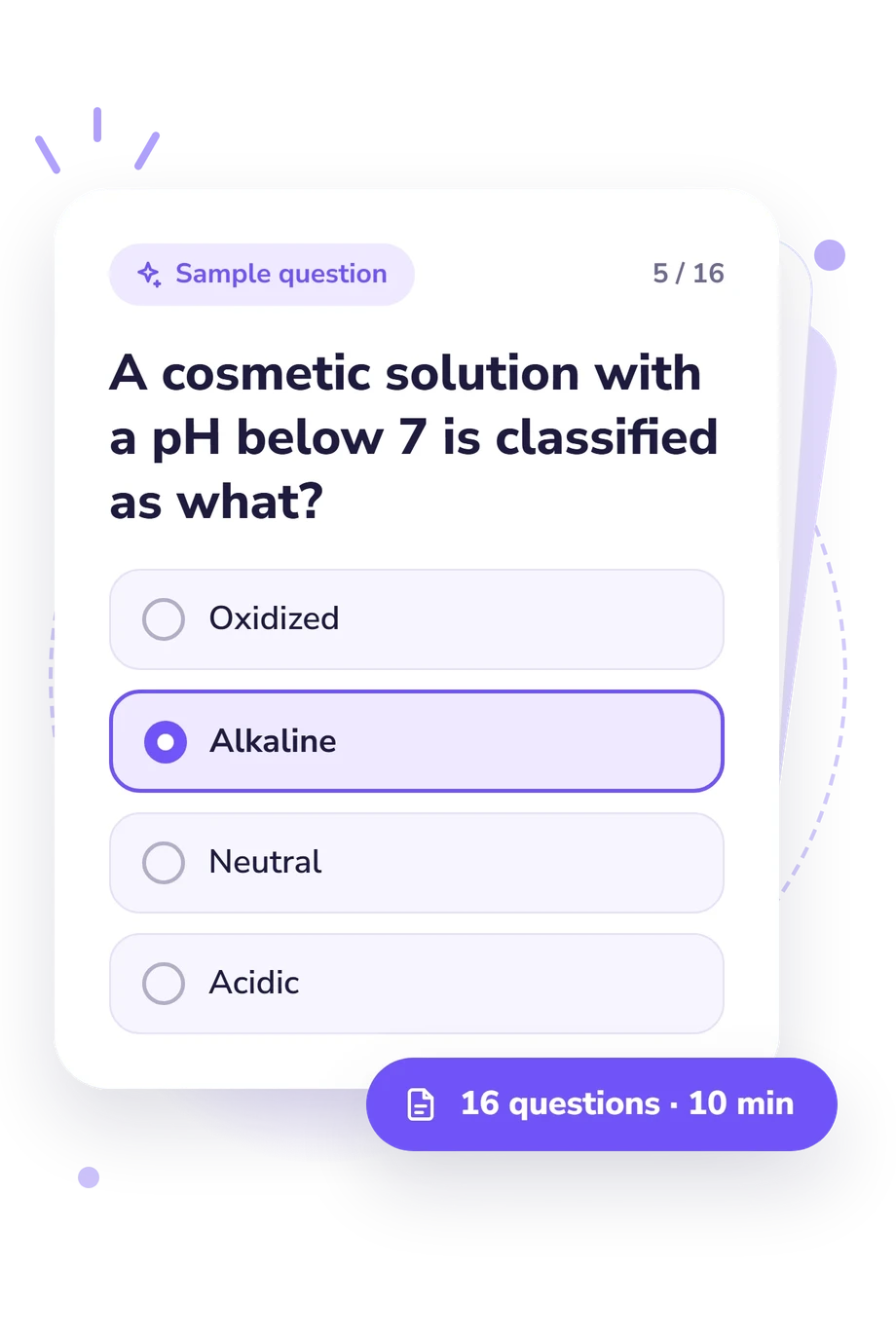
- Oxidized
- Alkaline
- Neutral
- Acidic
- The medulla
- The cortex
- The cuticle
- The follicle
Cosmetology or Esthetician Quiz - Description and methodology of the test
People weighing a future in salon or skincare services can use this assessment to examine the practical knowledge behind each path. The cosmetology or esthetician quiz focuses on everyday decisions rather than personality or career prediction. Readers considering a Should I Be a Cosmetologist Quiz can use it to compare familiarity with hair-service concepts, skin care, sanitation, and professional boundaries and identify training content for further exploration.
What This Assessment Explores
Questions focus on foundational knowledge used when comparing the two routes. They cover hair and skin services, pH, consultation details, contraindications, scope of practice, exposure control, and the difference between reusable and single-use implements. The result reflects recognition of common principles and safer professional decisions, not a prediction of talent, creativity, or job satisfaction.
Anyone considering a Should I Be an Esthetician Quiz can use the skin-care items to see which concepts feel familiar and which deserve further study; the result identifies knowledge areas, not personal suitability.
Its single displayed scale is Cosmetology and Esthetics Knowledge (0-16). Foundation Building covers 0-6, Developing Knowledge covers 7-12, and Strong Knowledge covers 13-16; these bands describe educational progress, not professional competence or licensure.
Methodology and Scientific Basis
Each item presents a practical scenario or knowledge question with four answer choices. Respondents choose the option that best fits safety, scope, sanitation, or basic theory. The result is one educational score; answer weights are not specified.
Its coverage is conceptually consistent with NIC Cosmetology Theory Examination CIB (2022) and NIC Esthetics Theory Examination CIB (2020), covering safety, sanitation, services, and professional responsibilities. It also aligns with Milady’s foundations text and Popalyar et al.’s (2019) infection-prevention study, but is not adapted from or validated by them.
The main content groups are:
- Hair and skin fundamentals cover anatomy, pH, inspection, and service principles.
- Consultation and contraindications show when client information should change a service.
- Scope of practice separates cosmetic care from diagnosis or treatment outside the role.
- Sanitation and exposure control assess barriers, disinfection, disposal, and incident response.
This questionnaire gives an educational score for the knowledge. It can guide study and compare interests with training content as a cosmetology versus esthetics quiz. Results vary with exposure, attention, guessing, and context; rules and product directions govern practice, while training develops skills.
- National-Interstate Council of State Boards of Cosmetology, Inc. (2022). National Cosmetology Theory Examination Candidate Information Bulletin (CIB): Examination Content and Important Instructions. NIC.
- National-Interstate Council of State Boards of Cosmetology, Inc. (2020). National Esthetics Theory Examination Candidate Information Bulletin (CIB). NIC.
- Doyle, Jeanna, Nielsen, Mary, Sarfati, Lydia, Schlaiss, Jean, and Todd, Laura. (2020). Milady Standard Foundations with Standard Esthetics: Fundamentals (12th ed.). Cengage Learning. ISBN 9780357263792.
- Popalyar, A., Stafford, J., Ogunremi, T., and Dunn, K. (2019). Infection prevention in personal services settings: Evidence, gaps and the way forward. Canada Communicable Disease Report, 45(1), 1-11. 10.14745/ccdr.v45i01a01
Updated: