
Should I Give Him Another Chance Quiz
How the Scales are Structured
Who Usually Takes This Test?
See How You Compare
Below is a preview of how scores are typically distributed across each scale.
Example Questions From the Test
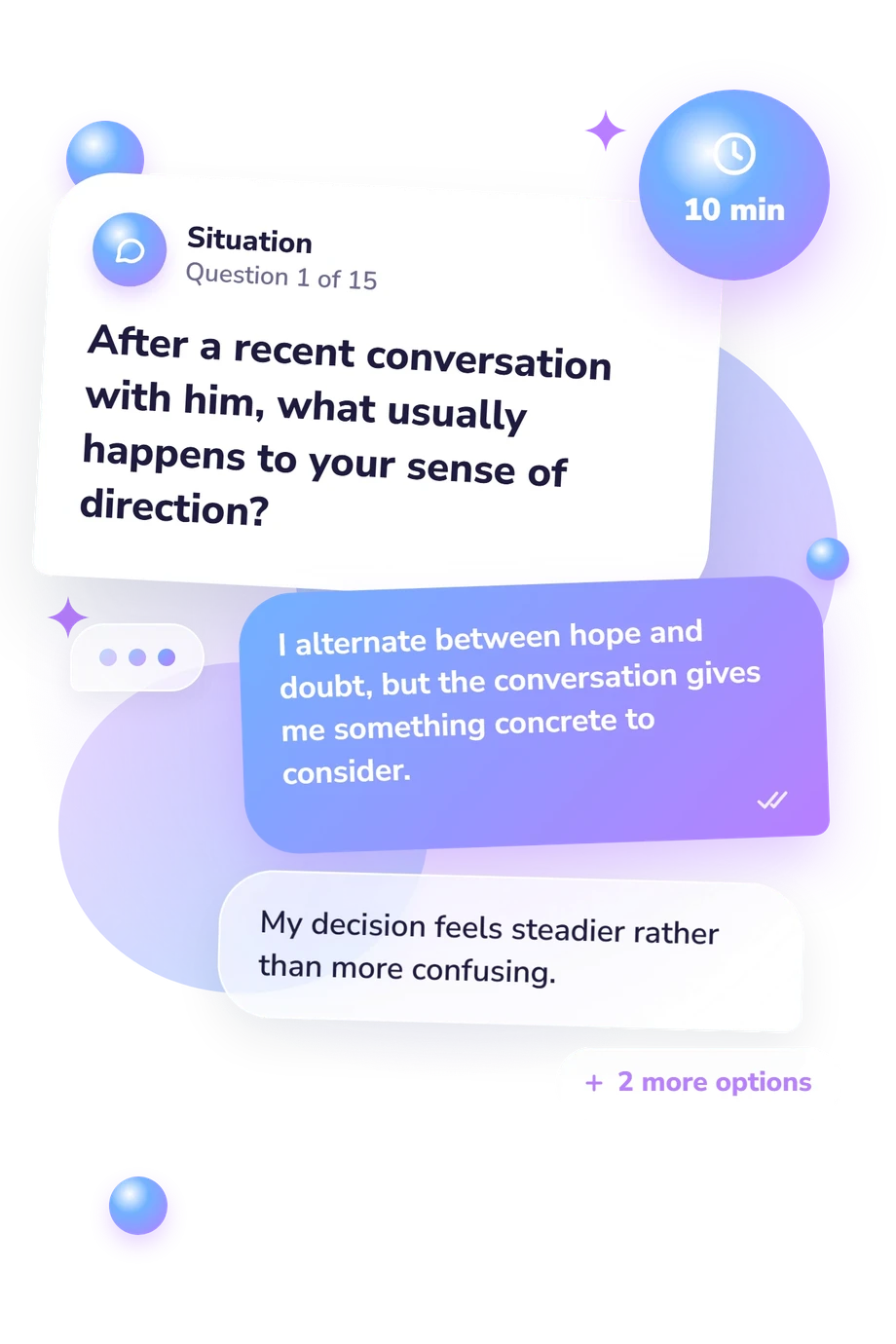
- I alternate between hope and doubt, but the conversation gives me something concrete to consider.
- My decision feels steadier rather than more confusing.
- I feel pulled in opposite directions and need quiet before I can hear my own judgment.
- I remain somewhat uncertain, but I can identify which way I am leaning.
- Nothing he could say now would restore my desire to try again.
- He clearly names the harm, accepts responsibility, and has already shown consistent change.
- I would need time away before deciding whether any apology feels meaningful.
- His words matter, but I would need to see matching actions over time.
- He would probably listen, though we might need several conversations to agree on the details.
- I do not want to reopen negotiations about the relationship.
- I expect respectful discussion and genuine follow-through from both of us.
- I cannot yet predict his response, so I would rather observe from a distance.
Should I Give Him Another Chance Quiz - Description and methodology of the test
Anyone weighing renewed contact can use the Should I Give Him Another Chance Quiz to sort feelings, evidence, and personal limits before choosing a direction. It is intended for a person facing mixed signals after a breakup, especially when hope, grief, pressure, and caution compete. A should i give my ex another chance quiz can frame the same decision around whether returning would support present wellbeing.
What This Assessment Explores
Questions examine how contact, distance, apologies, boundaries, conflict, and imagined futures affect judgment. They also ask about pressure, guilt, emotional capacity, and whether promised change appears in sustained behavior. The result therefore reflects decision conditions, not chemistry or longing alone.
These three dimensions describe the directions your answers currently support:
- Move On (0-15) shows affinity with leaving: Limited Pull to Leave (0-5), Meaningful Reasons to Leave (6-10), or Strong Moving-On Affinity (11-15).
- Pause and Reassess (0-15) indicates the pull toward space: Direction Already Forming (0-5), Useful Breathing Room (6-10), or Strong Pause Affinity (11-15).
- Rebuild Together (0-15) reflects openness to trying again: Limited Pull to Rebuild (0-5), Conditional Openness (6-10), or Strong Rebuilding Affinity (11-15).
The profile helps compare desire, safety, evidence, and capacity before acting. The question behind a should i give him a second chance quiz is broader than whether feelings remain.
Methodology and Scientific Basis
Each item presents a relationship situation with four response options. Choices vary by certainty, readiness, emotional capacity, expected change, or evidence needed before acting. Responses are grouped into three displayed scores: the highest is the strongest affinity, while scores within one point of it form a blended result rather than a single instruction.
Dailey et al. (2011) links returning relationships with lingering attachment, uncertainty, and perceived improvement. Tomlinson et al. (2004) connects willingness to reconcile after a broken promise with apology quality, reparative action, sincerity, relationship history, and expectations about future behavior. Joel et al. (2021) associates ambivalence about staying or leaving with day-to-day shifts in commitment and plans to end the relationship.
The questionnaire is conceptually consistent with these findings, not an adaptation of any one instrument. It is an online self-reflection questionnaire rather than a standardized scale, so its bands are interpretive labels rather than population norms. Self-report can also reflect current context, self-awareness, and response bias. The second chance relationship quiz is best read as a snapshot: coercion, stalking, threats, intimidation, or physical harm override the totals and warrant safety planning and outside support.
- Rene M. Dailey, Borae Jin, Abigail Pfiester, and Gary Beck (2011). On-Again/Off-Again Dating Relationships: What Keeps Partners Coming Back? Journal of Social Psychology, 151(4), 417-440. 10.1080/00224545.2010.503249
- Edward C. Tomlinson, Brian R. Dineen, and Roy J. Lewicki (2004). The Road to Reconciliation: Antecedents of Victim Willingness to Reconcile Following a Broken Promise. Journal of Management, 30(2), 165-187. 10.1016/j.jm.2003.01.003
- Samantha Joel, Sarah C. E. Stanton, Elizabeth Page-Gould, and Geoff MacDonald (2021). One Foot Out the Door: Stay/Leave Ambivalence Predicts Day-to-Day Fluctuations in Commitment and Intentions to End the Relationship. European Journal of Social Psychology, 51(2), 294-312. 10.1002/ejsp.2739
Updated: