
Dorm Room Aesthetic Quiz
How the Scales are Structured
Who Usually Takes This Test?
See How You Compare
Below is a preview of how scores are typically distributed across each scale.
Example Questions From the Test
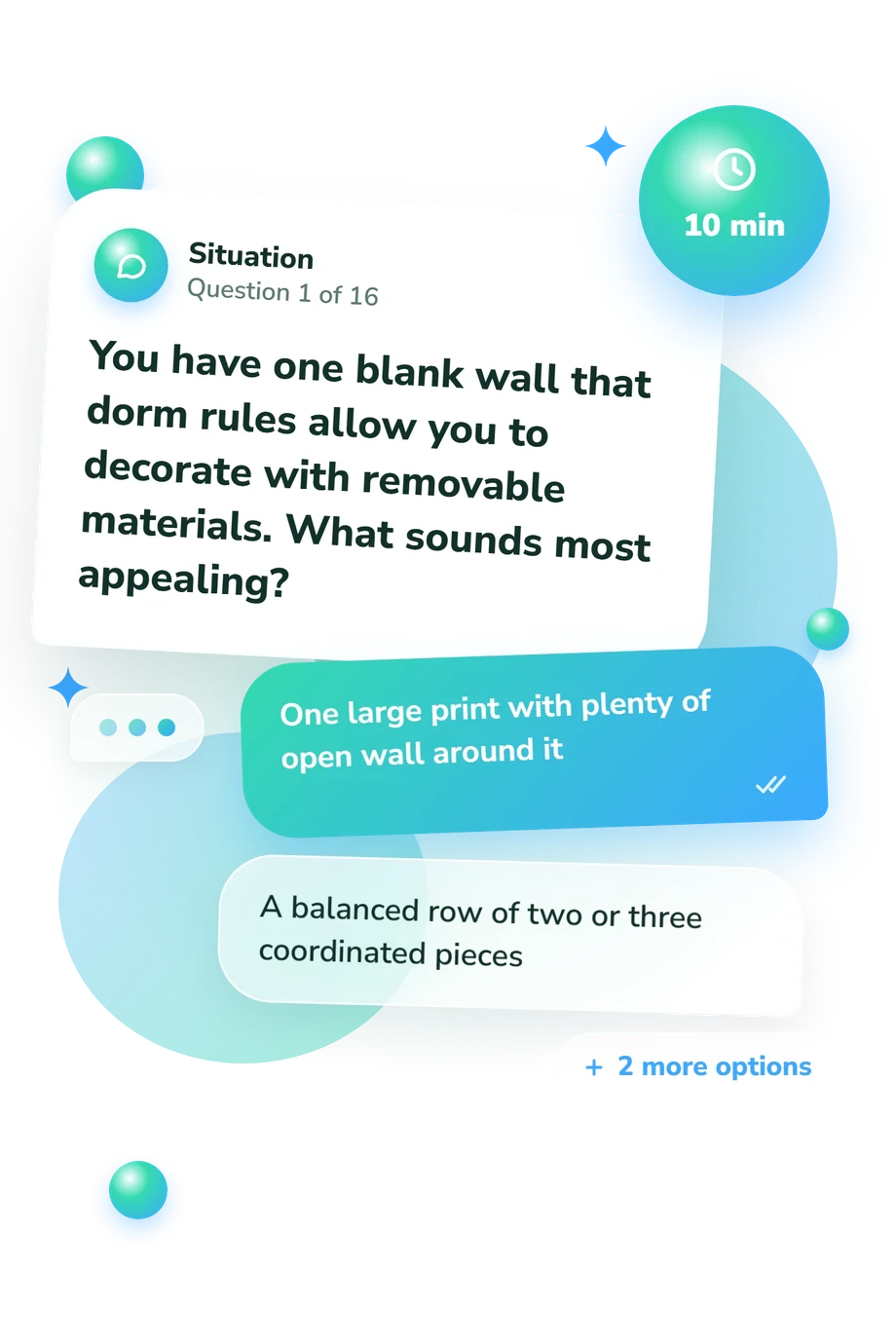
- One large print with plenty of open wall around it
- A balanced row of two or three coordinated pieces
- A varied gallery of prints, photos, postcards, and small keepsakes
- A compact gallery wall using different images within one color story
- Leave it because maintaining a consistent palette matters most
- Buy it only if I can change another item to make it coordinate
- Use it as an unexpected accent among mostly coordinated pieces
- Take it home and let the contrast add character to the room
- Crisp solid bedding with a smooth, streamlined finish
- Layered linen-look fabrics in cream, sage, clay, or warm beige
- A soft neutral set with one knitted or woven accent
- A graphic or patterned set that becomes the room's focal point
Dorm Room Aesthetic Quiz - Description and methodology of the test
Students and renters who want a room that feels intentional can use this dorm room quiz to clarify the decorating instincts behind their choices. The dorm room aesthetic quiz connects preferences for color, texture, display, storage, and atmosphere with four visual profiles. It suits anyone planning a small shared space and seeking a practical starting point, not a fixed decorating rule.
What This Assessment Explores
The questionnaire explores how someone responds to visual warmth, order, layering, history, and nature-inspired detail. Scenarios cover decor, patterns, lighting, bedding, shelving, storage, and study atmosphere. It therefore works as a dorm room color schemes quiz while treating palette as one part of the profile.
These dimensions describe:
- Cozy Natural (0-12) measures warm light, tactile fabrics, gentle colors, and nature details: Different Direction (0-4), Natural Touches (5-8), Cozy Natural Match (9-12).
- Eclectic Maximalist (0-12) measures layered patterns, vivid color, expressive displays, and story-rich objects: Visually Reserved (0-4), Curated Expression (5-8), Eclectic Maximalist Match (9-12).
- Minimal Modern (0-12) measures clean lines, controlled color, concealed storage, and intentional accents: More Is Welcome (0-4), Selectively Simple (5-8), Minimal Modern Match (9-12).
- Vintage Academic (0-12) measures warm wood, classic patterns, old-world details, and study atmosphere: Contemporary Leaning (0-4), Classic Accents (5-8), Vintage Academic Match (9-12).
Methodology and Scientific Basis
Each item presents a familiar dorm situation-arranging a wall, choosing bedding, managing storage, or combining patterns-followed by four response choices. The options express competing preferences, so no answer is treated as correct.
Scoring is descriptive across the four dimensions. The strongest score marks the clearest affinity, while scores within one point indicate a blend. Used as a design your dorm room quiz, the result can guide choices about lighting, textiles, storage, and displays.
The questionnaire is conceptually consistent with Lee and Park (2013), which links personality differences with housing and interior-design needs. Cook and Furnham (2012) connects aesthetic preferences with personality, while Wilson and Mackenzie (2000) addresses impressions formed from domestic interiors. It is not an adaptation of those studies.
Online scoring is descriptive rather than norm-referenced, so it does not establish standardized personality scores or clinical cutoffs. As a dorm color scheme quiz, it also cannot account fully for mood, budget, furniture, current context, or self-report bias; use the profile as a flexible design prompt.
- Lee, Heon-Ju, and Soo-Been Park. 2013. "Study on Users’ Housing and Interior Design Needs Affected by Personality Types." Journal of the Korean Institute of Interior Design 22 (6): 88-97.
- Cook, Richard, and Adrian Furnham. 2012. "Aesthetic Preferences for Architectural Styles Vary as a Function of Personality." Imagination, Cognition and Personality 32 (2): 103-114. 10.2190/IC.32.2.b
- Wilson, Margaret A., and Nicola E. Mackenzie. 2000. "Social Attributions Based on Domestic Interiors." Journal of Environmental Psychology 20 (4): 343-354. 10.1006/jevp.2000.0181
Updated: