
Am I Jewish Quiz
How the Scales are Structured
Who Usually Takes This Test?
See How You Compare
Below is a preview of how scores are typically distributed across each scale.
Example Questions From the Test
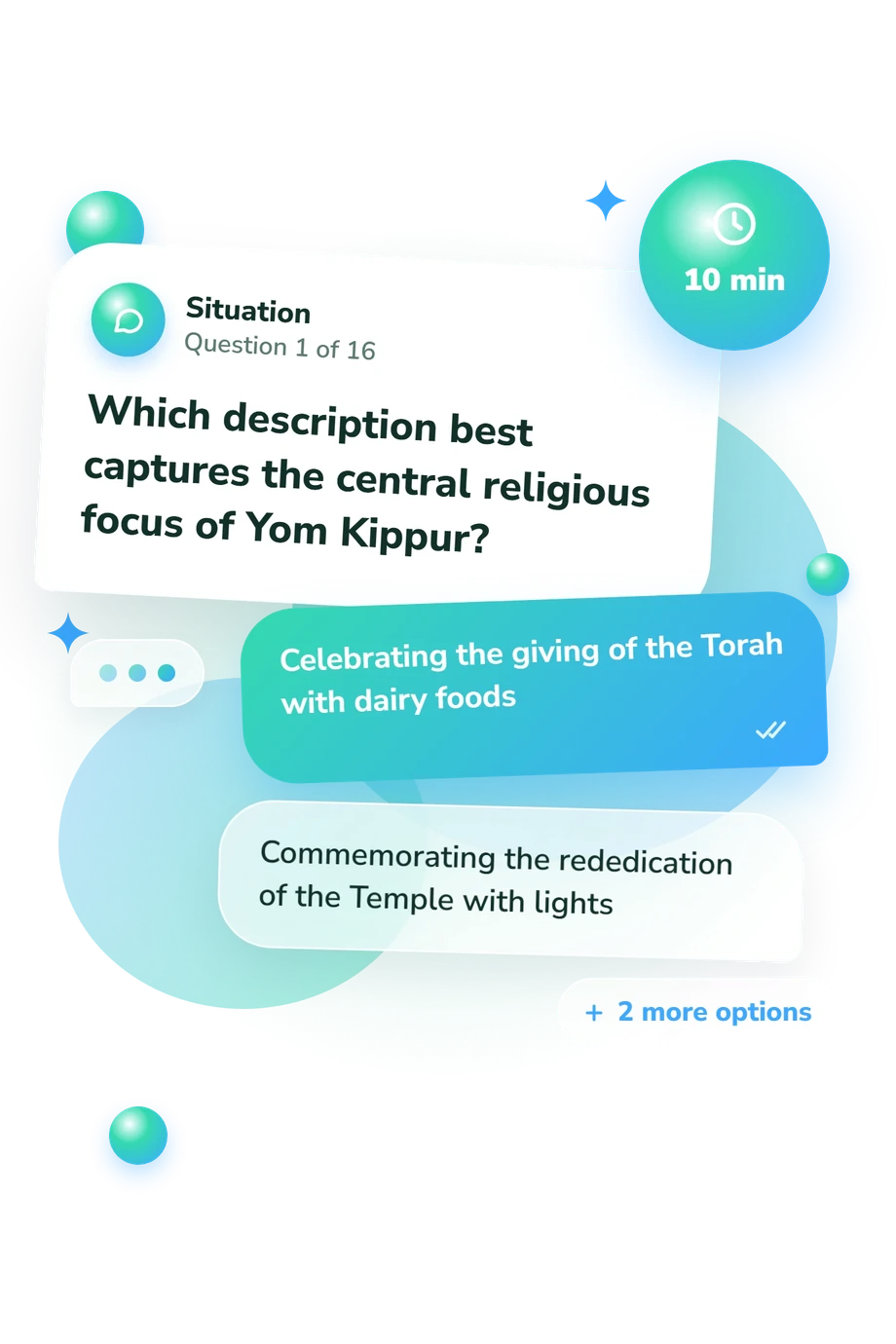
- Celebrating the giving of the Torah with dairy foods
- Commemorating the rededication of the Temple with lights
- Retelling the Exodus through a ceremonial meal
- Repentance, atonement, prayer, and traditionally fasting
- The creation of the world
- The return from Babylonian exile
- The victory associated with Purim
- The Exodus from slavery in Egypt
- The Mourner’s Kaddish
- The Shema
- Kol Nidrei
- The Four Questions
Am I Jewish Quiz - Description and methodology of the test
For readers who want a grounded way to explore what they know about Jewish life, Am I Jewish Quiz separates factual familiarity from questions of belonging or status. It works as a Jewish knowledge quiz for learners, curious visitors, and people reflecting on how traditions are understood. Taking it can help someone test recall across familiar material and choose subjects for further reading.
What This Assessment Measures
Rather than deciding whether someone is Jewish, the questionnaire checks recognition of religious, cultural, and historical concepts. For learners, this Jewish knowledge test offers a way to review Jewish life. Its result reflects answers to Jewish knowledge questions and does not establish Jewish identity or status.
Its questions cover three broad areas:
- Holidays and calendar knowledge shows familiarity with Passover, Yom Kippur, Shabbat, and Hebrew dates.
- Texts, practices, and objects show recognition of the Torah, Shema, mezuzah, mourning customs, kashrut, and Hanukkah.
- History and community knowledge shows recognition of the Diaspora and varied Jewish movements and practices.
The result is Jewish Knowledge: 0-16, with Foundations to Build (0-6), Developing Knowledge (7-12), and Strong Knowledge (13-16). These bands describe tested knowledge, not Jewish identity or status.
Methodology and Evidence Base
Each item presents a short scenario or direct knowledge question with four answer choices. Respondents select the best answer, so the format tests recognition between related concepts rather than an open-ended account of belief or practice.
The questionnaire reports one displayed knowledge result. Its scoring does not state how many points an individual answer contributes. In practical terms, this Jewish traditions quiz checks factual recall rather than identity or belonging.
Its structure is conceptually consistent with the U.S. Religious Knowledge Survey (2019), which uses general religion questions to assess factual knowledge. It also aligns with Karimi, Hjelm, and Äystö’s 2026 work on religious literacy, but is not presented as an adaptation of either source. Pew’s 2020 study of Jewish Americans adds context about varied affiliation, practice, and community life.
As a self-administered factual knowledge questionnaire, it is not a standardized measure of Jewish status. Results may reflect education, prior exposure, language, and current attention as well as knowledge; identity questions require context beyond a factual score.
- Pew Research Center. What Americans Know About Religion. Pew Research Center, July 23, 2019.
- Karimi, Zeinab, Titus Hjelm, and Tuomas Äystö. “Measuring religious literacy: towards building an instrument.” British Journal of Religious Education, published online July 30, 2026, 18 pages. 10.1080/01416200.2026.2706081.
- Pew Research Center. Jewish Americans in 2020. Pew Research Center, May 11, 2021.
Updated: