
6 Second ECG Quiz
How the Scales are Structured
Who Usually Takes This Test?
See How You Compare
Below is a preview of how scores are typically distributed across each scale.
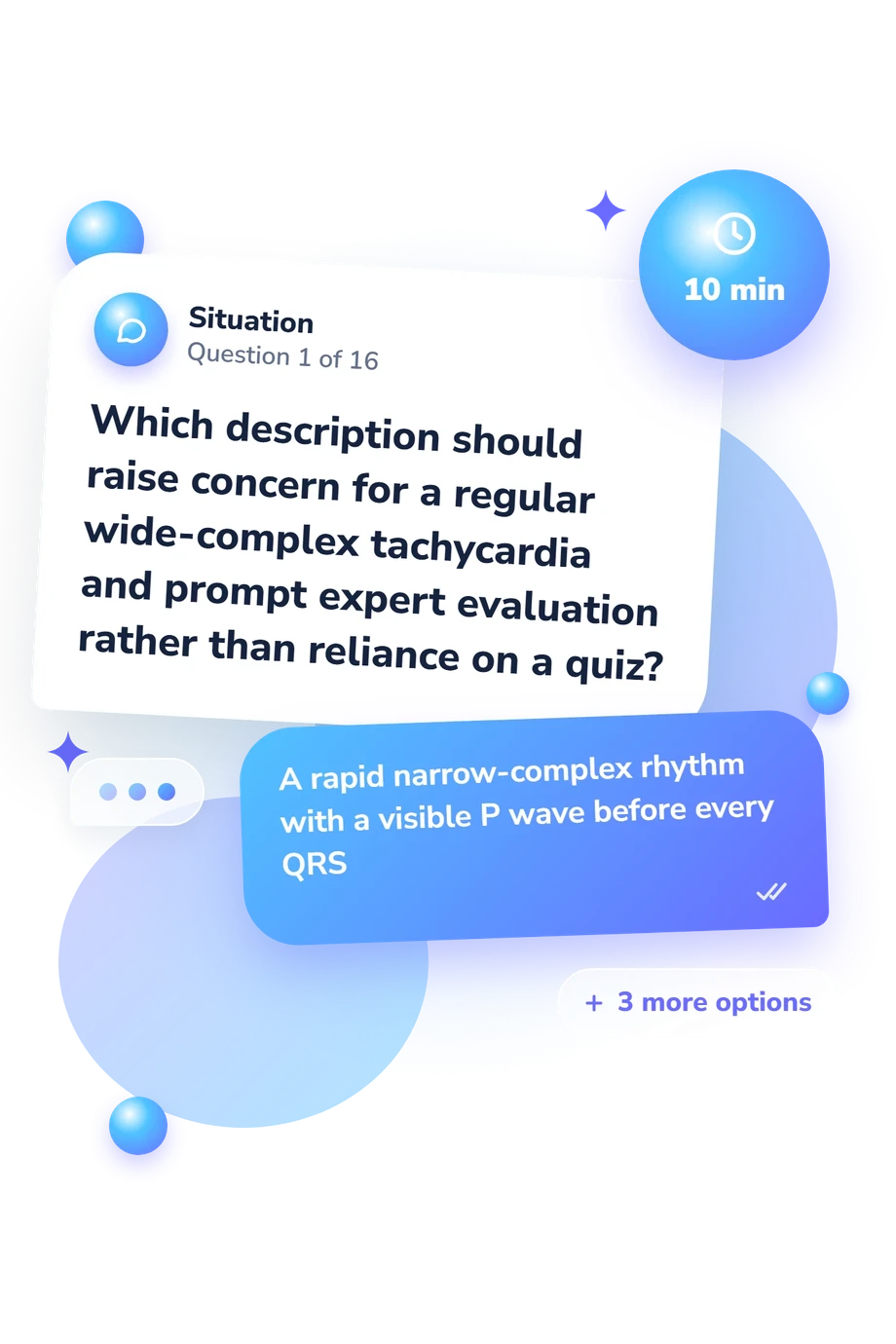
Example Questions From the Test
- 90 beats per minute
- 81 beats per minute
- 100 beats per minute
- 54 beats per minute
- 50 beats per minute
- 30 beats per minute
- 60 beats per minute
- 75 beats per minute
- The exact rate of every individual cardiac cycle
- An estimate of the average ventricular rate during that sample
- The atrial rate, regardless of which waves were counted
- The longest R–R interval converted into a rate
6 Second ECG Quiz - Description and methodology of the test
People learning basic ECG reading can use this assessment to check whether core rhythm concepts are becoming usable rather than merely familiar. The questions identify review needs in ECG rate calculation, rhythm description, intervals, conduction, artifacts, and responses to concerning symptoms. That focus can guide the next stage of practice. The 6 Second ECG Quiz suits students, trainees, and curious readers seeking a focused knowledge check.
What This Assessment Explores
Basic ECG literacy is central. Items translate paper speed, intervals, P waves, QRS complexes, and R-R timing into a defensible strip description. The questions test ECG rhythm interpretation: regularity, rhythm clues, and the limits of calculation when symptoms or an uncertain tracing are present.
The following themes are components of the single educational knowledge score:
- Rate calculation shows whether you can estimate ventricular rate from a timed strip and understand the estimate.
- Rhythm recognition tests links among regularity, atrial activity, ventricular timing, and descriptions such as atrial fibrillation.
- Intervals and conduction examine PR duration, QRS width, and atrial-ventricular relationships.
- Artifacts and symptom context show whether you can separate movement distortion from rhythm change and recognize when calculation should not guide a concerning situation.
Results use 6-Second ECG Knowledge, scored 0-16: Foundations to build (0-6), Developing knowledge (7-12), and Strong knowledge (13-16).
Methodology and Scientific Basis
In practice, this six-second ECG quiz uses text-described strip scenarios with four answer choices. It asks for the best interpretation or calculation, so performance depends on applying relationships rather than recalling isolated definitions. Topics include the Six-Second ECG method (Barill, 2012), timed QRS counting, 25 mm/s measurements, conduction, artifacts, supraventricular rhythms, and atrial fibrillation.
This test is an online questionnaire, not a reproduction or adaptation of a published instrument; its content is conceptually consistent with Barill’s method and the 2009 AHA/ACCF/HRS recommendations for QRS and intraventricular conduction, while rhythm-safety distinctions are consistent with the 2015 ACC/AHA/HRS supraventricular tachycardia guideline and the 2023 ACC/AHA/ACCP/HRS atrial fibrillation guideline.
The scoring output is educational rather than norm-referenced, so the bands function as study guidance rather than population-based cutoffs. The displayed score is unvalidated and cannot diagnose or clear a tracing; text-only examples differ from real ECG review, results can be affected by prior instruction and attention, and concerning symptoms or findings require professional review, with urgent help needed for severe symptoms.
- Barill, Tracy. The Six Second ECG: A Practical Guide to Basic and 12 Lead ECG Interpretation. SkillStat Learning Inc., 2012. ISBN 978-0-9864723-0-5.
- Surawicz, Borys, Rory Childers, Barbara J. Deal, and Leonard S. Gettes. AHA/ACCF/HRS Recommendations for the Standardization and Interpretation of the Electrocardiogram: Part III: Intraventricular Conduction Disturbances: A Scientific Statement from the American Heart Association Electrocardiography and Arrhythmias Committee, Council on Clinical Cardiology; the American College of Cardiology Foundation; and the Heart Rhythm Society. Circulation. 2009;119(10):e235-e240. 10.1161/CIRCULATIONAHA.108.191095.
- Page, Richard L., Jose A. Joglar, Mary A. Caldwell, et al. 2015 ACC/AHA/HRS Guideline for the Management of Adult Patients With Supraventricular Tachycardia: A Report of the American College of Cardiology/American Heart Association Task Force on Clinical Practice Guidelines and the Heart Rhythm Society. Circulation. 2016;133(14):e506-e574. 10.1161/CIR.0000000000000311.
- Joglar, Jose A., Mina K. Chung, Anastasia L. Armbruster, et al. 2023 ACC/AHA/ACCP/HRS Guideline for the Diagnosis and Management of Atrial Fibrillation: A Report of the American College of Cardiology/American Heart Association Joint Committee on Clinical Practice Guidelines. Circulation. 2024;149(1):e1-e156. 10.1161/CIR.0000000000001193.
Updated: