
Yes or No Quiz
How the Scales are Structured
Who Usually Takes This Test?
See How You Compare
Below is a preview of how scores are typically distributed across each scale.
Example Questions From the Test
- It combines two qualities that may deserve different answers.
- It uses a past-tense verb.
- It should assume that checkout was easy.
- It needs more positive wording.
- As missing or unanswered data, distinct from No.
- As No, because nothing was selected.
- As Yes, because the respondent saw the question.
- As half Yes and half No.
- The person understands the choice and can decide voluntarily.
- The preferred answer is emphasized repeatedly.
- Silence is automatically recorded as agreement.
- The person is given only a few seconds to decide.
Yes or No Quiz - Description and methodology of the test
Readers who design surveys, interpret forms, or want to sharpen everyday binary reasoning can use this yes/no quiz to inspect how they handle clear wording and logical conditions. The yes or no quiz helps them decide whether to revise question wording, check logical conditions, or study response design. Its focus is educational: it does not measure personality or general intelligence. The result links these skills to practical wording and logic practice.
What This Assessment Explores
This assessment examines how a person interprets yes/no wording in survey and rule-based situations. The items reward attention to what a prompt actually asks rather than guessing from tone. The result shows recognition of clear structure, ambiguity, and limits in binary answers.
Questions sample three practical areas:
- Wording and focus show whether you avoid double negatives, loaded phrasing, combined qualities, and hidden assumptions.
- Logical conditions show whether you apply if/only-if rules, universal claims, and counterexamples.
- Response design shows whether you distinguish missing answers, voluntary nonresponse, binary choices, and rating scales.
The scale, Yes or No Knowledge (0-16), counts correct answers. Foundations to build (0-6) signals recognition with gaps; Developing knowledge (7-12) signals many correct judgments with room to sharpen wording and inference; Strong knowledge (13-16) signals understanding of binary questions and response design.
Methodology and Scientific Basis
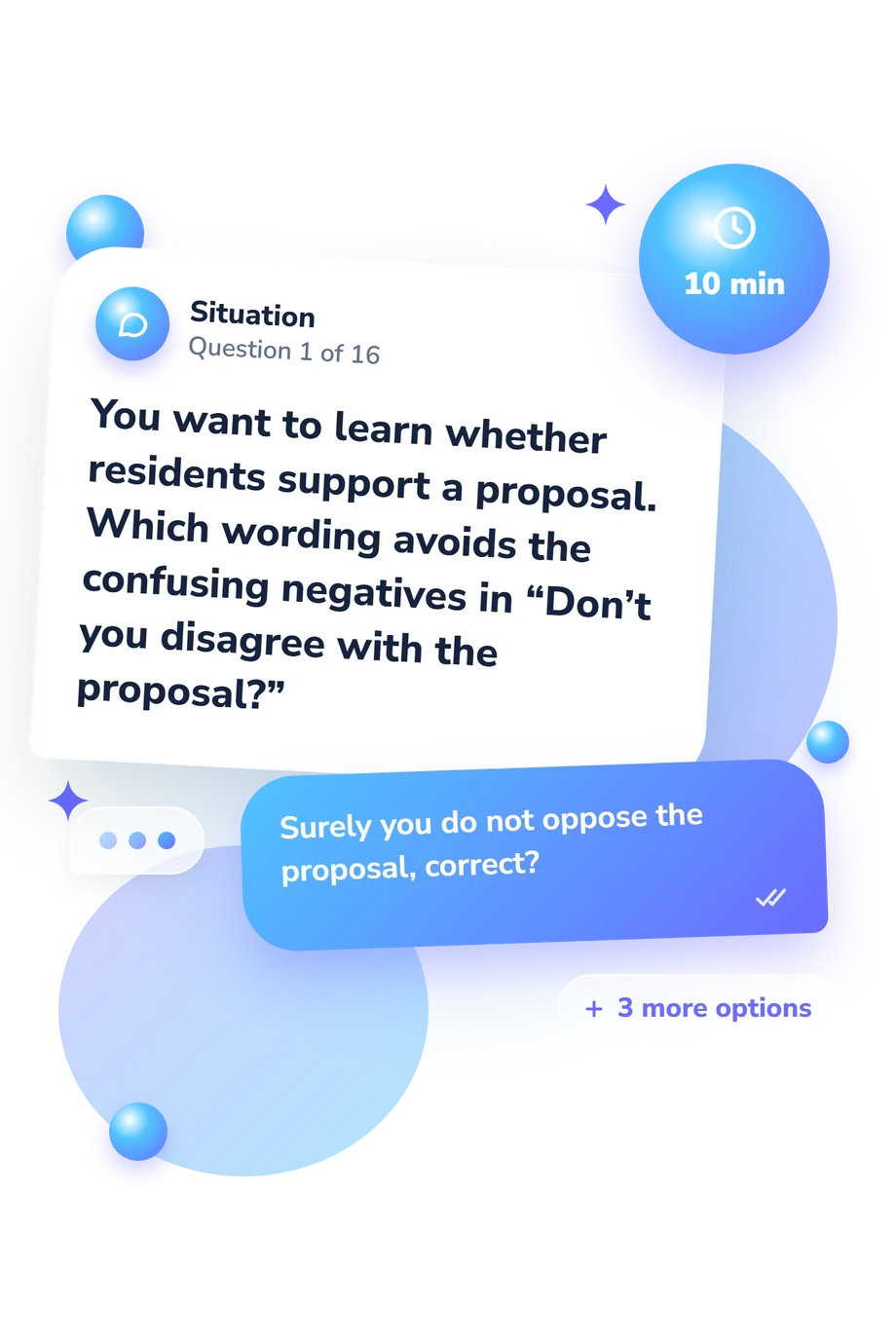
Each item presents a short scenario or prompt with four answer choices. The choices test clear wording, stated conditions, inconsistencies, counterexamples, and appropriate response formats. One point is awarded for each correct answer, so the total reflects the number of correct answers rather than self-rated confidence.
In practical terms, this yes-or-no question assessment is conceptually consistent with Schuman and Presser (1981), whose work highlights wording, ambiguity, and response effects in survey questions. Schaeffer and Presser (2003) and Krosnick and Presser (2010) extend that methodological context to question form, context, and questionnaire design. The online questionnaire is not presented as an adaptation of those published works.
Interpret the result as performance on these concepts at the time of completion. Reading precision, familiarity with survey terminology, and sensitivity to hidden assumptions can affect it. These bands describe performance on this questionnaire rather than standing in a reference population, so the result is best used to identify learning needs rather than make broad claims about reasoning ability.
- Schuman, Howard, and Stanley Presser. 1981. Questions and Answers in Attitude Surveys: Experiments on Question Form, Wording, and Context. New York: Academic Press.
- Schaeffer, Nora Cate, and Stanley Presser. 2003. The Science of Asking Questions. Annual Review of Sociology 29: 65-88. 10.1146/annurev.soc.29.110702.110112
- Krosnick, Jon A., and Stanley Presser. 2010. Question and Questionnaire Design. In Handbook of Survey Research, 2nd ed., edited by Peter V. Marsden and James D. Wright, 263-313. Bingley, UK: Emerald Group Publishing.
Updated: