
Microaggression in the Workplace Quiz
How the Scales are Structured
Who Usually Takes This Test?
See How You Compare
Below is a preview of how scores are typically distributed across each scale.
Example Questions From the Test
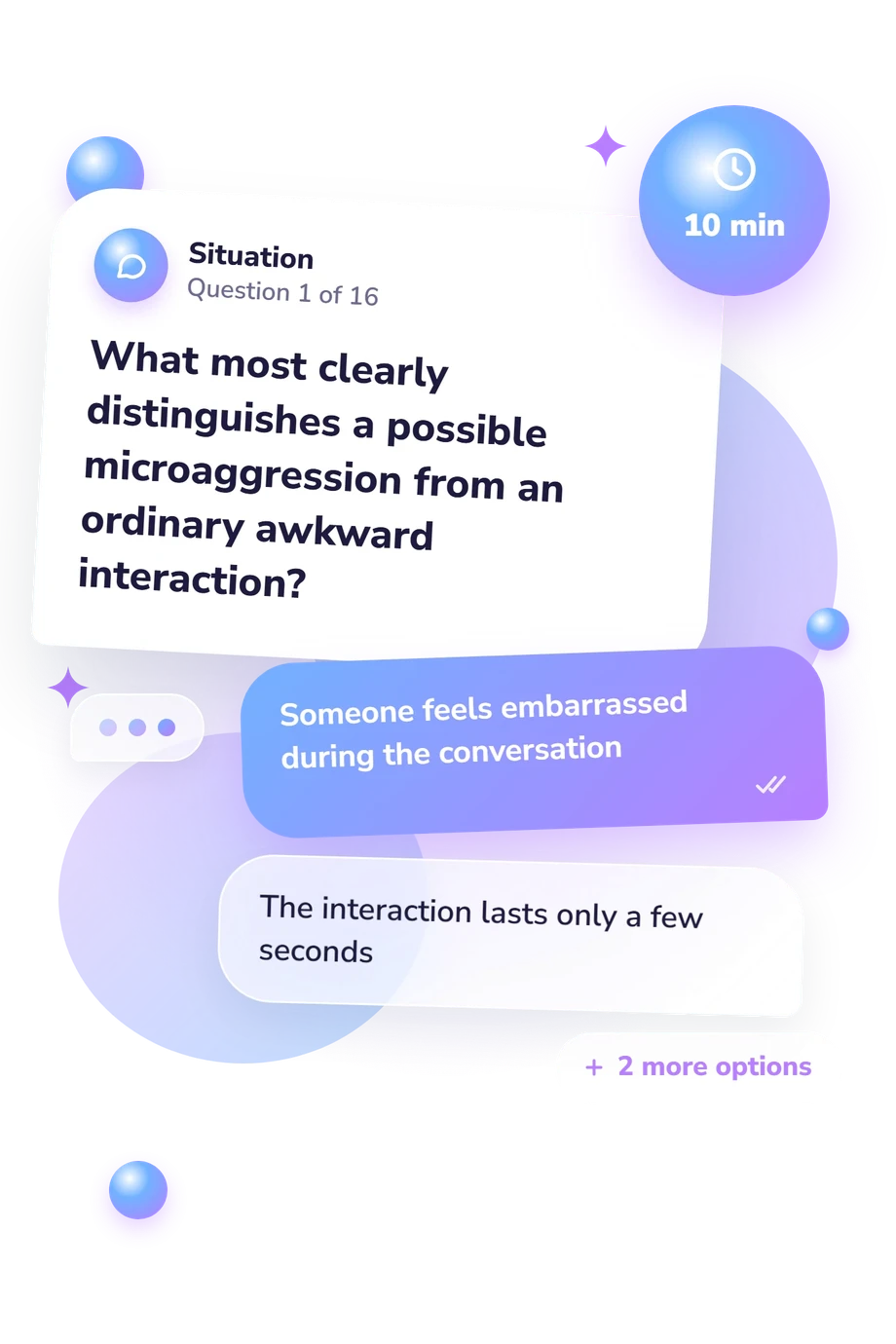
- Someone feels embarrassed during the conversation
- The interaction lasts only a few seconds
- The people involved have different job titles
- The message draws meaning from an identity-related stereotype, exclusion, or history, considered alongside context and impact
- A team chooses a smaller room because attendance is expected to be low
- Two colleagues disagree about the best layout for a shared workspace
- An office replaces worn furniture with a different style
- A leadership display presents only one demographic as the organization’s historical and current image of authority
- “I’m sorry. I made an assumption that had a harmful impact. Thank you for telling me; I’ll work not to repeat it.”
- “I treat everyone the same, so let’s agree this was a misunderstanding.”
- “I already apologized, so bringing it up again is unfair.”
- “I’m sorry you took it that way, but that wasn’t what I meant.”
Microaggression in the Workplace Quiz - Description and methodology of the test
For employees, managers, educators, and allies, this workplace microaggression assessment offers a focused way to examine how identity-linked messages operate at work. The Microaggression in the Workplace Quiz asks you to distinguish stereotypes, exclusion, impact, repair, and organizational patterns without treating every awkward exchange as the same category. Its single result indicates overall educational understanding and may suggest topics for further learning.
What This Assessment Explores
The questions ask respondents to recognize verbal, behavioral, and environmental microaggressions, distinguish structural barriers from interpersonal and environmental microaggressions, and interpret identity, context, intent, and impact together. The microaggressions quiz tests recognition alongside constructive action and repair, including acknowledgment, documentation, support, and proportionate bystander or organizational responses.
These learning areas include:
- Recognition and context explain how identity, history, setting, and delivery shape meaning, including differences between interpersonal and environmental microaggressions and structural barriers.
- Impact and intent distinguish a speaker’s purpose from a message’s possible effect.
- Repair and ally response show how listening, apology, redirection, and credit can interrupt harm.
- Prevention and systems address documentation, equitable practices, accountability, and recurring patterns.
Workplace Microaggression Knowledge (0-16) indicates overall understanding across recognition, context, patterns, impact, response, repair, and prevention. Its educational bands are Foundation Building (0-6), Developing Understanding (7-12), and Strong Understanding (13-16).
Methodology and Evidence Base
Each item offers four answer choices and asks for the response that best fits the concept or situation. Scenarios address identity-linked assumptions, belonging, names, pronouns, stereotype-based praise, interruptions, environmental messages, documentation, bystander intervention, and organizational prevention.
Responses form a knowledge result: higher totals indicate stronger command of recognition, response, repair, and prevention. The displayed bands are educational descriptors for reflection and learning. The educational result from this microaggression awareness test can support further learning, but it does not establish intent, diagnose behavior, or provide a legal conclusion.
The faculty bystander-training study by Haynes-Baratz and colleagues provides conceptual background on learning and responses to academic microaggressions, alongside Sue and colleagues’ microintervention framework for targets, allies, and bystanders. Sue and colleagues’ earlier framework describes subtle verbal, behavioral, and environmental messages connected with marginalized identities. These sources do not validate this broader workplace questionnaire, which is not presented as their adaptation.
Interpretation can shift with attention, prior knowledge, current context, and honest judgment, so the result is best read as a snapshot of educational understanding alongside broader discussion of conduct and organizational climate.
- Haynes-Baratz, M. C., Metinyurt, T., Li, Y. L., Gonzales, J., & Bond, M. A. (2021). Bystander training for faculty: A promising approach to tackling microaggressions in the academy. New Ideas in Psychology, 63, Article 100882. 10.1016/j.newideapsych.2021.100882
- Sue, D. W., Alsaidi, S., Awad, M. N., Glaeser, E., Calle, C. Z., & Mendez, N. (2019). Disarming racial microaggressions: Microintervention strategies for targets, White allies, and bystanders. American Psychologist, 74(1), 128-142. 10.1037/amp0000296
- Sue, D. W., Capodilupo, C. M., Torino, G. C., Bucceri, J. M., Holder, A. M. B., Nadal, K. L., & Esquilin, M. E. (2007). Racial microaggressions in everyday life: Implications for clinical practice. American Psychologist, 62(4), 271-286. 10.1037/0003-066X.62.4.271
Updated: