
Muscles of the Neck Quiz
How the Scales are Structured
Who Usually Takes This Test?
See How You Compare
Below is a preview of how scores are typically distributed across each scale.
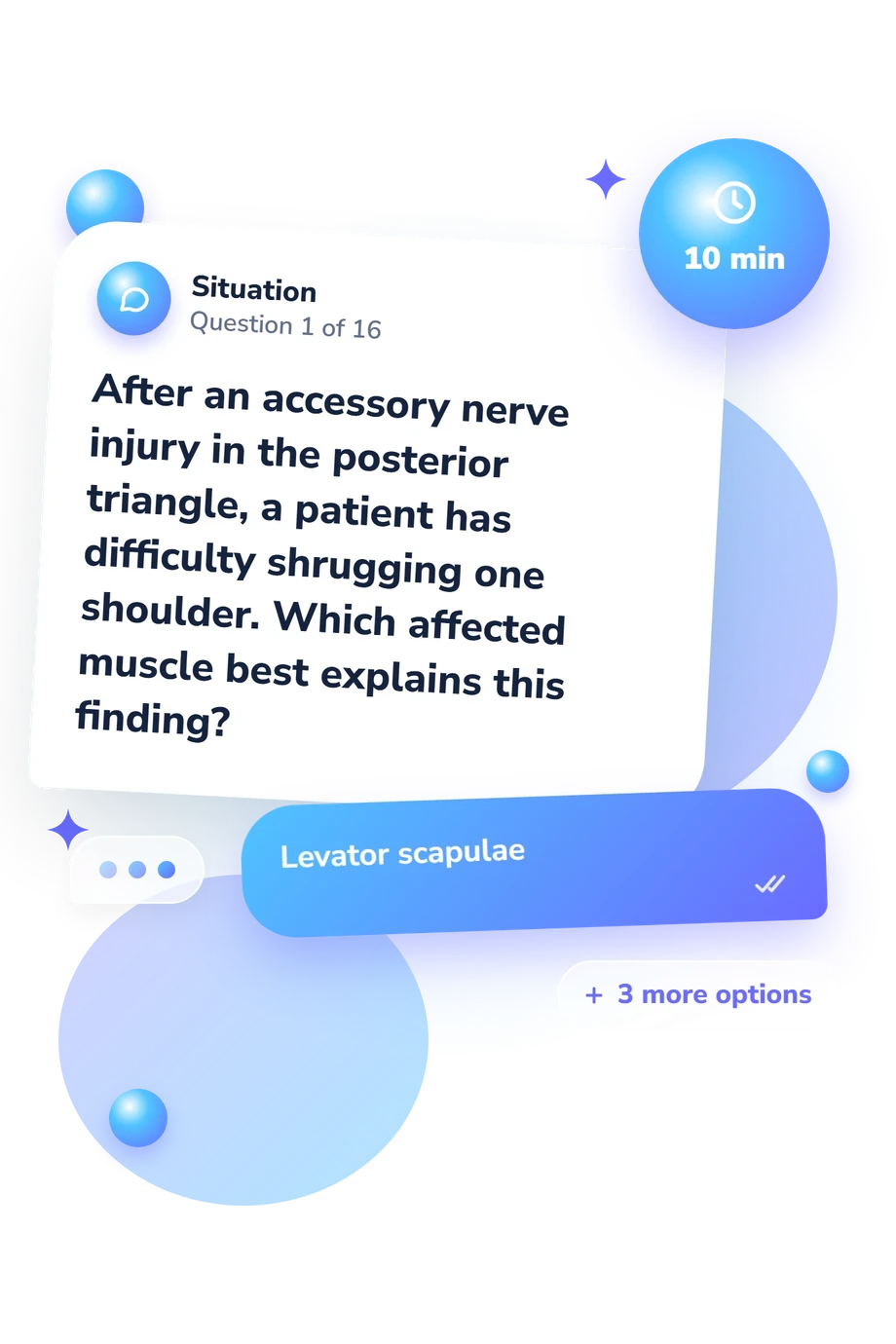
Example Questions From the Test
- Between the sternocleidomastoid and trapezius
- Between the sternohyoid and sternothyroid
- Between the mylohyoid and geniohyoid
- Between the anterior and middle scalenes
- Cervical branch of the facial nerve
- C1 fibers traveling with the hypoglossal nerve
- Spinal accessory nerve
- Phrenic nerve
- Sternohyoid
- Thyrohyoid
- Omohyoid
- Sternothyroid
Muscles of the Neck Quiz - Description and methodology of the test
For students, trainees, and anatomy-minded clinicians, the muscles of the neck quiz is a focused way to check whether structural knowledge can be applied to movement, innervation, and clinical landmarks. It suits anyone who wants a neck muscle test that goes beyond naming individual structures. The result highlights where review may be most useful.
What This Assessment Measures
The questionnaire tests regional anatomy and foundational recognition. Items connect muscles with actions, supplies, attachments, landmarks, and responses to injury or movement. It covers superficial, suprahyoid, infrahyoid, scalene, posterior, and suboccipital regions. Integrating regional anatomy rather than labels makes results useful for exam revision and identifying gaps in recall.
As a neck muscle anatomy quiz, it samples these themes:
- Superficial and posterior muscles are assessed through shrugging, head rotation, lateral flexion, and attachment patterns.
- Suprahyoid and infrahyoid muscles are distinguished by hyoid, laryngeal, swallowing, and floor-of-mouth actions.
- Scalenes and deep cervical muscles are tested through rib elevation, nerve relationships, landmarks, and postural control.
The displayed Neck Muscle Knowledge scale runs from 0-16: Foundation is 0-6, Developing is 7-12, and Strong is 13-16. The band indicates how consistently the respondent applies neck-muscle anatomy to the tested situations.
Methodology and Evidence Base
Each item in this neck anatomy quiz presents a short anatomical or clinical scenario with four answer choices. The full form uses single-best-answer questions covering nerve supply, muscle action, attachments, spatial relationships, and applied landmarks. Responses produce the displayed result and band, indicating current performance on the tested anatomy and highlighting nerve supply, actions, attachments, and spatial relationships for review.
The tested content is conceptually consistent with regional anatomy described in Moore's Clinically Oriented Anatomy (Dalley and Agur, 2023) and Drake, Vogl, and Mitchell (2023), but the questionnaire is not presented as an adaptation of either source. Conley and colleagues (1995) provide context on human neck-muscle function, especially movement, but their study does not validate this questionnaire.
Its educational purpose is to check knowledge of neck-muscle structures, actions, innervation, and relationships. Performance can vary with prior coursework, recall, attention, and the respondent's interpretation of a vignette. It does not assess practical dissection skill, physical examination, or measured neuromuscular activation, so the result is best used to select topics for anatomy review and to revisit missed relationships.
- Dalley, Arthur F., II, and Anne M. R. Agur. Moore's Clinically Oriented Anatomy. 9th ed. Philadelphia: Wolters Kluwer, 2023. ISBN 978-1-9751-5406-6.
- Drake, Richard L., A. Wayne Vogl, and Adam W. M. Mitchell. Gray's Anatomy for Students. 5th ed. Philadelphia: Elsevier, 2023. ISBN 978-0-323-93423-7.
- Conley, Michael S., Ronald A. Meyer, Jacob J. Bloomberg, Daniel L. Feeback, and Gary A. Dudley. “Noninvasive Analysis of Human Neck Muscle Function.” Spine 20, no. 23 (1995): 2505-2512. DOI 10.1097/00007632-199512000-00009.
Updated: