
What Moon Phase Am I Quiz
How the Scales are Structured
Who Usually Takes This Test?
See How You Compare
Below is a preview of how scores are typically distributed across each scale.
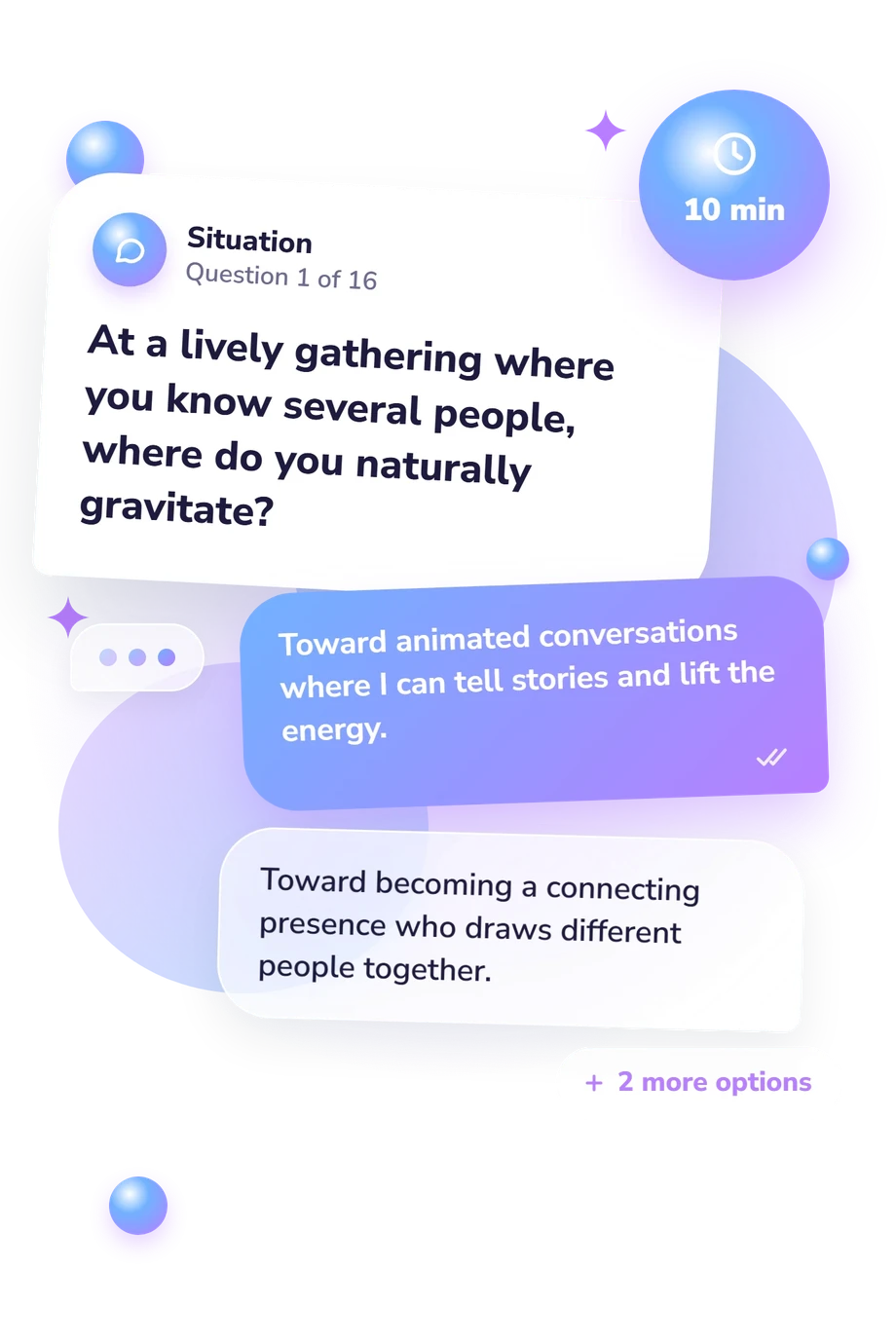
Example Questions From the Test
- Toward animated conversations where I can tell stories and lift the energy.
- Toward becoming a connecting presence who draws different people together.
- Toward one comfortable conversation away from the center.
- Between a few groups, participating without becoming a focal point.
- Give the project a defined block of time, then leave room for other things.
- Let my energy that morning determine whether I touch it at all.
- Shape much of the day around making a visible leap forward.
- Step away from it completely and seek a different kind of experience.
- Share it with a trusted person and see how it lands.
- Keep it in my notes as something personally complete.
- Present it to a group in a polished, engaging form.
- Put it fully into the world and invite an active response.
What Moon Phase Am I Quiz - Description and methodology of the test
People interested in symbolic self-reflection may use the What Moon Phase Am I Quiz to consider how they handle attention, pauses, endings, and forward movement. It suits readers who want a reflective profile rather than a right-or-wrong judgment. The questionnaire frames the what phase of the moon am I quiz as a symbolic reflection on present habits and choices.
What This Assessment Explores
The questions turn everyday choices about visibility, solitude, closure, and momentum into four lunar profiles. They suit readers seeking a reflective snapshot: the leading pattern describes what currently resonates, not a fixed identity. The four profiles give a reflective answer through the what phase of the moon are you quiz, showing which symbolic orientation currently fits.
The four result dimensions are:
- Full Moon (0-12) measures resonance with visibility and shared expression: Light resonance (0-4), Clear resonance (5-8), or Strong resonance (9-12).
- New Moon (0-12) measures resonance with privacy, renewal, and fresh starts: Light resonance (0-4), Clear resonance (5-8), or Strong resonance (9-12).
- Waning Moon (0-12) measures resonance with closure, review, and release: Light resonance (0-4), Clear resonance (5-8), or Strong resonance (9-12).
- Waxing Moon (0-12) measures resonance with progress, experimentation, and development: Light resonance (0-4), Clear resonance (5-8), or Strong resonance (9-12).
Methodology and Scientific Basis
Each prompt offers four responses to a concrete situation, such as joining a group, handling an unfinished project, ending a chapter, or developing an idea. The choices contrast ways of expressing energy, pausing, releasing, celebrating, and building momentum. There is no correct answer; the useful response is the one that best matches your present style.
Scoring uses four independent affinity scores, not a single total; each spans 0-12. Leading profiles within one point form a blended result. The test functions as a moon phase reflection quiz, giving symbolic language for noticing patterns in current preferences without treating them as fixed personality traits.
Startup and Russell (1985) caution against treating lunar phases as causal predictors: their study found no reliable lunar effect on personality-test scores. Rotton and Kelly (1985) likewise questioned broad lunar-behavior claims. Neither source validates this questionnaire, its scoring, or its four symbolic profiles; both address literal lunar effects, not this symbolic format. No population norms or validated cutoffs are reported for this questionnaire. Self-perception and current circumstances shape responses, so the result is a momentary profile rather than a clinical diagnosis.
- Startup, M. J., & Russell, R. J. H. (1985). Lunar effects on personality test scores: A failure to replicate. Personality and Individual Differences, 6(2), 267-269. 10.1016/0191-8869(85)90118-7
- Rotton, James, & Kelly, Ivan William. (1985). Much ado about the full moon: A meta-analysis of lunar-lunacy research. Psychological Bulletin, 97(2), 286-306. 10.1037/0033-2909.97.2.286
Updated: