
What Kind of Teen Are You Quiz
How the Scales are Structured
Who Usually Takes This Test?
See How You Compare
Below is a preview of how scores are typically distributed across each scale.
Example Questions From the Test
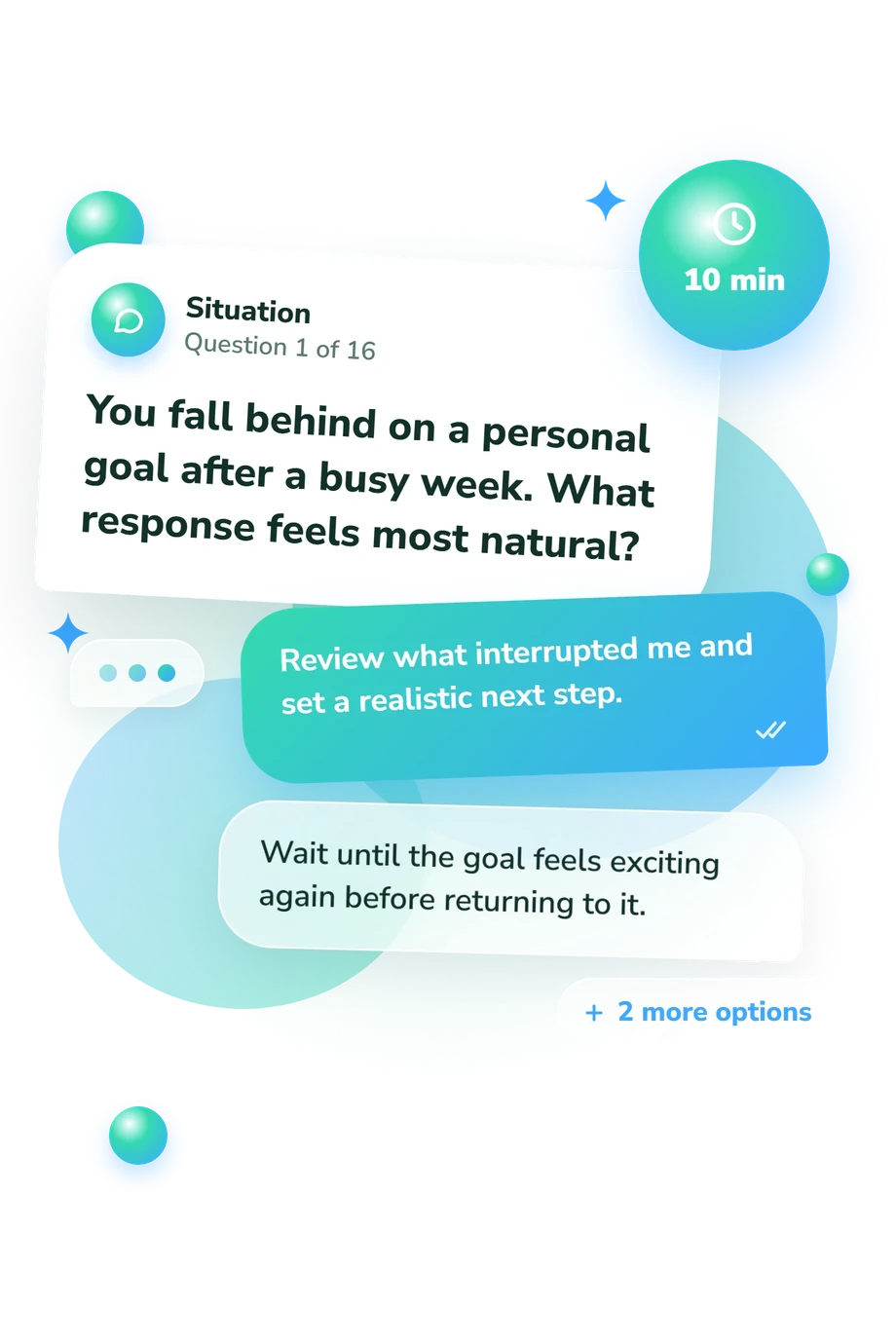
- Review what interrupted me and set a realistic next step.
- Wait until the goal feels exciting again before returning to it.
- Restart with a lighter plan that can flex around the next week.
- Ask someone to work alongside me so restarting feels easier.
- Stay mainly with the person I know and enjoy a quieter evening.
- Find an activity I can focus on without needing much conversation.
- Meet a few people if introductions happen naturally.
- Start conversations and look for ways to bring people together.
- Helping everyone communicate and feel included.
- Completing my assigned section independently and reliably.
- Trading ideas with one or two teammates I work well with.
- Organizing the tasks so the group can stay on schedule.
What Kind of Teen Are You Quiz - Description and methodology of the test
Young people who want a clearer picture of their everyday preferences can use this assessment to reflect on how they relate, create, explore, and pursue goals. The What Kind of Teen Are You Quiz offers a pattern-based profile rather than a single label. It can make a teen personality quiz useful for naming strengths, tensions, and priorities that may change across situations.
What This Assessment Explores
Questions place you in everyday situations involving goals, gatherings, friendships, free time, unfamiliar places, creativity, teamwork, and changing plans. They examine how you balance connection, expression, novelty, and structure. Framed as a quiz about what type of teenager you are, the result describes preferences, not maturity, popularity, talent, or success.
The four result dimensions are:
- Connector (0-12) measures social energy: Independent Rhythm (0-4), Flexible Connector (5-8), People-Centered (9-12).
- Creator (0-12) measures your drive to imagine, make, reinterpret, and express ideas; Practical Interpreter (0-4), Situational Creator (5-8), and Expression-Led (9-12).
- Explorer (0-12) measures attraction to novelty and changing experiences; Familiarity First (0-4), Selective Explorer (5-8), and Adventure-Led (9-12).
- Grounded Achiever (0-12) measures preference for purposeful goals and steady progress; Open-Ended Pace (0-4), Adaptive Planner (5-8), and Progress-Focused (9-12).
Scores within one point of another style can blend.
Methodology and Evidence Base
Each item presents an everyday situation with four possible responses, and you choose the option that feels most natural. This self-report format turns preferences into a profile across social, creative, exploratory, and goal-directed choices.
The result reports four separate dimension scores and descriptive bands rather than one overall type. Because no per-answer weighting rule is stated, the labels are best read as profile summaries, not precise measures of ability. A teen personality test works best when answers describe typical behavior rather than an ideal self-image.
Methodologically, the questionnaire is conceptually consistent with person-centered and developmental approaches, but it is not presented as an adaptation of a published instrument. Gamboa et al. (2023) identified socio-emotional profiles involving curiosity, optimism, empathy, sociability, and responsibility. Hirschi (2008) supports viewing adolescent traits, interests, values, and self-evaluations as connected. The OECD (2021) treats social and emotional skills as relevant to functioning and development, while Ringwald et al. (2024) documents personality change across adolescence.
It is not standardized or norm-referenced; current context, response style, and self-awareness can shift a descriptive result, so it should not be treated as a diagnosis.
- Gamboa, Vítor, Suzi Rodrigues, Filipa Bértolo, Beatriz Marcelo, and Olímpio Paixão. (2023). Socio-emotional skills profiles and their relations with career exploration and perceived parental support among 8th grade students. Frontiers in Psychology, 14, 1214395. 10.3389/fpsyg.2023.1214395
- Hirschi, Andreas. (2008). Personality complexes in adolescence: Traits, interests, work values, and self-evaluations. Personality and Individual Differences, 45(8), 716-721. 10.1016/j.paid.2008.07.018
- OECD. (2021). Beyond Academic Learning: First Results from the Survey of Social and Emotional Skills. OECD Publishing, Paris. 10.1787/92a11084-en
- Ringwald, Whitney R., Aleksandra Kaurin, Katherine M. Lawson, Aidan G. C. Wright, and Richard W. Robins. (2024). The Development of Personality-From Metatraits to Facets-Across Adolescence and Into Adulthood in a Sample of Mexican-Origin Youth. Journal of Personality and Social Psychology, 126(6), 1140-1160. 10.1037/pspp0000487
Updated: