
Water Conservation Quiz
How the Scales are Structured
Who Usually Takes This Test?
See How You Compare
Below is a preview of how scores are typically distributed across each scale.
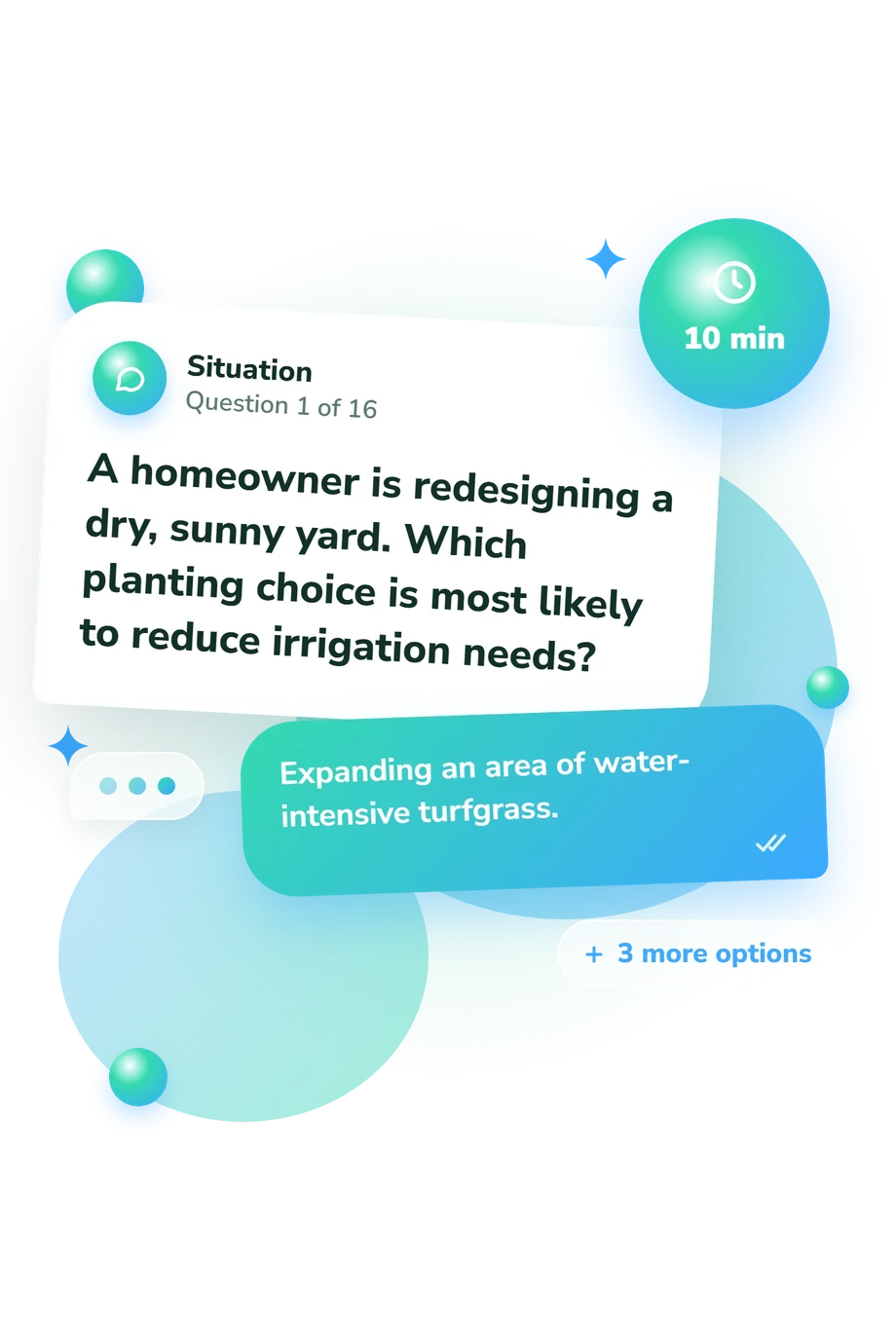
Example Questions From the Test
- It slows evaporation and helps moderate soil temperature.
- It makes roots absorb any available water immediately.
- It directs rainfall away from the soil and into storm drains.
- It increases the water pressure inside irrigation lines.
- Use a pressure washer until the debris reaches the street.
- Spray it with a hose fitted with a shutoff nozzle.
- Rinse it slowly with a low-flow garden hose.
- Sweep the debris with a broom and dispose of it appropriately.
- Pre-rinse every dish under running water before loading it.
- Run several half-full loads so dishes have more space.
- Wash the same dishes by hand under a continuously running tap.
- Run a properly loaded full dishwasher using an efficient cycle.
Water Conservation Quiz - Description and methodology of the test
Designed for people who want a practical check of everyday water-conservation knowledge, this water conservation assessment gives learners and households a way to choose practical study priorities. Respondents work through water conservation quiz questions to identify principles they know and areas that merit review. Its result supports targeted learning rather than defining a person’s commitment to conservation.
What This Assessment Measures
The questionnaire checks whether a respondent can recognize practical water-saving decisions in familiar settings. Its items cover indoor use, outdoor irrigation, leak detection, rainwater, greywater, food waste, water footprints, and the environmental effects of treating and moving water. This makes it useful as a water conservation knowledge test for learners and households connecting general principles with observable actions.
The result is one knowledge scale: a higher score means more answers match the conservation principle in each scenario. It shows recognition of effective choices across everyday contexts, not a personality profile. The displayed interpretation is:
- Water Conservation Knowledge, 0-16, describes recognition of sound conservation concepts: Foundations to Build (0-6) suggests basic ideas need review; Developing Knowledge (7-12) reflects understanding with room to strengthen application; Strong Knowledge (13-16) indicates consistent recognition of practical choices.
This profile can guide focused review without defining a person’s commitment or environmental identity.
Methodology and Evidence
Each item uses a four-option multiple-choice format describing a concrete decision, such as checking a suspected toilet leak or selecting an efficient irrigation time. The respondent chooses the best answer, and each correct response receives one point, producing the knowledge total. The format tests recognition of principles rather than reported frequency of household water conservation practices.
Its content is conceptually consistent with Dean et al. (2016), whose work links community water knowledge with water-related behaviours and policy support. It also aligns with Dolnicar, Hurlimann, and Grün (2012) on conservation behaviour and with Fielding, Russell, Spinks, and Mankad (2012) on household determinants, including infrastructure and psychosocial influences. The cited studies provide conceptual context but do not validate this questionnaire or establish population norms for its scores.
Reviewing quiz questions and answers about water conservation can connect household routines with outdoor practices and wider water impacts.
Interpret the displayed band as an indication of knowledge on the scenarios included here, not as a measure of actual consumption, motivation, or long-term behaviour. Response bias, current attention, prior experience, and current context can affect answers, so the result is best used to identify specific learning goals and questions for broader reflection.
- Dean, Angela J., Kelly S. Fielding, and Fiona J. Newton. "Community Knowledge about Water: Who Has Better Knowledge and Is This Associated with Water-Related Behaviors and Support for Water-Related Policies?" PLOS ONE 11(7) (2016): e0159063. 10.1371/journal.pone.0159063
- Dolnicar, Sara, Anna Hurlimann, and Bettina Grün. "Water conservation behavior in Australia." Journal of Environmental Management 105 (2012): 44-52. 10.1016/j.jenvman.2012.03.042
- Fielding, Kelly S., Sally Russell, Anneliese Spinks, and Aditi Mankad. "Determinants of household water conservation: The role of demographic, infrastructure, behavior, and psychosocial variables." Water Resources Research 48 (2012): W10510. 10.1029/2012WR012398
Updated: