
Verbal Reasoning Test
How the Scales are Structured
Who Usually Takes This Test?
See How You Compare
Below is a preview of how scores are typically distributed across each scale.
Example Questions From the Test
- Strongly disagree
- Disagree
- Not sure
- Agree
- Strongly disagree
- Disagree
- Not sure
- Agree
- Strongly disagree
- Disagree
- Agree
- Strongly agree
Verbal Reasoning Test - Description and methodology of the test
People seeking a current self-reflection profile of how they process written material, arguments, and word relationships can use the verbal reasoning test to identify present strengths and review priorities. This questionnaire suits anyone who wants a clearer view of language-based reasoning, and the result can direct verbal reasoning practice toward skills that need attention.
What This Assessment Explores
The questions examine short passages, word relationships, analogies, tone, structure, assumptions, evidence, conclusions, and inference. The profile helps readers see which language-based reasoning skills feel strongest or need practice. The questionnaire provides a verbal test profile through three complementary scales:
- Overall Verbal Reasoning (0-100) measures performance across comprehension, vocabulary relationships, analogies, and arguments; higher scores indicate stronger understanding and supported conclusions. Developing (0-49); Solid (50-74); Strong (75-100).
- Reading Comprehension (0-30) measures extracting key information, inferring implicit meaning, and answering questions based on short passages. Developing (0-12); Proficient (13-22); Advanced (23-30).
- Verbal Logic & Inference (0-30) measures evaluating arguments, spotting assumptions, and determining which conclusions follow. Developing (0-10); Proficient (11-20); Advanced (21-30).
Together, the scales distinguish passage understanding from verbal analysis while preserving an overall view.
Methodology and Evidence Base
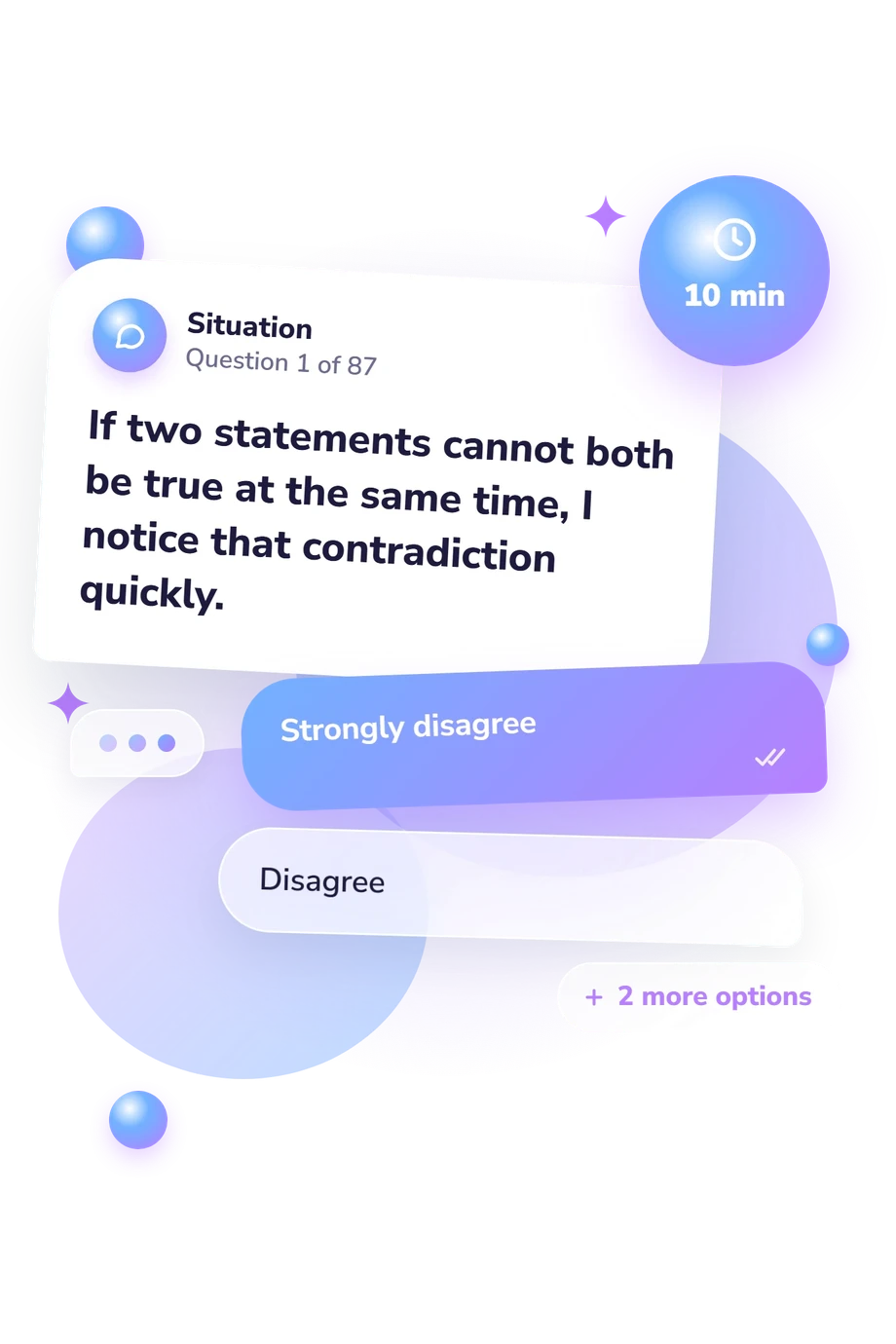
Representative items rate reasoning operations with options such as Strongly disagree, Disagree, Agree, and Strongly agree; some include Not sure. They cover assumptions, evidence, conclusions, inference, tone, and premise-based reasoning. In this verbal reasoning assessment, the format captures perceived ability rather than directly measured performance.
Responses become displayed scores, but the questionnaire does not document how each answer contributes points. The ranges are score scales, not a conversion rule reconstructable from an individual pattern.
The content is conceptually consistent with Watson-Glaser Critical Thinking Appraisal (Watson & Glaser, 1980), particularly its treatment of assumptions, deductions, interpretations, and arguments. It is a separate self-report questionnaire and does not produce a direct Watson-Glaser score. Cain and Oakhill (1999) address inference in comprehension, while Loo and Thorpe (1999) and Gadzella and Baloğlu (2003) concern related forms or samples; these studies cannot establish reliability, validity, or norms for this questionnaire.
Its standardization status is not documented. Self-awareness, reading familiarity, fatigue, and current context can affect self-ratings, so results describe reported strengths rather than clinical or population-level status.
- Watson, Goodwin, and Edward M. Glaser. Watson-Glaser Critical Thinking Appraisal. Psychological Corporation, 1980.
- Cain, Kate, and Jane V. Oakhill. "Inference making ability and its relation to comprehension failure." Reading and Writing, vol. 11, nos. 5-6, 1999, pp. 489-503. 10.1023/A:1008084120205
- Loo, Robert, and Karran Thorpe. "A Psychometric Investigation of Scores on the Watson-Glaser Critical Thinking Appraisal New Form S." Educational and Psychological Measurement, vol. 59, no. 6, 1999, pp. 995-1003. 10.1177/00131649921970305
- Gadzella, Bernadette M., and Mustafa Baloğlu. "Psychometric Properties of Watson-Glaser Critical Thinking Appraisal for a Sample of Education Majors." Psychological Reports, vol. 92, no. 3, 2003, pp. 1249-1254. 10.2466/pr0.2003.92.3c.1249
Updated: