
Taste in Women Quiz
How the Scales are Structured
Who Usually Takes This Test?
See How You Compare
Below is a preview of how scores are typically distributed across each scale.
Example Questions From the Test
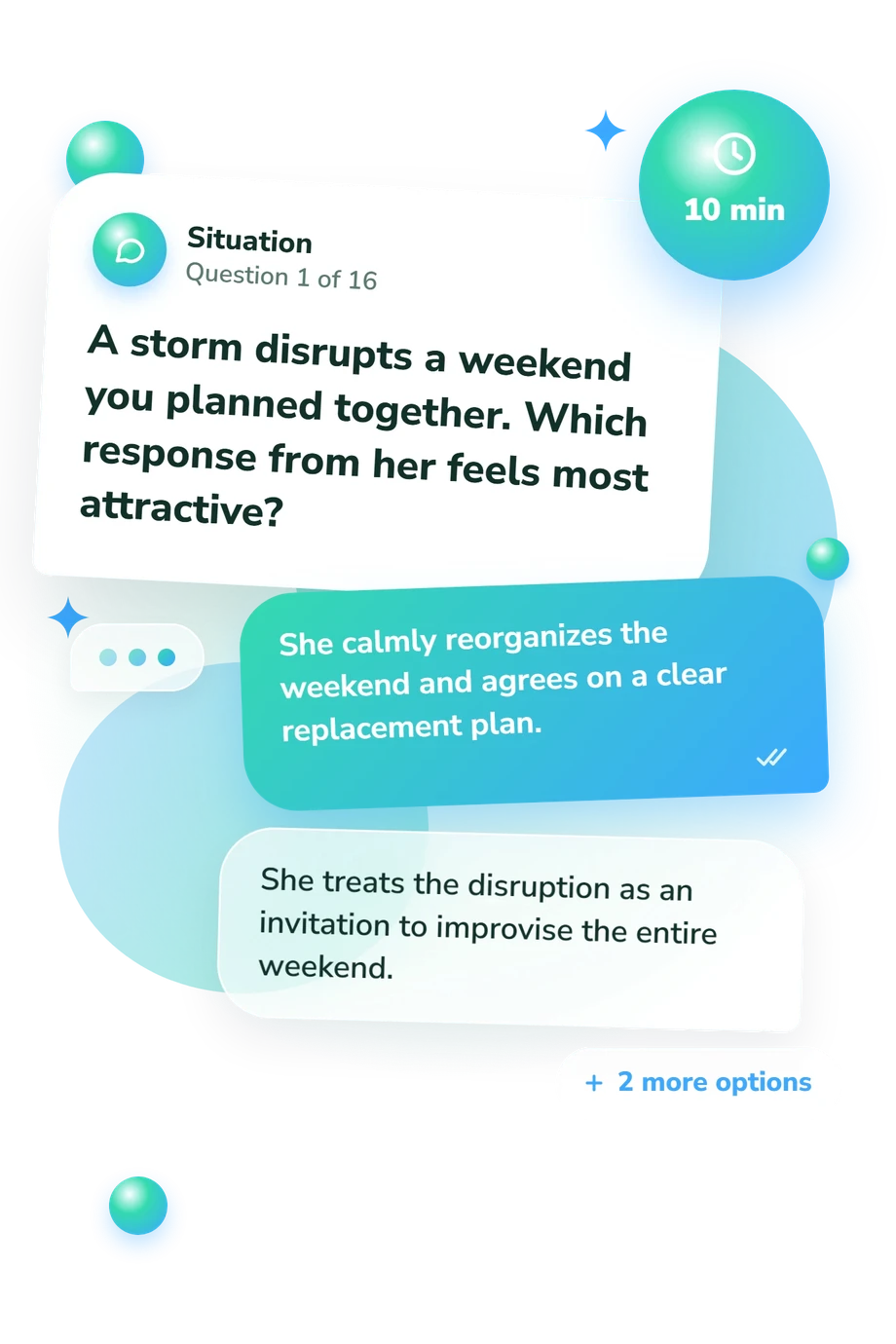
- She calmly reorganizes the weekend and agrees on a clear replacement plan.
- She treats the disruption as an invitation to improvise the entire weekend.
- She considers a few alternatives, then settles into one dependable option.
- She chooses an immediate substitute activity and leaves the rest undecided.
- She reads selected displays closely and discusses the most interesting ones.
- She moves intuitively toward whatever catches her eye in the moment.
- She studies the context, connects exhibits, and wants to exchange interpretations.
- She enjoys the atmosphere and saves most conversation for afterward.
- Comparing theories about why a social trend is changing.
- Trading funny stories about people and places you both know.
- Discussing a recent film and what its ending might mean.
- Planning an activity inspired by something mentioned at dinner.
Taste in Women Quiz - Description and methodology of the test
Anyone curious about how their attraction patterns take shape can use this questionnaire to organize preferences across familiar relationship situations. It offers a way to identify which areas matter most without judging another person. The Taste in Women Quiz groups those responses, showing which preference areas carry the most weight and where several may be closely matched.
What This Assessment Explores
Rather than ranking people, the assessment describes the attraction preferences you bring to a potential relationship. Its result is intended for anyone curious about the qualities they notice, seek, or value in a woman, not for judging another person. The highest dimension indicates the strongest affinity, while close scores can form a blended profile.
The four result dimensions are:
- Adventurous & Spontaneous (0-12) reflects novelty and improvisation: Familiarity-Leaning (0-4), Selective Explorer (5-8), or Strong Adventurous Affinity (9-12).
- Affectionate & Expressive (0-12) reflects visible warmth and reassurance: Subtle-Affection Preference (0-4), Warm but Measured (5-8), or Strong Expressive Affinity (9-12).
- Curious & Cerebral (0-12) reflects ideas and shared learning: Experience-Led Connection (0-4), Conversational Curiosity (5-8), or Strong Cerebral Affinity (9-12).
- Grounded & Steady (0-12) reflects reliability and structure: Flexible Preference (0-4), Balanced Stability (5-8), or Strong Grounded Affinity (9-12).
Methodology and Scientific Basis
Each item presents a relationship scenario with four possible responses about plans, communication, affection, hobbies, emotional support, or conversation. Choosing the response that best matches your attraction reveals preference patterns rather than observed behavior, helping you compare preferred qualities in a potential partner across situations.
Responses are combined into the displayed dimensions, and the comparison identifies the strongest affinity. Scores within one point are read as a blended result; the questionnaire does not state an answer-by-answer point formula, so no extra scoring rule should be inferred.
Schwarz and Hassebrauck (2012) provide the closest conceptual reference for mate-selection preferences. Klümper, Hassebrauck, and Schwarz (2024) examine preference patterns across sexual-orientation groups, while Fletcher, Simpson, Thomas, and Giles (1999) support studying ideals in intimate relationships. This questionnaire is conceptually consistent with those works, not an adaptation or validated reproduction of their instruments.
It is not presented as a standardized version with population norms. Since answers are self-reported, mood, current relationship context, interpretation of a scenario, and self-awareness can influence the profile, which is best read as structured reflection rather than a clinical conclusion.
- Schwarz, S., & Hassebrauck, M. (2012). Sex and age differences in mate-selection preferences. Human Nature, 23(4), 447-466. 10.1007/s12110-012-9152-x
- Klümper, L., Hassebrauck, M., & Schwarz, S. (2024). Intersexual and intrasexual differences in mate selection preferences among lesbian women, gay men, and bisexual women and men. Archives of Sexual Behavior, 53(1), 177-203. 10.1007/s10508-023-02665-9
- Fletcher, G. J. O., Simpson, J. A., Thomas, G., & Giles, L. (1999). Ideals in intimate relationships. Journal of Personality and Social Psychology, 76(1), 72-89. 10.1037/0022-3514.76.1.72
Updated: