
Spot the Ball Picture Quiz
How the Scales are Structured
Who Usually Takes This Test?
See How You Compare
Below is a preview of how scores are typically distributed across each scale.
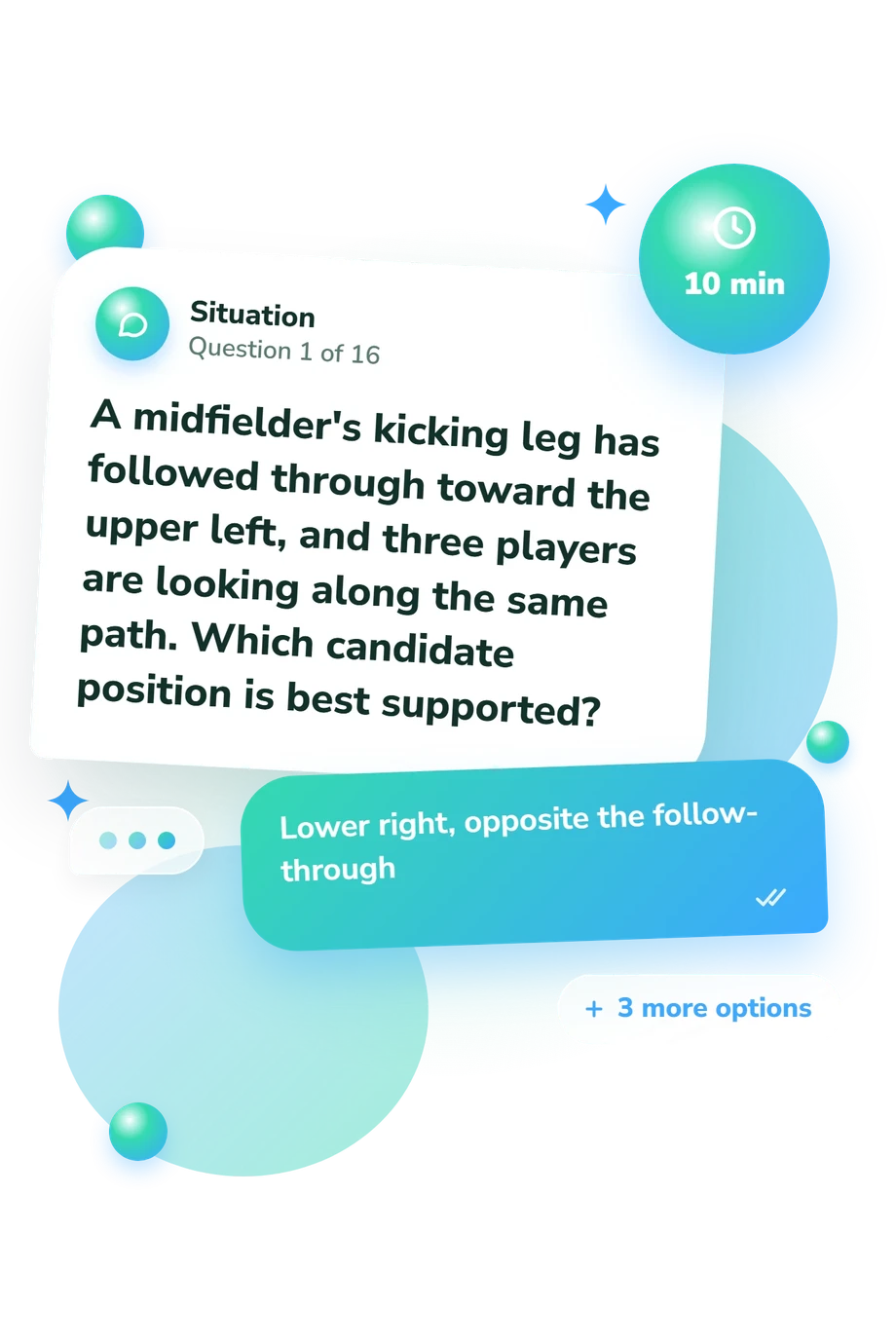
Example Questions From the Test
- Upper left
- Center
- Lower center
- Upper right
- The estimated center of the original ball position
- The outer edge of the estimated ball
- The direction in which the ball is moving
- The nearest player's eye position
- Their convergence can narrow the ball's likely position
- They reveal which player is most famous
- They establish the exact speed of the missing ball
- Their number determines how high the ball must be
Spot the Ball Picture Quiz - Description and methodology of the test
Readers who enjoy visual puzzles or want to examine how they weigh evidence in a traditional football scene can use this visual reasoning test before deciding whether the format suits them. The assessment focuses on disciplined comparison of clues rather than football skill or athletic experience. The spot the ball picture quiz suits anyone curious about how carefully they judge a scene when the available evidence is incomplete.
What This Assessment Explores
Questions focus on traditional spot-the-ball scenes: estimating where a removed ball was located. They require combining gaze direction, body movement, positioning, perspective, and convergence instead of treating one clue as decisive. This method makes the exercise useful for practising spot-the-ball reasoning, with or without football expertise.
The result uses one displayed scale:
- Spot the Ball Knowledge (0-16) reflects your understanding of the visual reasoning used in traditional spot-the-ball football pictures. Foundations (0-6) reflects basic cue recognition with reliance on isolated clues; Developing Observer (7-12) indicates combined signals with less geometric precision; Skilled Observer (13-16) indicates consistent use of gaze, movement, perspective, and corroborating evidence.
A higher band suggests stronger command of the tested reasoning pattern, not athletic ability or certainty about every real image. The score is a focused snapshot of your current understanding of the visual reasoning used in traditional spot-the-ball scenes.
Methodology and Evidence Base
Each item describes a football scene. You trace sight lines, weigh movement and posture, account for occlusion or foreshortening, and choose where clues converge. Some items test coordinate geometry and whether a clue is supported by corroborating evidence. Each spot-the-ball question presents answer choices, and the displayed score summarizes the responses.
The displayed scale combines responses, and its bands guide interpretation. This is a text-based knowledge exercise rather than an official competition, with no separate clinical, personality, or athletic-performance score.
The closest conceptual source is Balamurugan and colleagues' Spot the Ball study, which examines hidden information inferred from behavioral cues. Related work by Mould and Klostermann adds context on visual inference and perception-action links. The questions are conceptually consistent with that published work, but these studies do not validate this questionnaire, provide norms or scoring evidence, or establish standardized or clinical validity.
Guessing, concentration, spatial reasoning, prior familiarity with spot-the-ball conventions, and ambiguity in text-described scenes can affect performance. Read the result as a snapshot of your current grasp of this reasoning pattern.
- Balamurugan, Neha, Sarah A. Wu, Cristóbal Eyzaguirre, Adam Chun, and Tobias Gerstenberg. "Spot the ball: Inferring Hidden Information from Human Behavioral Cues." Proceedings of the 47th Annual Conference of the Cognitive Science Society, 2025.
- Balamurugan, Neha, Sarah A. Wu, Adam Chun, Gabe Gaw, Cristóbal Eyzaguirre, and Tobias Gerstenberg. "Spot The Ball: A Benchmark for Visual Social Inference." arXiv preprint arXiv:2511.00261, 2025. 10.48550/ARXIV.2511.00261.
- Mould, M. S., K. Amano, D. H. Foster, and J. Oakley. "Spot the Ball: The Extent of the Functional Visual Field When Searching Natural Scenes." Perception, vol. 38, no. 1, 2009, pp. 43-44. 10.1177/03010066090380S101.
- Klostermann, André, Christian Vater, Ralf Kredel, and Ernst-Joachim Hossner. "Perception and Action in Sports. On the Functionality of Foveal and Peripheral Vision." Frontiers in Sports and Active Living, vol. 1, 2020, article 66. 10.3389/fspor.2019.00066.
Updated: