
Sleep Deprivation Test
How the Scales are Structured
Who Usually Takes This Test?
See How You Compare
Below is a preview of how scores are typically distributed across each scale.
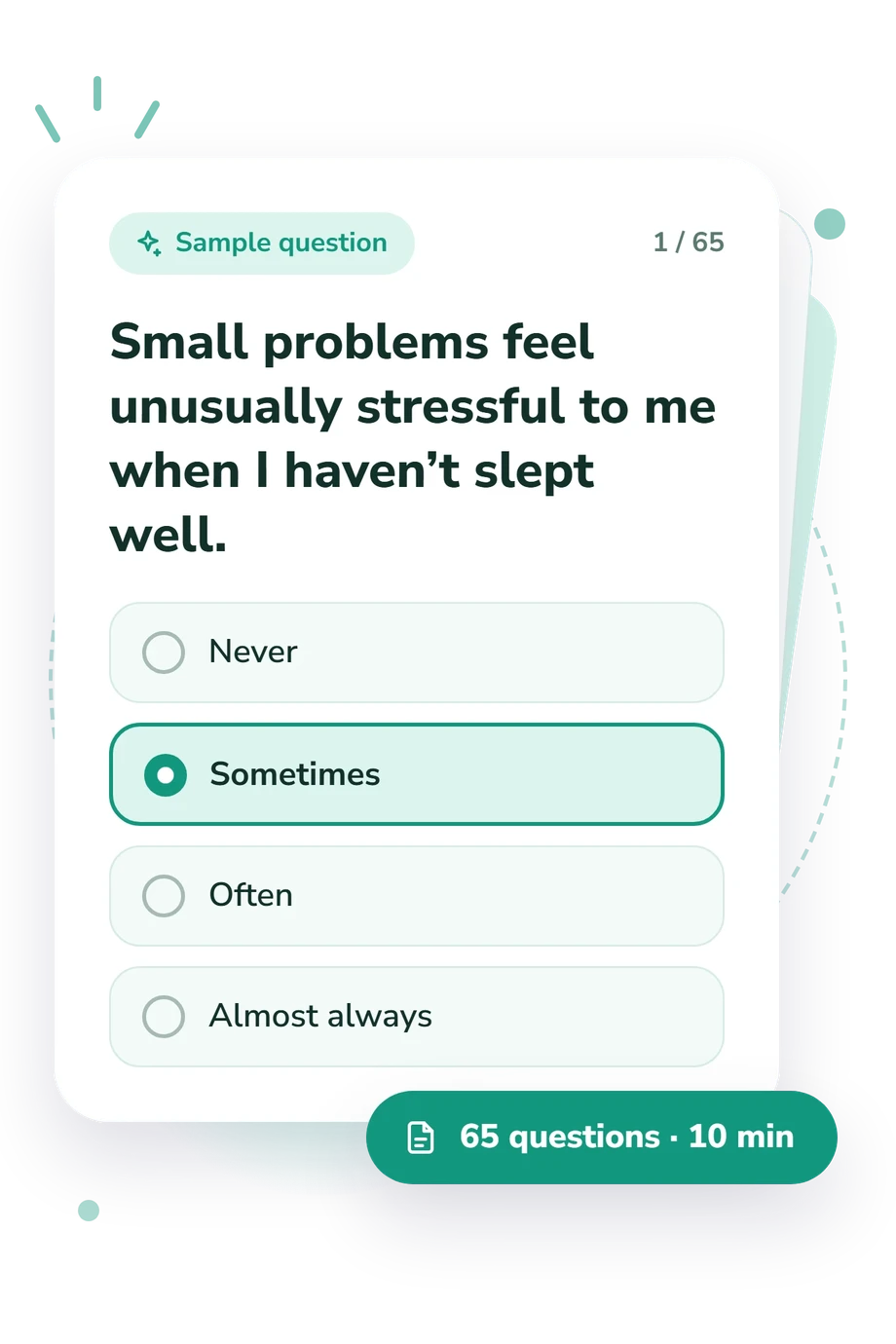
Example Questions From the Test
- Never
- Sometimes
- Often
- Almost always
- Never
- Sometimes
- Often
- Almost always
- Never
- Sometimes
- Often
- Almost always
Sleep Deprivation Test - Description and methodology of the test
People who notice mental fog, unusual tiredness, or stronger emotional reactions after poor sleep can use this sleep deprivation test to organize those experiences into a self-report profile. It is intended for people who want to examine how insufficient rest affects daytime functioning. This sleep deprivation quiz organizes familiar changes into three measurable domains.
What This Assessment Explores
Rather than measuring sleep duration alone, the questionnaire organizes daytime effects of insufficient rest into cognitive, energy, and emotional patterns. It can help clarify sleep deprivation symptoms and show which difficulties are most prominent in the respondent's profile.
The three dimensions are:
- Cognitive & Attention Lapses (0-30) measures brain fog, slowed thinking, forgetfulness, attention failures, and microsleeps; Low 0-10, Moderate 11-20, High 21-30.
- Fatigue Severity (0-40) measures sleepiness, low energy, and reduced stamina; Low fatigue 0-13, Moderate fatigue 14-26, High fatigue 27-40.
- Mood & Irritability Impact (0-20) captures irritability, stress sensitivity, low mood, and reduced motivation; Low impact 0-6, Moderate impact 7-13, High impact 14-20.
Together, these dimensions show whether reported difficulties are concentrated in attention, energy, emotional effects, or several areas at once. The profile can support more specific reflection on rest patterns and daytime demands.
Methodology and Evidence Base
Items ask about experiences linked with poor sleep. The questions use response options such as Never, Sometimes, Often, and Almost always, alongside graded intensity or truth choices. This format captures both occurrence and felt severity across concentration, fatigue, mood, and motivation.
Responses are grouped within the three domains. Higher totals indicate more frequent or disruptive effects in the relevant domain, allowing the result to show the strongest reported pattern. The sleep deprivation assessment presents the pattern across domains.
The methodology is a descriptive self-report approach. Its themes are conceptually consistent with the CHICa scale (Oginska et al., 2014), Durmer and Dinges' (2005) account of neurocognitive effects of sleep loss, and the FACES fatigue and sleepiness checklist described by Shapiro et al. (2002). The displayed bands describe score levels within this questionnaire and should not be treated as population norms.
Interpretation can be influenced by memory, current mood, health, medication, and candor; results are read alongside recent sleep patterns, daytime sleepiness, energy, concentration, emotional responses, motivation, and daily demands.
- Oginska H, Mojsa-Kaja J, Fafrowicz M, Marek T. Measuring individual vulnerability to sleep loss-the CHICa scale. Journal of Sleep Research. 2014;23(3):339-346. 10.1111/jsr.12115
- Durmer JS, Dinges DF. Neurocognitive consequences of sleep deprivation. Seminars in Neurology. 2005;25(1):117-129. 10.1055/s-2005-867080
- Shapiro CM, Flanigan M, Fleming JAE, Morehouse R, Moscovitch A, Plamondon J, Reinish L, Devins GM. Development of an adjective checklist to measure five FACES of fatigue and sleepiness: Data from a national survey of insomniacs. Journal of Psychosomatic Research. 2002;52(6):467-473. 10.1016/S0022-3999(02)00407-5
Updated: