
Signs Your Husband Is in the Closet Quiz
How the Scales are Structured
Who Usually Takes This Test?
See How You Compare
Below is a preview of how scores are typically distributed across each scale.
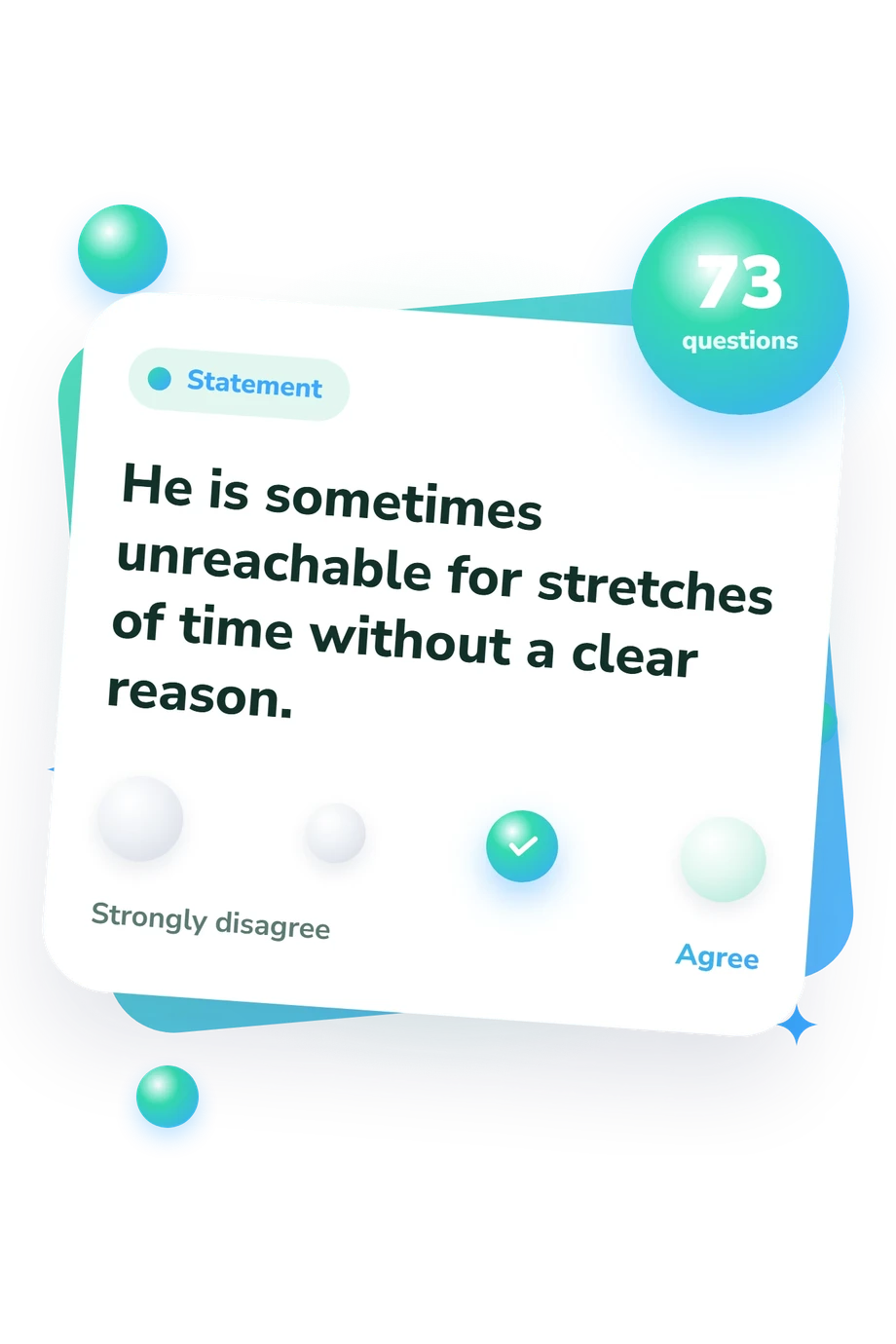
Example Questions From the Test
- Strongly disagree
- Disagree
- Not sure
- Agree
- Strongly disagree
- Disagree
- Not sure
- Agree
- Strongly disagree
- Disagree
- Not sure
- Agree
Signs Your Husband Is in the Closet Quiz - Description and methodology of the test
Partners who are unsettled by changes in closeness, communication, or privacy may use the Signs Your Husband Is in the Closet Quiz to consider concerns about possible orientation, concealment, or altered closeness. It is intended for partners weighing possible explanations for relationship change alongside stress, health, conflict, or ordinary differences in desire. The result identifies levels across intimacy, topic reactivity, and secrecy or distance, but does not establish sexual orientation.
What This Assessment Explores
The questionnaire reads the respondent’s perceptions of intimacy changes, LGBTQ+ topic reactivity, and secrecy or distance. It covers affection, sexual frequency, shared rituals, mismatched desire, guarded communication, privacy changes, and reactions to LGBTQ+ discussions. The result shows each dimension’s level within its own scale, rather than ranking them across scales.
The result covers three dimensions:
- Intimacy & Connection Shift (0-30) reflects recent changes in closeness; Stable Connection 0-10, Noticeable Shift 11-20, and Major Shift 21-30 are displayed bands.
- LGBTQ+ Topic Reactivity (0-20) captures perceived reactivity to LGBTQ+ discussions; Low Reactivity 0-6, Moderate Reactivity 7-13, and High Reactivity 14-20 are displayed bands.
- Perceived Secrecy & Distance (0-40) measures noticed privacy changes, withdrawal, or guardedness; Low 0-13, Moderate 14-26, and High 27-40 are displayed bands.
Higher scores indicate stronger perceived patterns within each dimension, as defined by that scale.
Methodology and Evidence Base
In the presented items, each statement uses four choices: Strongly disagree, Disagree, Not sure, or Agree. Their wording asks about recent or noticeable experiences, so the profile depends on the respondent’s memory, context, and interpretation of a partner’s behavior. The questionnaire reports scores for the displayed dimensions; higher scores indicate stronger perceived patterns within those dimensions, without supplying a probability or causal explanation.
The questionnaire is conceptually consistent with relevant research. Adler and Ben-Ari (2017) provide the closest subject match through work on secrecy and openness in mixed-orientation marriages. Kays, Yarhouse, and Ripley (2014) address relationship quality, while Jackson and Mohr (2016) distinguish stigma concealment from nondisclosure. Pachankis et al. (2020) offer context on concealment and mental health. These publications provide context for related constructs, not validation of this exact questionnaire, which is not presented as an adaptation of any one instrument.
The displayed bands, including those for secrecy and distance, are result categories for each dimension. Current stress, response bias, limited self-awareness, and alternative explanations can affect scores.
- Adler, Adir, and Adital Ben-Ari. "The Myth of Openness and Secrecy in Intimate Relationships: The Case of Spouses of Mixed-Orientation Marriage." Journal of Homosexuality, 64(6), 804-824, 2017. 10.1080/00918369.2016.1236585
- Kays, Jill L., Mark A. Yarhouse, and Jennifer S. Ripley. "Relationship Factors and Quality Among Mixed-Orientation Couples." Journal of Sex & Marital Therapy, 40(6), 512-528, 2014. 10.1080/0092623X.2013.788107
- Jackson, Skyler D., and Jonathan J. Mohr. "Conceptualizing the Closet: Differentiating Stigma Concealment and Nondisclosure Processes." Psychology of Sexual Orientation and Gender Diversity, 3(1), 80-92, 2016. 10.1037/sgd0000147
- Pachankis, John E., Conor P. Mahon, Skyler D. Jackson, Benjamin K. Fetzner, and Richard Bränström. "Sexual Orientation Concealment and Mental Health: A Conceptual and Meta-Analytic Review." Psychological Bulletin, 146(10), 831-871, 2020. 10.1037/bul0000271
Updated: