
Should I Bulk or Cut Quiz
How the Scales are Structured
Who Usually Takes This Test?
See How You Compare
Below is a preview of how scores are typically distributed across each scale.
Example Questions From the Test
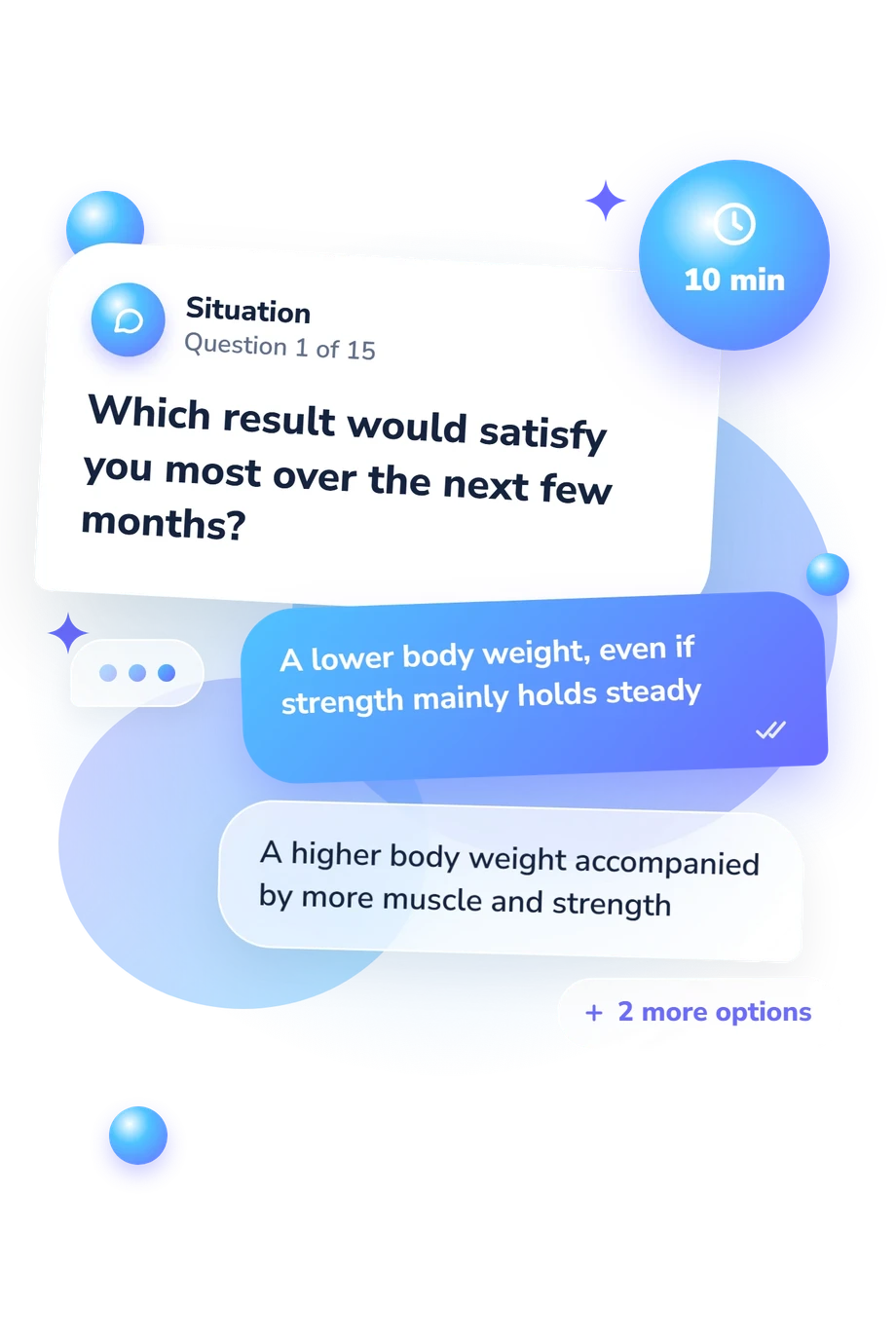
- A lower body weight, even if strength mainly holds steady
- A higher body weight accompanied by more muscle and strength
- A similar body weight with better training performance or gradual shape changes
- A small movement in either direction, depending on what my progress data shows
- Seeing a lower scale weight and more visible definition
- Keeping my weight steady while I settle into a routine
- Adding noticeable muscle, even if my weight gradually rises
- Improving strength and shape without committing to much weight change
- Move directly into the opposite weight-change phase
- Hold near my current weight and rebuild a comfortable routine
- Continue the same phase but at a slower pace
- Allow a slight weight trend while making recovery the priority
Should I Bulk or Cut Quiz - Description and methodology of the test
People deciding whether to prioritize fat loss, muscle gain, maintenance, or gradual recomposition can use the Should I Bulk or Cut Quiz to organize competing goals and practical trade-offs. Anyone reviewing a training and nutrition phase can compare three directions, choose one to evaluate, and decide what progress signals to monitor. This questionnaire's bulk or cut comparison includes maintenance and recomposition, showing which direction deserves attention first.
What This Assessment Explores
Its questions examine which direction fits your present aims, circumstances, and tolerance for trade-offs, making this a bulk or cut quiz for comparing current priorities. Items cover desired weight and definition, muscle, strength, training progress, appetite, routine stability, recovery, and recent trends. The result dimensions are:
- Fat-Loss Cut Affinity (0-15) shows whether goals and deficit tolerance favor fat loss; Limited fit (0-5), Conditional fit (6-10), or Strong affinity (11-15).
- Lean Bulk Affinity (0-15) shows whether muscle-building goals and comfort with gain favor a modest surplus; Limited fit (0-5), Conditional fit (6-10), or Strong affinity (11-15).
- Maintenance/Recomposition Affinity (0-15) shows whether stable weight, performance, recovery, or gradual shape change fits best; Limited fit (0-5), Conditional fit (6-10), or Strong affinity (11-15).
Your highest score is the strongest affinity; scores within one point indicate a blend.
Methodology and Scientific Basis
Each item offers four response options about outcomes and trade-offs, including slower fat-loss progress, adding food for muscle gain, maintaining weight during stress, or reassessing after a trend. This self-report is not a performance test.
Responses are compared across the three dimensions. The displayed score is an unvalidated reflective summary, and its bands are not established clinical cutoffs; they describe present fit rather than a fixed plan. The highest result suggests the clearest direction; close scores support a blended interpretation, and the output can inform a bulk or cut decision without making one preference permanent.
Longland et al. (2016) offer the closest empirical evidence, studying lean-mass gain and fat loss during energy restriction with resistance training; Iraki et al. (2019) discuss off-season muscle gain, Ruiz-Castellano et al. (2021) address fat-loss phases, and Barakat et al. (2020) examine muscle and fat change. The questionnaire is conceptually consistent with these discussions, is not an adaptation of them, and is not validated by them. Self-report reflects context and self-awareness, so treat the result as an unvalidated reflective summary, not a medical or nutrition assessment.
- Iraki J, Fitschen P, Espinar S, Helms E. Nutrition Recommendations for Bodybuilders in the Off-Season: A Narrative Review. Sports (Basel). 2019;7(7):154. 10.3390/sports7070154
- Ruiz-Castellano C, Espinar S, Contreras C, Mata F, Aragon AA, Martínez-Sanz JM. Achieving an Optimal Fat Loss Phase in Resistance-Trained Athletes: A Narrative Review. Nutrients. 2021;13(9):3255. 10.3390/nu13093255
- Barakat C, Pearson J, Escalante G, Campbell B, De Souza EO. Body Recomposition: Can Trained Individuals Build Muscle and Lose Fat at the Same Time? Strength and Conditioning Journal. 2020;42(5):7-21. 10.1519/SSC.0000000000000584
Updated: