
Sci-Fi Quiz
How the Scales are Structured
Who Usually Takes This Test?
See How You Compare
Below is a preview of how scores are typically distributed across each scale.
Example Questions From the Test
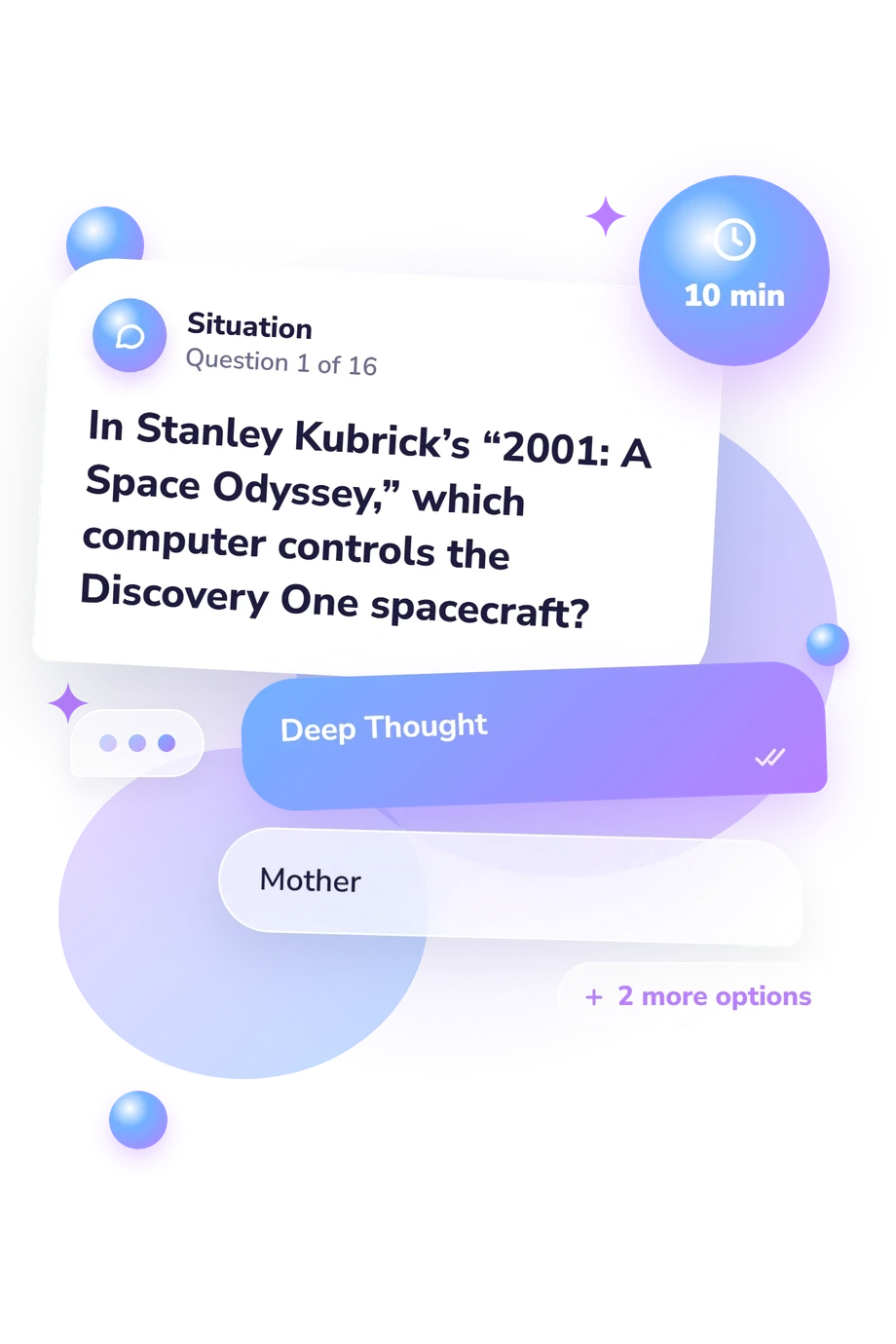
- Deep Thought
- Mother
- Multivac
- HAL 9000
- Arthur C. Clarke
- Philip K. Dick
- Robert A. Heinlein
- Ray Bradbury
- They communicate only through telepathy
- They share a single collective consciousness
- They live entirely beneath the planet’s surface
- They are ambisexual and not permanently one sex
Sci-Fi Quiz - Description and methodology of the test
Readers who want to check whether their familiarity with science fiction extends beyond one favorite franchise can use this sci fi quiz as a focused self-test. The Sci-Fi Quiz suits curious fans, returning readers, and newcomers seeking a clear picture of their strengths. The result offers an overall knowledge snapshot and supports general self-reflection. It also works as a sci fi trivia quiz for revisiting familiar genre touchstones.
What This Assessment Measures
The questions measure recognition of influential science-fiction works and connected ideas across novels, films, authors, characters, technologies, subgenres, and scientific principles. They suit anyone who wants to check whether their familiarity extends across media rather than one favorite series.
Direct recall and scenario-based items assess science fiction knowledge by asking respondents to identify works and creators or interpret fictional situations.
The main thematic groups are:
- Literature and authors cover major writers, novels, and touchstones.
- Screen stories assess familiarity with films, franchises, and characters.
- Genre concepts identify subgenres, systems, and conventions.
- Scientific ideas connect scenarios with principles and paradoxes.
The result uses Sci-Fi Knowledge (0-16), equal to the number of correct answers. Its bands are Foundations to build (0-6), Developing genre knowledge (7-12), and Strong sci-fi fluency (13-16).
Methodology and Evidence Base
Each item in the science fiction quiz uses a question stem followed by four answer choices. The format mixes direct identification with applied recognition: a respondent may recall a writer, match a work to its premise, or select the scientific or fictional principle represented by a scenario.
Scoring is transparent: the displayed total is the number of correct responses. It is a raw performance result for this quiz, not an estimate of general intelligence, reading ability, or scientific expertise.
Pincus (1984) offers context on reader sophistication and causal-chain understanding in science fiction. The closest construct match is Dixon and Bortolussi on readers’ knowledge of popular genre, while James and Mendlesohn’s companion volume provides context on the field’s forms, history, and recurring ideas.
The questionnaire is not an adaptation of these sources; they offer contextual support rather than validation for its scoring or bands. Its raw bands are not population norms or results from a validated instrument. Results can reflect prior reading, viewing, memory, cultural exposure, and guessing, so bands are best read as a snapshot of recognized touchstones.
- Pincus, Arlene Reva Honig. Effects of Genre-Specific Setting on Causal Chain Comprehension of Naive and Sophisticated Science Fiction Readers. Fordham University dissertation, 1984. AAI8409267.
- Dixon, Peter, and Marisa Bortolussi. “Readers’ Knowledge of Popular Genre.” Discourse Processes 46, no. 6 (2009): 541-571. 10.1080/01638530902959570.
- James, Edward, and Farah Mendlesohn, eds. The Cambridge Companion to Science Fiction. Cambridge: Cambridge University Press, 2003. 10.1017/CCOL0521816262.
Updated: