
Perks of Being a Wallflower Quiz
How the Scales are Structured
Who Usually Takes This Test?
See How You Compare
Below is a preview of how scores are typically distributed across each scale.
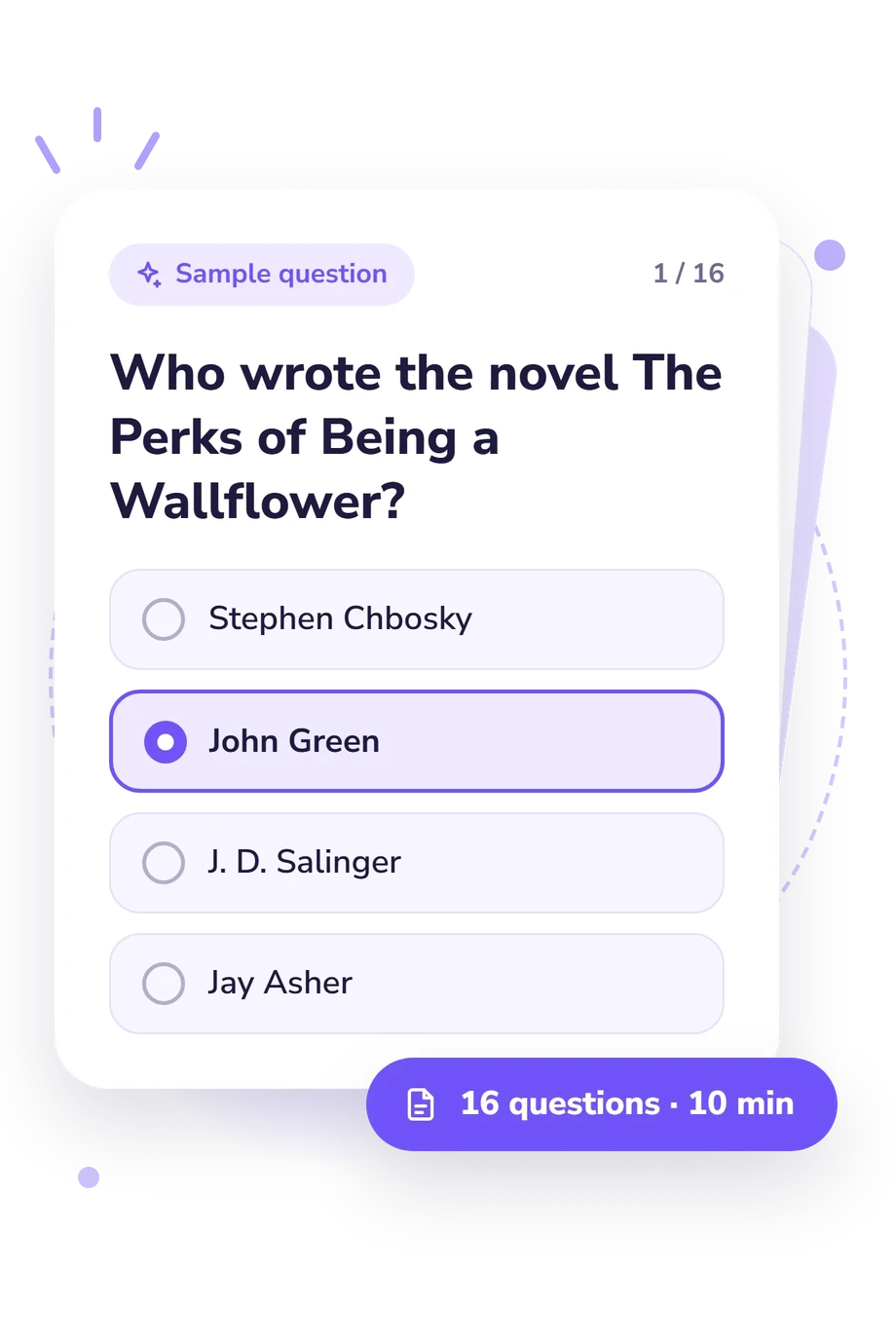
Example Questions From the Test
- Stephen Chbosky
- John Green
- J. D. Salinger
- Jay Asher
- Patrick
- Sam
- Bill
- Charlie’s father
- As entries in Charlie’s private diary
- As a screenplay written by Charlie
- Through a third-person narrator following several students
- As letters Charlie sends to an unnamed friend
Perks of Being a Wallflower Quiz - Description and methodology of the test
Readers who remember Charlie’s relationships, turning points, and cultural touchstones can use the perks of being a wallflower quiz to check how clearly the story remains in memory. As a wallflower quiz, it suits fans of the novel, the film, or both, while focusing on entertainment knowledge rather than personal traits. The result summarizes recall of characters, events, themes, and adaptation details.
What This Assessment Measures
This is a knowledge check about The Perks of Being a Wallflower, not a measure of temperament or social behavior. Items examine authorship, narrative form, setting, friendships, conflicts, memorable lines, decisions, and novel-to-film details. A reader treating it as the perks of being a wallflower personality quiz should expect story knowledge, not a personality type; it reflects recall, not identity.
The result uses one overall scale:
- The Perks of Being a Wallflower Knowledge (0-16) shows how accurately you recall the work’s characters, plot, themes, and adaptation details.
The bands describe recall: Emerging Recall (0-6) means some elements are familiar but key details may be hazy; Developing Knowledge (7-12) means you grasp the story but may revisit finer connections; Strong Knowledge (13-16) means you recall characters, plot, themes, and adaptation details in detail. This is an unofficial entertainment result.
Methodology and Evidence Base
Each item presents four answer choices and asks you to select the detail that matches the story. The format tests recognition and recall: an answer is checked against a relevant character, event, quotation, setting, or production fact, then contributes to the overall knowledge result. It rewards familiarity with the content rather than introspection or disclosure.
Its primary reference is Perks of Being a Wallflower (Chbosky, 1999), alongside Stephen Chbosky’s 2012 film adaptation. Questions cover novel-specific facts, shared details, and film production, including its director. Brown and Hammer’s 2015 discussion offers a relational reading, but this questionnaire is not an adaptation of their article or a validated psychological instrument.
This questionnaire does not ask which perks of being a wallflower character quiz takers resemble; it scores knowledge of the work. Results are descriptive recall levels, not population norms, pass marks, or evidence of expertise. Self-administered performance can vary with memory, attention, familiarity with one version, and current circumstances. Use the outcome as a focused reading-and-viewing check, and treat missed answers as prompts to revisit the story.
- Chbosky, Stephen. The Perks of Being a Wallflower. New York: Pocket Books, 1999.
- The Perks of Being a Wallflower. Written and directed by Stephen Chbosky. Summit Entertainment, 2012.
- Brown, Colton, and Tonya R. Hammer. “The Perks of Being Relational: Reviewing The Perks of Being a Wallflower.” Journal of Creativity in Mental Health, vol. 10, no. 2, 2015, pp. 258-261. 10.1080/15401383.2015.1033506
Updated: