
Native American Quiz
How the Scales are Structured
Who Usually Takes This Test?
See How You Compare
Below is a preview of how scores are typically distributed across each scale.
Example Questions From the Test
- Assimilation
- Federalism among U.S. states
- Eminent domain
- Tribal sovereignty and the government-to-government relationship
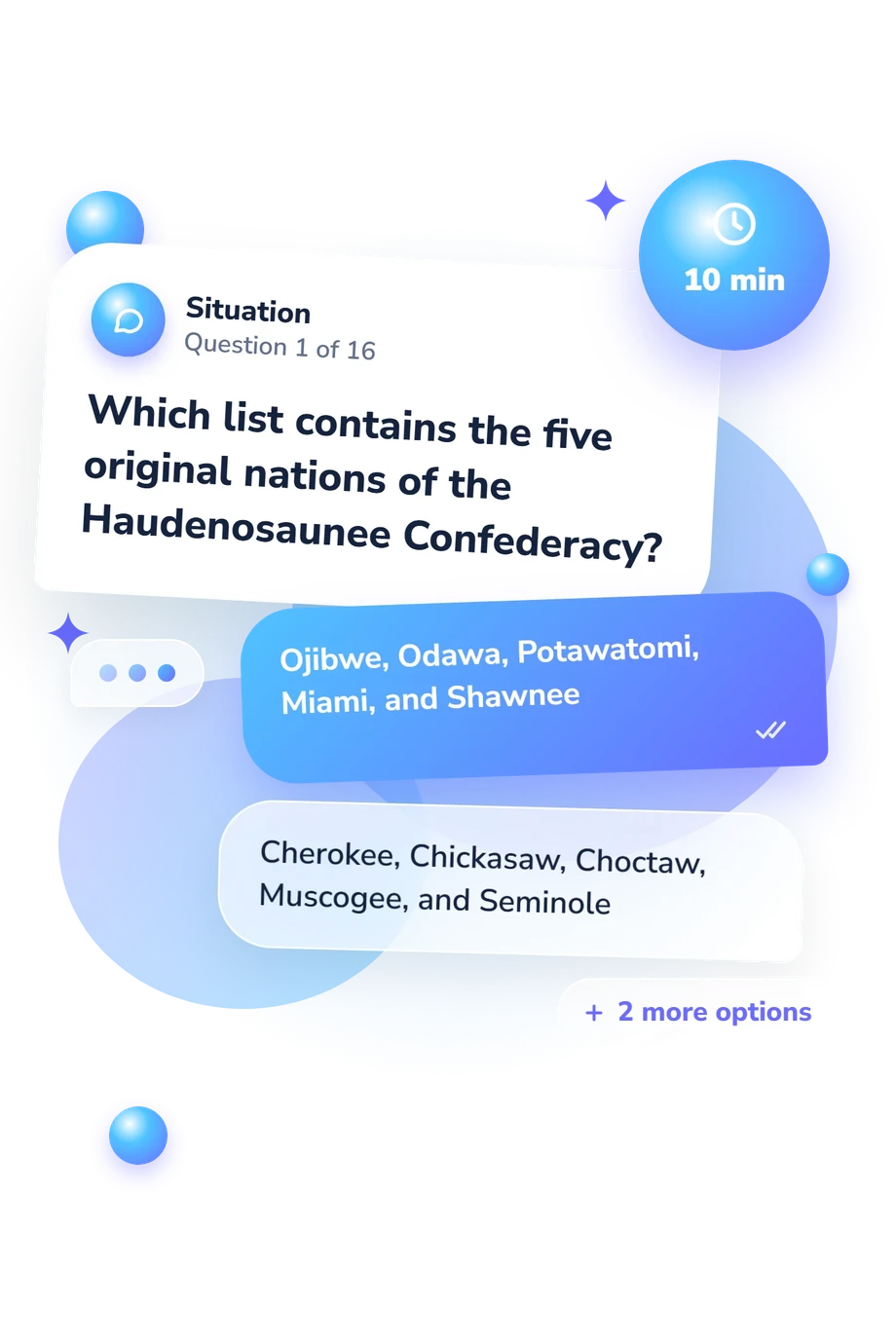
- Ojibwe, Odawa, Potawatomi, Miami, and Shawnee
- Cherokee, Chickasaw, Choctaw, Muscogee, and Seminole
- Mohawk, Oneida, Onondaga, Cayuga, and Seneca
- Lakota, Dakota, Nakota, Cheyenne, and Arapaho
- Mesa Verde
- Cahokia
- Chaco Canyon
- Poverty Point
Native American Quiz - Description and methodology of the test
Readers who want a grounded introduction to Indigenous histories can use this assessment to check their Native American history knowledge across political, cultural, archaeological, and historical topics. The Native American Quiz is designed for curious learners who want a structured way to notice strengths and gaps. Its multiple-choice questions connect Native nations, places, events, laws, and cultural practices.
What This Assessment Explores
This assessment checks introductory knowledge of Native nations, their histories, laws, lifeways, and movements in the United States. It suits curious learners seeking a broad snapshot rather than specialist study. By moving among nations and regions, the questions test Native American knowledge by asking you to distinguish political identities, cultural traditions, and historical settings rather than treating Indigenous peoples as one group.
The questions represent these thematic areas; the single displayed scale summarizes introductory knowledge across them:
- Sovereignty and law appear through treaties, federal policy, government-to-government relationships, and landmark cases.
- Nations and history connect peoples, places, chronology, archaeology, and colonial contact.
- Cultural knowledge covers regional lifeways, foodways, technologies, and ceremonies.
- Movements and contributions include activism, self-determination, citizenship, and military service.
- Native American History Knowledge: 0-16 summarizes the overall result: Foundations to build 0-6, Developing knowledge 7-12, or Strong knowledge 13-16.
Methodology and Scientific Basis
Each item presents a question with four answer choices and one best answer. The format checks recognition and connections across law, chronology, geography, lifeways, and public movements. Cultural material is one part of this broader Native American history assessment, alongside legal, archaeological, historical, and political topics.
The questionnaire measures educational knowledge rather than self-reported identity, attitudes, or experience. No point-by-point weighting is specified, so the displayed total should be read as an overall summary rather than a detailed profile.
The result is reported on the displayed scale with its three bands. They describe performance on this questionnaire, not complete historical expertise.
Content is conceptually consistent with Native Knowledge 360° Essential Understandings (2023). Historical framing also aligns with Edmunds, Hoxie, and Salisbury (2007), Deloria and Salisbury (2002), and Wilkins and Lomawaima (2001) on sovereignty and federal law. These works provide subject-matter context; this questionnaire has no established norms or validation evidence specific to its score. Guessing, prior education, wording, and current attention can affect performance. Interpret the result as a snapshot of the covered material.
- National Museum of the American Indian. Native Knowledge 360°: Framework for Essential Understandings about American Indians. Smithsonian Institution, 2023.
- Edmunds, R. David, Frederick E. Hoxie, and Neal Salisbury. The People: A History of Native America. Houghton Mifflin, 2007.
- Deloria, Philip J., and Neal Salisbury, eds. A Companion to American Indian History. Blackwell Publishers, 2002. 10.1002/9780470996461
- Wilkins, David E., and K. Tsianina Lomawaima. Uneven Ground: American Indian Sovereignty and Federal Law. University of Oklahoma Press, 2001.
Updated: