
Lord of the Flies Chapter 2 Quiz
How the Scales are Structured
Who Usually Takes This Test?
See How You Compare
Below is a preview of how scores are typically distributed across each scale.
Example Questions From the Test
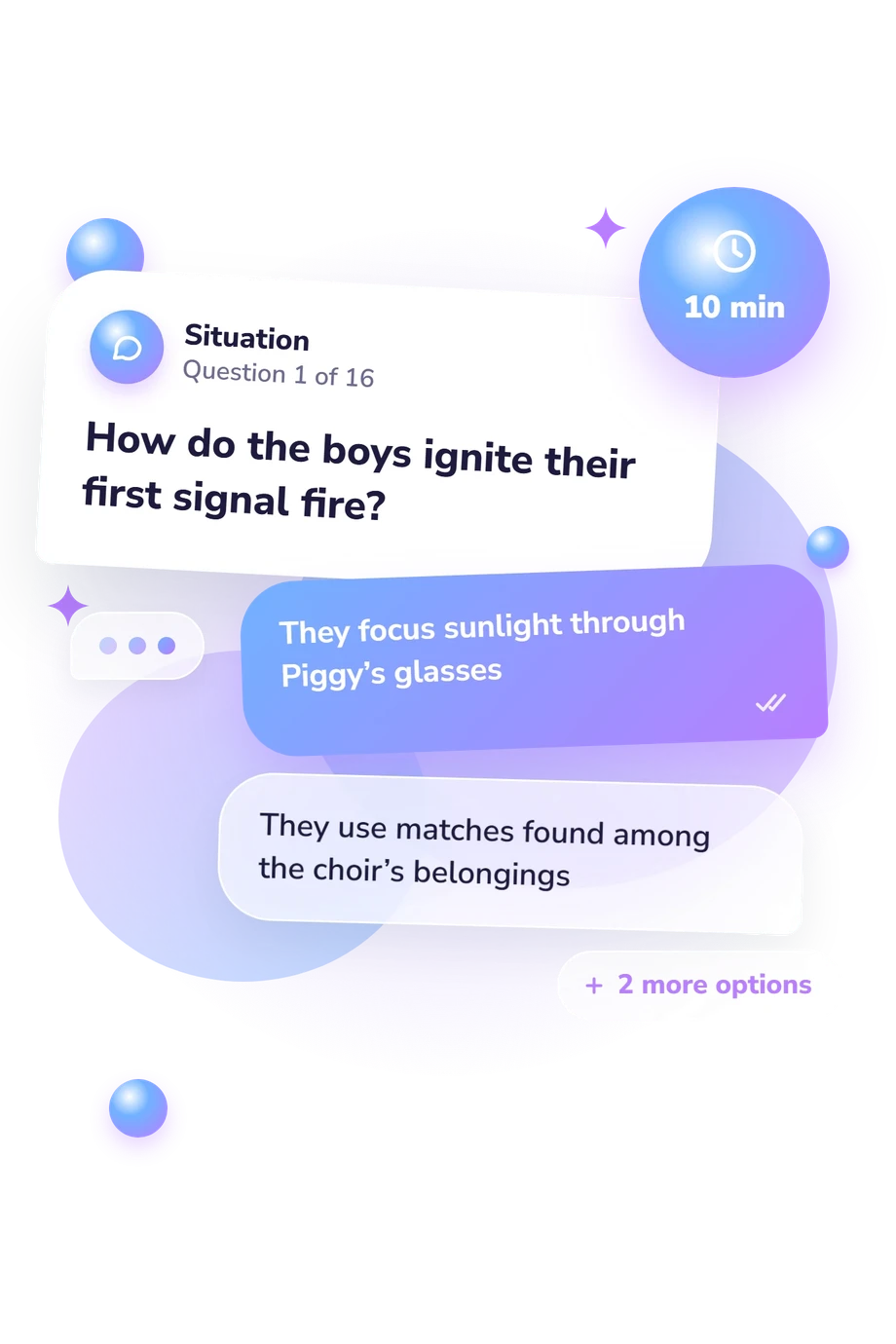
- They focus sunlight through Piggy’s glasses
- They use matches found among the choir’s belongings
- They strike stones together over dry grass
- They carry embers from a cooking fire on the beach
- As a large bird circling above the mountain
- As a wild pig hiding beside the bathing pool
- As a sea creature moving inside the lagoon
- As a snake-like beastie that came in the dark
- A scar running across his forehead
- A bandage wrapped around his hand
- A mulberry-colored birthmark on his face
- A torn choir cloak over one shoulder
Lord of the Flies Chapter 2 Quiz - Description and methodology of the test
Readers revisiting Golding’s novel can use this assessment to check how securely they follow Chapter 2’s turning points, character decisions, and emerging conflict. The Lord of the Flies Chapter 2 Quiz suits students, book-club members, and independent readers who want a focused comprehension check before discussing symbolism or wider themes. Its Lord of the Flies Chapter 2 questions connect factual recall with interpretation.
What This Assessment Explores
Chapter 2 follows the boys’ first attempt at organized survival as order weakens. It covers the assembly, conch rule, beastie report, signal fire, and missing littlun, linking events with fear, authority, and responsibility. A Chapter 2 comprehension quiz is useful when it tests interpretation as well as recall.
The questions group into four dimensions:
- Assembly and authority show Ralph establishing shared rules.
- The beast discussion shows fear entering group decisions.
- The signal fire shows how haste threatens rescue.
- Consequences show the missing child’s moral significance.
The result is Lord of the Flies Chapter 2 Knowledge, reported on a 0-16 range. It is an unvalidated educational summary, not an official assessment affiliated with the novel or its publisher. Foundation to revisit (0-6) marks topics to review; Developing knowledge (7-12) indicates some gaps; Strong knowledge (13-16) reflects secure recall and interpretation.
Methodology and Evidence Base
Each item presents a chapter-based question with four answer choices. The reader selects the option matching an event or interpretation, so the result combines recall with basic literary reasoning. The score summarizes performance across the set; no weighting, norm group, or official pass standard is stated.
The textual anchor is Lord of the Flies (Golding, 1954), especially the assembly, beast discussion, fire, and its consequences. Attention to group order, fear, impulsivity, and moral tension is conceptually consistent with Kinkead-Weekes and Gregor (1967) and Juraszek’s (2023) discussion of cognitive bias in the novel. This questionnaire is not an adaptation or validation of those publications; they clarify why the selected events matter.
During a Lord of the Flies quiz review, compare uncertain responses with the chapter and note whether mistakes concern sequence, character action, or interpretation. A higher result suggests stronger command of the material, while a lower result identifies topics to revisit. Since the questionnaire is unvalidated, performance may reflect prior study, memory, reading context, and item wording; treat it as an educational self-check, not a standardized measure of literary ability.
- Golding, William. Lord of the Flies. London: Faber and Faber, 1954.
- Kinkead-Weekes, Mark, and Ian Gregor. William Golding: A Critical Study. London: Faber and Faber, 1967.
- Juraszek, Dawid Bernard. "Defects of (Human) Nature? Cognitive Biases in Golding’s Lord of the Flies." Literature Interpretation Theory, vol. 34, no. 3, 2023, pp. 220-243. 10.1080/10436928.2023.2239705
Updated: