
Life Science Quiz
How the Scales are Structured
Who Usually Takes This Test?
See How You Compare
Below is a preview of how scores are typically distributed across each scale.
Example Questions From the Test
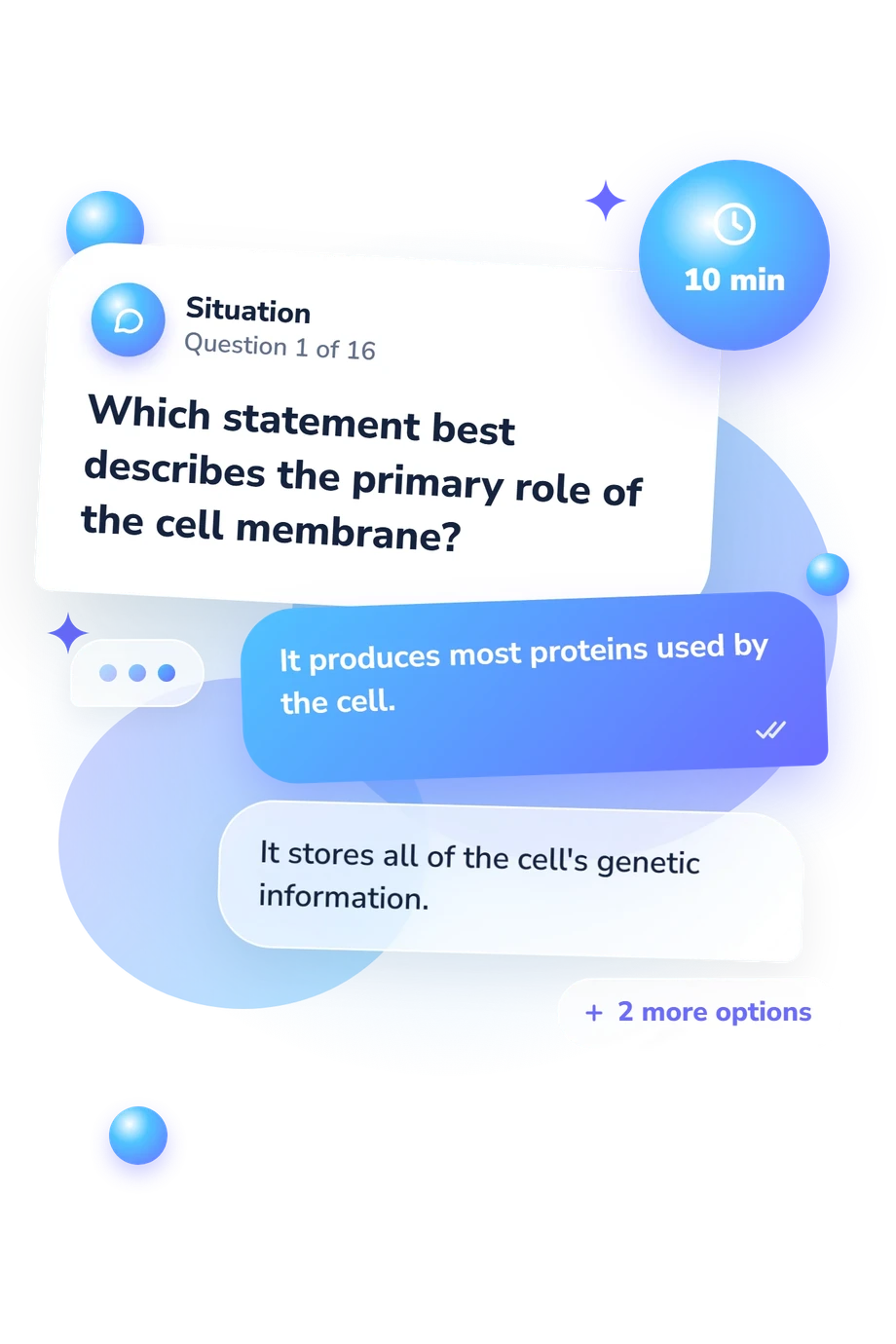
- It produces most proteins used by the cell.
- It stores all of the cell's genetic information.
- It regulates which substances enter and leave the cell.
- It converts glucose directly into DNA.
- Mitochondrion
- Golgi apparatus
- Nucleus
- Lysosome
- It causes the liver to release more glucose into the blood.
- It promotes glucose uptake and storage, lowering blood glucose.
- It prevents body cells from using glucose for respiration.
- It converts all absorbed glucose directly into protein.
Life Science Quiz - Description and methodology of the test
People who want a practical check of their biology foundations can use this life science quiz to see how well they connect ideas across living systems. It suits independent learners, students, and teachers who want a foundational biology quiz for a quick instructional snapshot. The result indicates your broad level of foundational knowledge and whether general review may be useful.
What This Assessment Explores
The questionnaire measures foundational biology knowledge through problems rather than isolated vocabulary. Its result reflects how accurately a reader recognizes relationships in cells, heredity, evolution, ecology, physiology, and experimental design.
Its life-science quiz questions ask learners to apply principles involving membrane transport, genetics, natural selection, ecology, physiology, and experimental design, including codon changes, vaccination, food webs, and osmosis.
These groups show what the result samples:
- Cell biology shows how well membranes, organelles, division, and water balance are understood.
- Genetics links DNA, codons, proteins, and inheritance into a pattern of information flow.
- Ecology and evolution show how energy, populations, adaptation, and selection interact.
- Physiology and reasoning show how regulation, immunity, respiration, and experimental controls support explanations.
Life Science Knowledge: 0-16 is reported as Foundations to revisit (0-6), Developing knowledge (7-12), or Strong knowledge (13-16).
Methodology and Evidence Base
Each item presents a short biological situation or concept prompt with four alternatives and one best answer. The questionnaire reports one overall result rather than separate topic scores.
As a biology knowledge test, it works as a structured learning check. Correct answers depend on recognizing relationships, such as differential reproduction in antibiotic resistance or gas exchange during exercise, rather than recalling isolated terms. The options require choosing the explanation that best fits the scenario, not merely recognizing a familiar term.
This questionnaire is conceptually consistent with MOSART-LS (Sadler et al., 2013), related foundational-biology assessment work by Pienaar, Prince, and Abrahams (2021), and GenBio-MAPS (Couch et al., 2019), but it is not an adaptation or validated version of those instruments.
These sources do not establish norms for this questionnaire. It has no stated standardized reliability estimates, population norms, or clinical cutoffs. Guessing, prior study, attention, and current context can influence selected answers, so treat the result as a broad indication of knowledge rather than a complete measure of biological understanding.
- Sadler, Philip M., Coyle, Harold P., Smith, Nancy C., Miller, Jaimie L., Mintzes, Joel J., Tanner, Kimberly D., and Murray, John. (2013). Assessing the Life Science Knowledge of Students and Teachers Represented by the K-8 National Science Standards. CBE-Life Sciences Education, 12(3), 553-575. 10.1187/cbe.12-06-0078
- Pienaar, L., Prince, R., and Abrahams, A. (2021). Development of a baseline assessment tool to establish students’ foundational knowledge of life sciences at entry to university. African Journal of Health Professions Education, 13(1), 77-82. 10.7196/AJHPE.2021.v13i1.1226
- Couch, Brian A., Wright, Christian D., Freeman, Scott, Knight, Jennifer K., Semsar, Kathryn, Smith, M. K., Summers, Megan M., Zheng, Y., Crowe, Alison J., and Brownell, Sara E. (2019). GenBio-MAPS: A programmatic assessment to measure student understanding of Vision and Change core concepts across general biology programs. CBE-Life Sciences Education, 18(1), ar1. 10.1187/cbe.18-07-0117
Updated: