
Essay Quiz
How the Scales are Structured
Who Usually Takes This Test?
See How You Compare
Below is a preview of how scores are typically distributed across each scale.
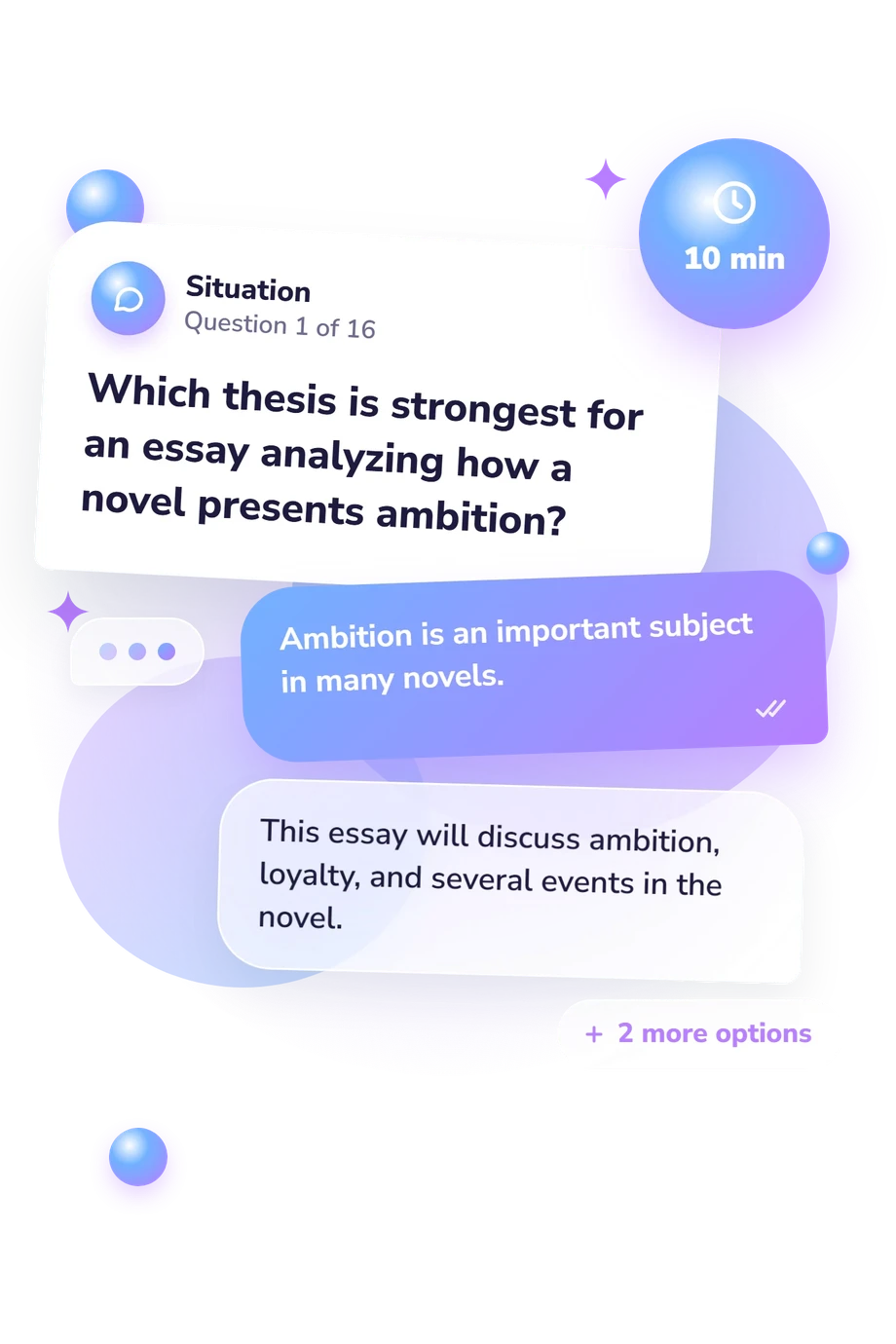
Example Questions From the Test
- A direct quotation
- A bibliography entry
- A thesis statement
- A paraphrase
- For example
- However
- Similarly
- As a result
- Synthesize the main insight and clarify why the analysis matters.
- Copy the introduction word for word to reinforce consistency.
- Introduce an unrelated argument that the body did not examine.
- Add several new quotations without explaining their relevance.
Essay Quiz - Description and methodology of the test
Designed for students, teachers, and independent learners who want to check core academic writing knowledge, this essay quiz focuses on decisions that shape an analytical response rather than on personal writing style. Because questions in this essay writing quiz present choices that resemble common planning decisions, the result helps readers decide whether to begin drafting, revisit instruction, or seek another way to clarify their approach.
What This Assessment Explores
The questionnaire checks knowledge used to build and interpret analytical essays. It suits learners revisiting concepts or readers reviewing the difference between plot summary and analysis before working on a draft. Connections among claims, textual details, literary devices, and paragraph decisions form the knowledge tested by this literary analysis quiz.
These knowledge groups are:
- Argument and thesis knowledge shows whether a reader can identify a focused claim and address a counterargument.
- Evidence and source use indicate whether quotations, paraphrases, signal phrases, and citations are distinguished.
- Organization and analysis reveal whether structure, transitions, close reading, and interpretation connect details to meaning.
- Literary concepts measure recognition of motif, metaphor, dramatic irony, and unreliable narration.
The result is Essay Knowledge (0-16): Foundations to build (0-6), Developing knowledge (7-12), or Strong knowledge (13-16). It is educational feedback, not a formal measure of writing ability.
Methodology and Scientific Basis
The response format uses four-option multiple-choice items. Each prompt asks readers to select an answer, distinguishing precise reasoning from distractors that may be general, incomplete, or unrelated. The output is one Essay Knowledge result, not separate subscores. The multiple-choice format makes this analytical essay test useful for identifying what to revisit before writing.
Questions about argument, organization, evidence, and reasoning are conceptually consistent with the argumentative-writing focus discussed by Ozfidan and Mitchell (2022), while Acheson offers relevant guidance for literary essays involving thesis, close reading, structure, and interpretation. Sparks et al. (2014) provide broader writing-assessment context for treating selected responses as narrower than complex written communication. This questionnaire is not an adaptation or validation of any cited instrument.
Because the items ask for recognition of principles rather than extended composition, they cannot demonstrate fluent prose, originality, or control of every genre. Performance may vary with prior instruction, terminology familiarity, and attention on the day. Use the feedback to choose review topics such as thesis focus, source handling, transitions, or close reading, then evaluate actual writing through a draft and rubric.
- Ozfidan, Burhan, and Connie Mitchell. Assessment of Students’ Argumentative Writing: A Rubric Development. Journal of Ethnic and Cultural Studies 9, no. 2 (2022): 121-133. DOI 10.29333/ejecs/1064.
- Acheson, Katherine O. Writing Essays About Literature: A Brief Guide for University and College Students. 2nd ed. Broadview Press, 2021.
- Sparks, Jesse R., Yi Song, Wyman Brantley, and Ou Lydia Liu. Assessing Written Communication in Higher Education: Review and Recommendations for Next-Generation Assessment. ETS Research Report Series, RR-14-37 (2014): 1-52. DOI 10.1002/ets2.12035.
Updated: