
Colon Quiz
How the Scales are Structured
Who Usually Takes This Test?
See How You Compare
Below is a preview of how scores are typically distributed across each scale.
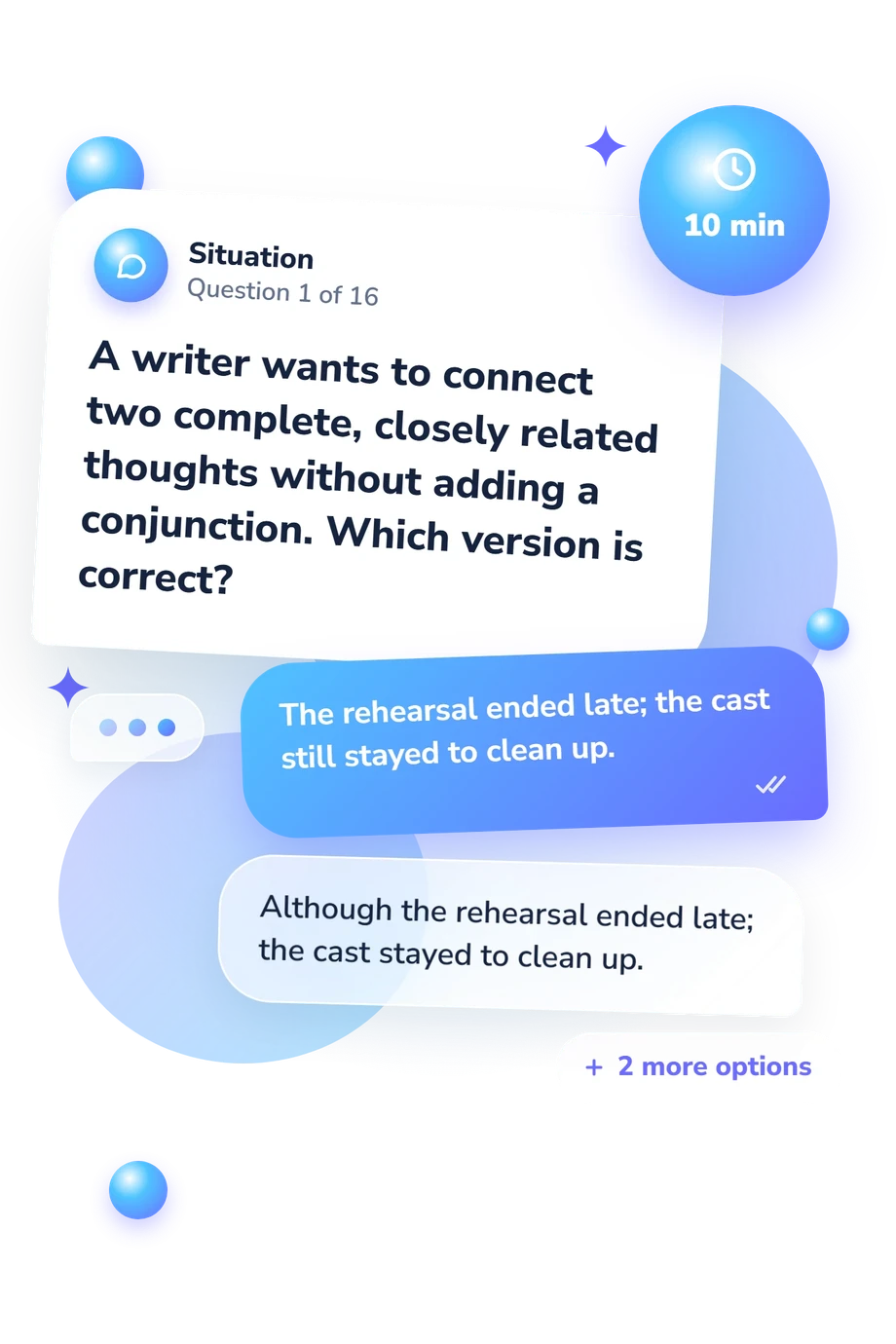
Example Questions From the Test
- The rehearsal ended late; the cast still stayed to clean up.
- Although the rehearsal ended late; the cast stayed to clean up.
- The rehearsal ended late, the cast stayed afterward to clean up.
- The rehearsal ended late; but the cast stayed to clean up.
- The trail was icy, therefore we decided to turn back.
- Because the trail was icy; therefore, we turned back.
- The trail was icy; therefore, we turned back.
- The trail was icy: therefore; turning back was our decision.
- A colon
- A semicolon
- A comma
- No punctuation
Colon Quiz - Description and methodology of the test
For writers, students, editors, and anyone reviewing punctuation rules, the colon quiz offers a focused way to check whether familiar marks are being used for the right grammatical reasons. As a colon punctuation test, it helps identify rules that deserve closer practice, especially when a sentence contains clauses, explanations, quotations, or a detailed list.
What This Assessment Explores
The questions examine colons and semicolons. They ask you to distinguish independent clauses, identify when a colon introduces an explanation, list, or quotation, and avoid punctuation that interrupts a verb and its complement. Other items test semicolons in complex lists and before words such as therefore.
For learners, this quiz on colon and semicolon rules turns conventions into practical choices. The displayed scale, Colon and Semicolon Knowledge (0-16), measures accuracy across these conventions.
The result is organized into these learning areas:
- Clause boundaries show whether you identify the structure required before a colon or semicolon.
- Colon functions show how you introduce explanations, examples, lists, and quoted statements.
- Semicolon and editing choices show whether you join related clauses, separate detailed lists, and reject comma splices.
Foundations to Review covers 0-6, Developing Command covers 7-12, and Strong Command covers 13-16. These bands describe tested knowledge, not overall writing ability.
Methodology and Evidence Base
Each item uses four-option multiple choice. Some ask for the correctly punctuated sentence; others test a rule, a sentence boundary, or the function of a mark. Scoring is direct: each correct answer earns one point, producing the total. The stated scoring rule does not assign partial credit.
Recognition is the focus of this English punctuation quiz, which presents standard conventions in short contexts. The content is conceptually consistent with Lee and Kim (2010) and Sülükçü and Kırboğa (2020), which place punctuation knowledge in an educational setting. Bruthiaux (1995) contributes a historical and pedagogical perspective on semicolon use, while Baron (2001) treats punctuation as a meaning-making feature of written language. This questionnaire is not presented as an adaptation of any one published instrument.
A score can show which conventions deserve practice, especially clause boundaries, introductions, and complex lists. It cannot establish how consistently you apply them in original paragraphs, and results may reflect familiarity with edited English and these particular sentence contexts. The bands are educational descriptors rather than norm-referenced cutoffs, and the quiz is not a formal writing assessment.
- Lee, Jeong-won, and Kim, Mi-jin. A Study on Middle School Students' Use of English Punctuation. English Education 9, no. 1 (2010): 113-132. 10.18649/jkees.2010.9.1.113
- Sülükçü, Yusuf, and Kırboğa, Ayşe. A Study on the Punctuation Knowledge Levels of Freshmen Students. Journal of Language and Linguistic Studies 16, no. 2 (2020): 684-710. 10.17263/JLLS.759273
- Bruthiaux, Paul. The Rise and Fall of the Semicolon: English Punctuation Theory and English Teaching Practice. Applied Linguistics 16, no. 1 (1995): 1-14. 10.1093/applin/16.1.1
- Baron, Naomi S. Commas and Canaries: The Role of Punctuation in Speech and Writing. Language Sciences 23, no. 1 (2001): 15-67. 10.1016/S0388-0001(00)00027-9
Updated: