
AP Psychology Unit 1 Quiz
How the Scales are Structured
Who Usually Takes This Test?
See How You Compare
Below is a preview of how scores are typically distributed across each scale.
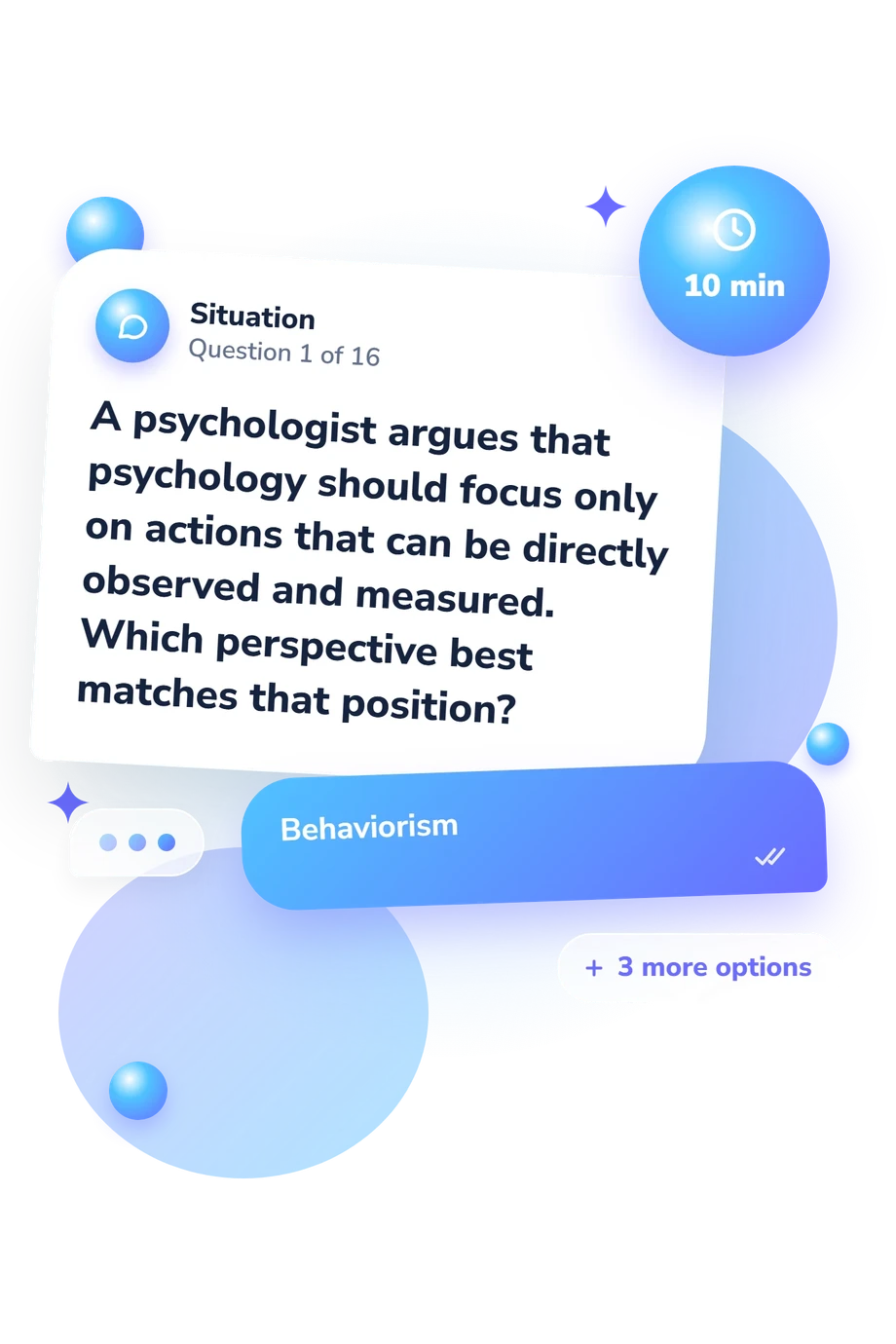
Example Questions From the Test
- Behaviorism
- Psychodynamic psychology
- Cognitive neuroscience
- Humanistic psychology
- Behavioral
- Cognitive
- Biological
- Evolutionary
- Surveying students who arrive earliest one morning
- Posting a link and using everyone who volunteers
- Surveying only students enrolled in honors classes
- Randomly selecting students from the complete school roster
AP Psychology Unit 1 Quiz - Description and methodology of the test
For students building a foundation before AP Psychology work, this assessment checks whether key ideas can be recognized and applied in classroom-style scenarios. As an AP Psychology Unit 1 practice test, it suits learners who want a focused checkpoint rather than a personality measure. The AP Psychology Unit 1 Quiz provides an overall Unit 1 knowledge snapshot. If missed questions are visible, they can point to topics for review.
What This Assessment Explores
The questions target introductory vocabulary and reasoning across psychological perspectives, research design, statistics, biological and cognitive explanations, and ethics. Across its AP Psychology Unit 1 practice questions, students distinguish related ideas and choose conclusions supported by studies or data.
The thematic areas represented by the questions are:
- Psychological perspectives show how different approaches explain behavior, mental processes, or adaptive functions.
- Research methods indicate how participants are selected, observed, assigned, measured, and protected.
- Statistics and data interpretation test variation, central tendency, correlation, operational definitions, and dependent variables.
- Ethics and application examine consent, review, limited deception, and debriefing.
Together, these areas create a conceptual snapshot. Missed answers are most useful as prompts to revisit the distinction behind each item.
Methodology and Evidence Base
This is a 16-item multiple-choice check with four options per question and one best answer. Short scenarios, definitions, and data examples require application rather than isolated recall. The online format turns performance into one displayed scale.
The scale is AP Psychology Unit 1 Knowledge (0-16). The catalogue reports Foundations to revisit (0-6), Developing command (7-12), and Strong command (13-16). These bands indicate whether to review foundations, strengthen application, or consolidate a solid grasp. The result is a study snapshot, not an official AP score.
College Board supplies the course framework for perspectives, methods, statistics, and ethics. The questionnaire is conceptually consistent with it and with introductory explanations from Spielman, Jenkins, and Lovett; it is not an adaptation of either source. American Psychological Association supports its treatment of consent, review, deception, and debriefing.
For an AP Psychology Unit 1 review, read the score with the questions missed and current preparation in mind. Performance can vary with recent study, wording familiarity, attention, and test-taking conditions. Reviewing missed items can clarify whether the difficulty involved a perspective, method, statistic, or ethical principle.
- College Board. (2019). AP Psychology Course and Exam Description: Effective Fall 2019. New York, NY: College Board.
- Spielman, Rose M., William J. Jenkins, and Marilyn D. Lovett. (2020). Psychology 2e. Houston, TX: OpenStax, Rice University.
- American Psychological Association. (2002). Ethical principles of psychologists and code of conduct. American Psychologist, 57(12), 1060-1073. 10.1037/0003-066X.57.12.1060
Updated: