
Am I the Chosen One Quiz
How the Scales are Structured
Who Usually Takes This Test?
See How You Compare
Below is a preview of how scores are typically distributed across each scale.
Example Questions From the Test
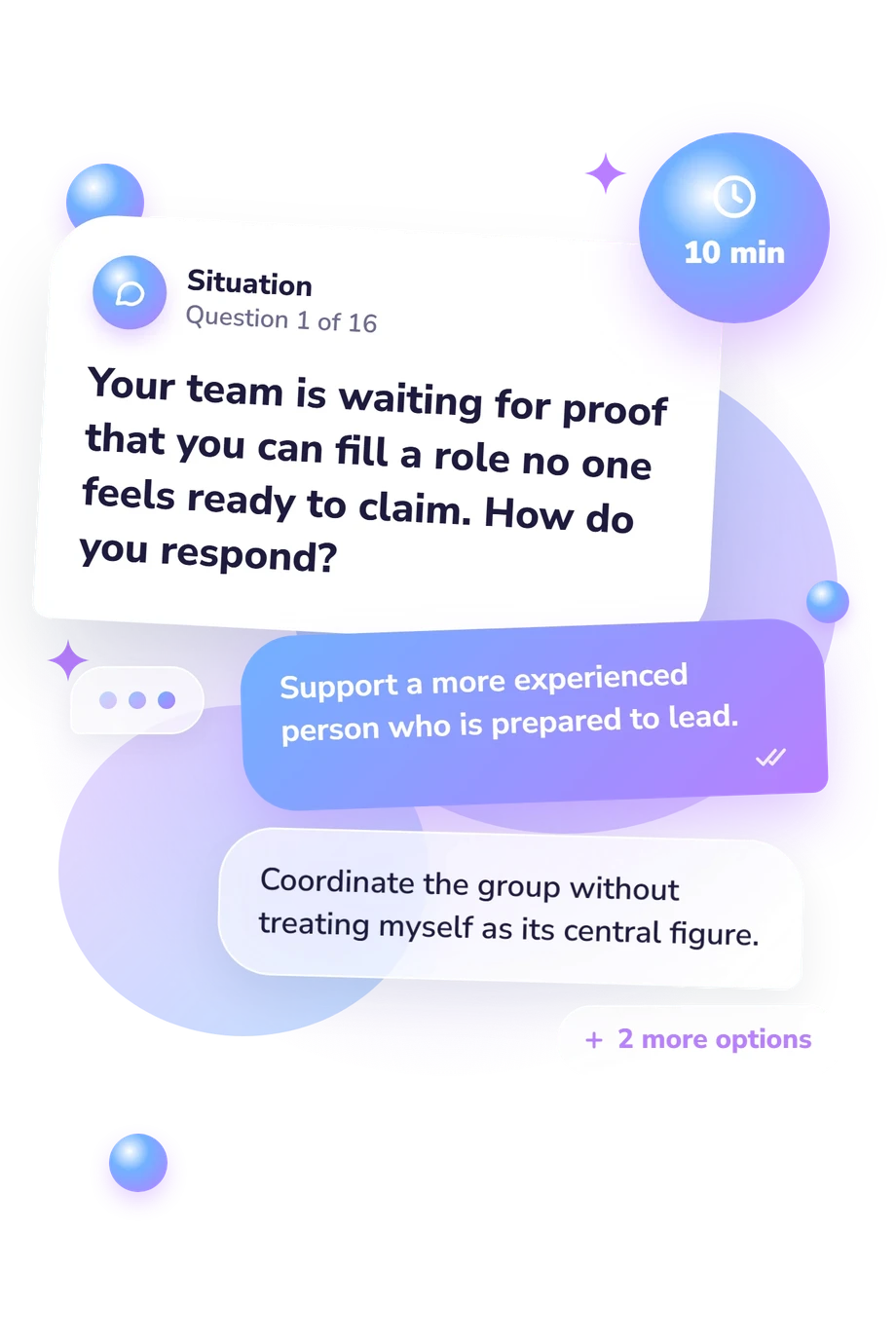
- Support a more experienced person who is prepared to lead.
- Coordinate the group without treating myself as its central figure.
- Take provisional responsibility while continuing to question my readiness.
- Step into the role through decisive action before certainty arrives.
- The mentor’s experience; I would respect the decision.
- The possibility of negotiating a safer compromise first.
- The need to build a capable team and secure authorized support.
- The person in danger; I would go if waiting might cost them everything.
- Embrace the public role and use the attention confidently.
- Accept the ceremonies because visibility can serve a useful purpose.
- Redirect much of the praise toward everyone who contributed.
- Feel uncomfortable with the fame and seek ordinary time with close friends.
Am I the Chosen One Quiz - Description and methodology of the test
For readers who enjoy testing how fictional archetypes fit their own choices, Am I the Chosen One Quiz turns familiar destiny scenarios into a structured reflection on responsibility, loyalty, courage, truth, and purpose. As a chosen one character quiz, it suits anyone who wants a playful comparison with enough detail to notice how they approach pressure, uncertainty, relationships, and moral trade-offs.
What This Assessment Explores
The assessment treats fictional heroes as contrasting response styles. Its scenarios examine duty, danger, truth, loyalty, authority, compassion, and purpose, showing which kind of calling feels most natural to you. As a chosen one personality test, it translates those preferences into four comparable character affinities.
These are the four result dimensions:
- Aang Affinity (0-12) reflects balance, creative nonviolence, and joyful duty; bands: Direct Resolver (0-4), Flexible Harmonizer (5-8), Strong Aang Affinity (9-12).
- Harry Potter Affinity (0-12) reflects loyalty, protective courage, and rule-bending for friends; bands: Different Path (0-4), Shared Courage (5-8), Strong Harry Affinity (9-12).
- Luke Skywalker Affinity (0-12) reflects purpose, intuition, hope, and belief in redemption; bands: Grounded Course (0-4), Hopeful Explorer (5-8), Strong Luke Affinity (9-12).
- Neo Affinity (0-12) reflects questioning imposed limits and acting before certainty; bands: Practical Reality (0-4), System Questioner (5-8), Strong Neo Affinity (9-12).
Methodology and Evidence Base
This is a scenario-based self-report questionnaire. Each item presents a fictional dilemma with four answer choices; choose the response closest to your instinct. Responses form four affinity totals: the highest is strongest, while any total within one point creates a blended result.
The item groups cover responsibility, danger, authority, truth, friendship, sacrifice, uncertainty, and power. As a fictional character quiz, it compares preferred approaches to tension rather than claiming supernatural abilities or a fixed destiny.
The conceptual anchor is Character Recognizability Scale (Żerebecki et al., 2024), which examines deeper similarities between audiences and media characters; this questionnaire is consistent with that work, not an adaptation of its scale. It also parallels Huang and Fung’s model of narrative-character identification, including merging, perspective-taking, understanding, and emotional involvement. Rogers et al. (2023) provide the related hero-journey context, linking that framing with experienced meaning in life.
The four scores are interpretive categories for an online self-reflection questionnaire, not standardized population norms. Mood, circumstances, character familiarity, and self-presentation can influence answers, so the result is a snapshot of preferred responses rather than a fixed identity.
- Żerebecki, Bartosz G., Suzanna J. Opree, Joep Hofhuis, and Susanne Janssen. "Beyond Perceived Similarity: Development and Validation of the Character Recognizability Scale (CRS)." Mass Communication and Society, 27(5), 1220-1251 (2024). DOI 10.1080/15205436.2024.2366224.
- Huang, Kate Y., and Helene H. Fung. "Measuring identification with narrative characters: the development and validation of a new scale." Current Psychology, 43, 24835-24849 (2024). DOI 10.1007/s12144-024-06191-2.
- Rogers, Benjamin A., Herrison Chicas, John Michael Kelly, Emily Kubin, Michael S. Christian, Frank J. Kachanoff, Jonah Berger, Curtis Puryear, Dan P. McAdams, and Kurt Gray. "Seeing your life story as a Hero’s Journey increases meaning in life." Journal of Personality and Social Psychology, 125(4), 752-778 (2023). DOI 10.1037/pspa0000341.
Updated: