
Analogy Quiz
How the Scales are Structured
Who Usually Takes This Test?
See How You Compare
Below is a preview of how scores are typically distributed across each scale.
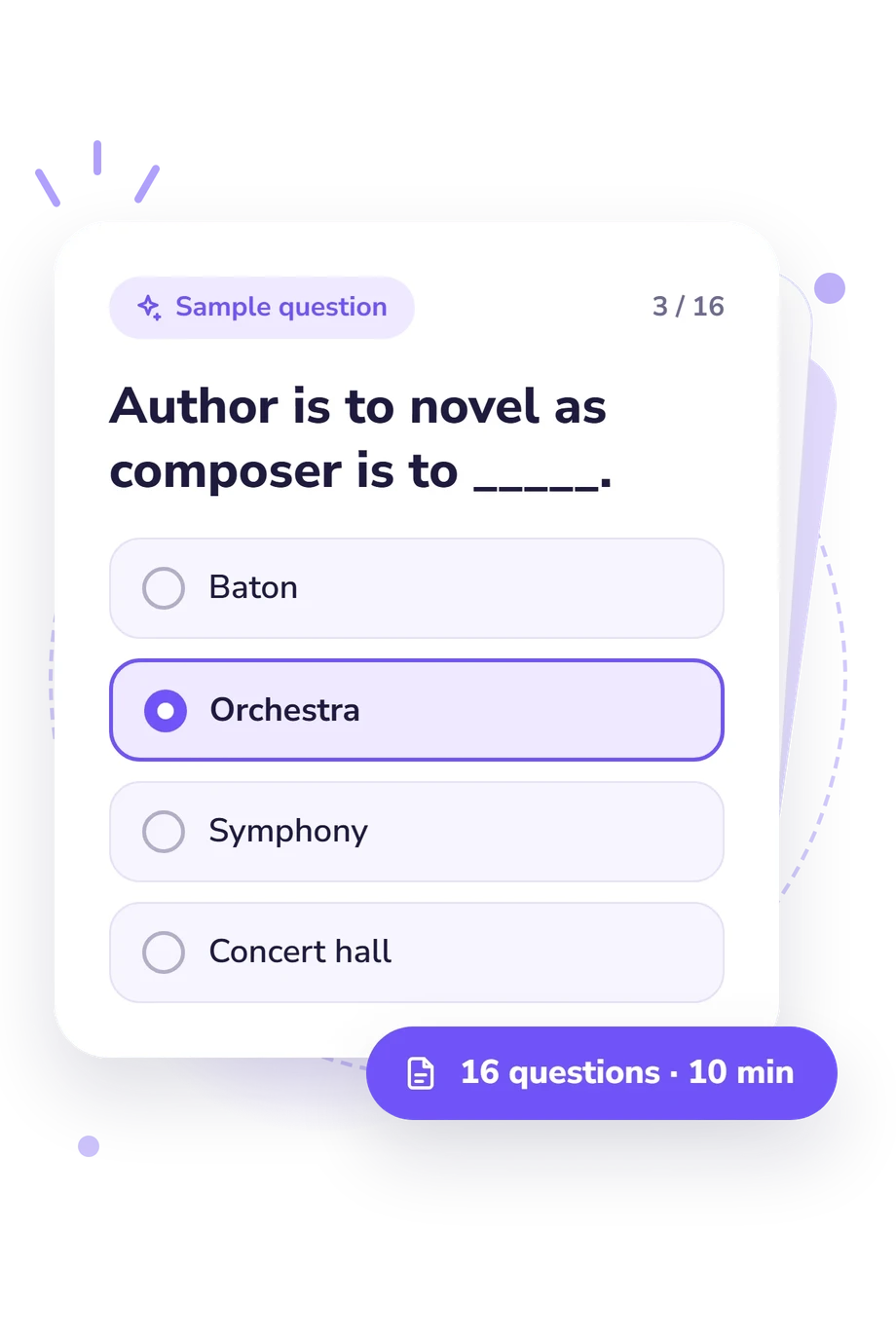
Example Questions From the Test
- Rest
- Wander
- Hurry
- Walk
- Fog
- Sunshine
- Gale
- Calm
- Baton
- Orchestra
- Symphony
- Concert hall
Analogy Quiz - Description and methodology of the test
People who want to strengthen verbal reasoning or understand how they compare relationships can use this analogy quiz as a focused exercise in pattern recognition. It suits people who want to practise language-based reasoning and enjoy word problems. In this analogy online quiz, short verbal comparisons are completed one at a time, and the result shows whether choices reflect precise links rather than merely familiar or attractive words.
What This Assessment Explores
These questions ask you to transfer a relationship from one pair of words to another. The pairs cover category, location, function, intensity, opposition, development, containment, and what an object indicates. Within this analogy assessment, these items examine whether you can identify the relevant link and preserve it across a new pair, rather than relying on vocabulary familiarity alone.
The result is reported as Analogy Knowledge (0-16). It measures recognition of relationships and distinguishes exact matches from plausible near matches. These are the three result bands:
- Foundations to Build (0-6) indicates that naming the link before comparing options may be useful.
- Developing Analogy Skill (7-12) indicates that familiar patterns are often identified, while subtler links may need closer comparison.
- Strong Analogy Knowledge (13-16) indicates consistent recognition of precise relationships.
This profile can guide practice toward deliberate comparison.
Methodology and Scientific Basis
Each item presents a short verbal relationship followed by four answer choices. You select the option that completes the same relation, such as author-novel, thermometer-temperature, or generous-stingy. Each correct answer adds one point to the displayed total; the bands describe levels of performance within this questionnaire.
The construction is conceptually consistent with Levine’s (1950) item-writing work and the materials examined by Ichien, Lu, and Holyoak (2020). Gentner’s structure-mapping framework offers a useful lens: solving depends on aligning the meaningful relation in the first pair with the corresponding relation in the second. Embretson, Schneider, and Roth (1986) show why verbal reasoning can involve multiple strategies, including vocabulary access, comparison, and response selection.
This analogy test is not presented as a documented adaptation or standardized administration of one published instrument. Its result describes performance on these selected relationships. Vocabulary, familiarity, attention, concentration, and the tendency to choose a plausible association can affect answers, so the profile is best read as a focused snapshot rather than a fixed ability measure.
- Ichien, Nicholas, Hongjing Lu, and Keith J. Holyoak. (2020). Verbal analogy problem sets: An inventory of testing materials. Behavior Research Methods, 52(5), 1803-1816. 10.3758/s13428-019-01312-3
- Levine, Abraham S. (1950). Construction and use of verbal analogy items. Journal of Applied Psychology, 34(2), 105-107. 10.1037/h0060718
- Embretson, Susan, Lisa M. Schneider, and David L. Roth. (1986). Multiple processing strategies and the construct validity of verbal reasoning tests. Journal of Educational Measurement, 23(1), 13-32. 10.1111/j.1745-3984.1986.tb00231.x
- Gentner, Dedre. (1983). Structure-mapping: A theoretical framework for analogy. Cognitive Science, 7(2), 155-170. 10.1016/S0364-0213(83)80009-3
Updated: