
What Kind of Student Are You Quiz
How the Scales are Structured
Who Usually Takes This Test?
See How You Compare
Below is a preview of how scores are typically distributed across each scale.
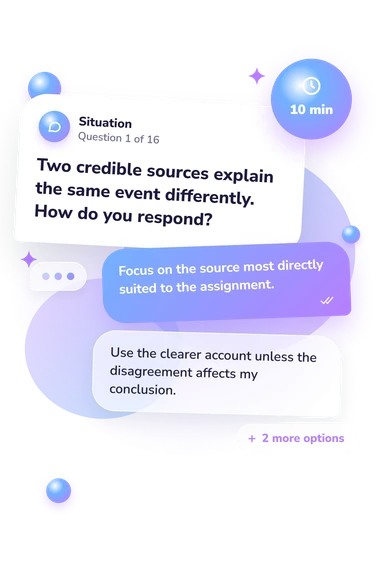
Example Questions From the Test
- Focus on the source most directly suited to the assignment.
- Use the clearer account unless the disagreement affects my conclusion.
- Compare their assumptions and look for the point where their interpretations diverge.
- Trace their evidence and methods to investigate why they reached different conclusions.
- Research the possibilities thoroughly before taking action.
- Write an outline of the likely sequence and refine it on paper.
- Make a rough mock-up to expose gaps before completing the full task.
- Run a small trial, inspect what happens, and adjust from the result.
- Considering its broad implications and place within the subject.
- Writing a clear summary of the central ideas.
- Creating my own concrete examples of how it works.
- Using it to complete a realistic task and seeing the outcome.
What Kind of Student Are You Quiz - Description and methodology of the test
Students who want to understand their habits can use the What Kind of Student Are You Quiz to examine how they approach learning, planning, inquiry, practical work, and shared study. It suits learners choosing study strategies, reflecting on a current challenge, or explaining why certain classroom settings feel more productive. The profile explores a practical question-what type of student am I?-while identifying several tendencies rather than one label.
What This Assessment Explores
Four preferences appear in study: dialogue, inquiry, application, and organization. Scenarios involving feedback, instructions, explanations, projects, deadlines, and group tasks show how they emerge in study life. The result offers dimensions, not one identity, for the question-what type of student are you?
The displayed dimensions are:
- Collaborative Contributor (0-12) reflects dialogue and shared problem-solving: Independent Processor 0-4; Situational Collaborator 5-8; Collaborative Contributor 9-12.
- Curious Explorer (0-12) reflects following questions and comparing explanations: Defined-path focus 0-4; Purposeful curiosity 5-8; Curious Explorer 9-12.
- Hands-On Applier (0-12) reflects examples, experiments, and practical use: Concept-first 0-4; Balanced applier 5-8; Hands-On Applier 9-12.
- Structured Planner (0-12) reflects organizing study through milestones and routines: Flexible-first 0-4; Selectively structured 5-8; Structured Planner 9-12.
Scores within one point of each other form a blended result, allowing the profile to show combinations rather than a forced winner.
Methodology and Scientific Basis
Each item describes an academic situation with four response options covering inquiry, planning, feedback, discussion, application, and independent or shared work. Choosing the closest response samples preference, not knowledge or ability.
The questionnaire produces scores for the four displayed dimensions, giving separate results for collaboration, curiosity, practical application, and planning. Outcomes within one point of each other are treated as a blended result.
Conceptually, it is consistent with the Inventory of Learning Styles (Vermunt, 1998), which links learning activity with regulation and orientations. Vermunt and Vermetten (2004) likewise support viewing study as interacting strategies rather than one fixed method; this questionnaire is not an adaptation of either instrument.
It can also frame the question-what kind of student am I?-without reducing study to a fixed identity. Pashler and colleagues (2008) found limited evidence for matching instruction to fixed learning styles. Respondents should interpret their profile in context: workload, confidence, subject familiarity, goals, and self-awareness may shape how these preferences appear in their answers, so it supports reflection and study planning rather than serving as a diagnostic measure.
- Vermunt, J. D. (1998). The regulation of constructive learning processes. British Journal of Educational Psychology, 68(2), 149-171. 10.1111/j.2044-8279.1998.tb01281.x
- Vermunt, J. D., & Vermetten, Y. J. (2004). Patterns in student learning: Relationships between learning strategies, conceptions of learning, and learning orientations. Educational Psychology Review, 16(4), 359-384. 10.1007/s10648-004-0005-y
- Pashler, H., McDaniel, M., Rohrer, D., & Bjork, R. (2008). Learning styles: Concepts and evidence. Psychological Science in the Public Interest, 9(3), 105-119. 10.1111/j.1539-6053.2009.01038.x